
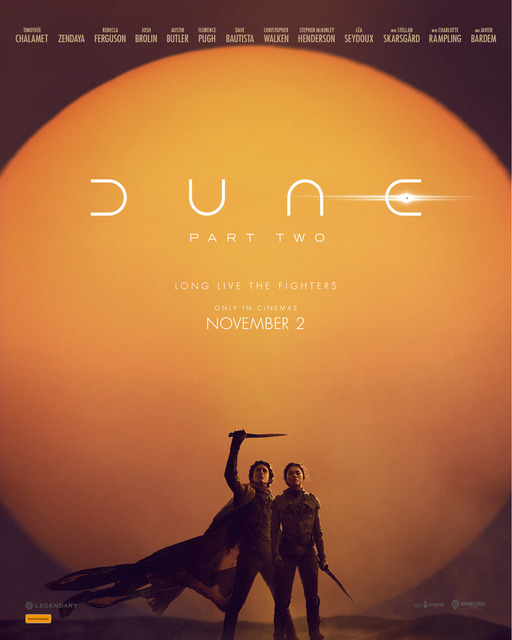
Dune: Part Two
- Director: Denis Villeneuve
- Writers: Denis Villeneuve, Josh Spaihts
- Starring: Timothée Chalamet, Zendaya, Rebecca Ferguson, Dave Bautista, Austin Butler, Florence Pugh, Léa Seydoux, Stellan Skarsgård, Christopher Walken
Grade: A
For the past two decades, there’s been a myriad of genre blockbusters that have tried to emulate the epic scope of Peter Jackson’s The Lord of the Rings trilogy. There have been some films that made a noble effort, but none have been able to successfully capture that lightning in the bottle. Enter Denis Villeneuve’s Dune films, a franchise that once felt like it would never actually get made after David Lynch’s ill-fated 1984 movie.
However, when the first Dune film hit theaters (and controversially HBO Max) in October 2021, it was met with acclaim from many, was showered with multiple Academy Awards, and despite its dumbfounded simultaneous streaming release, was a box office success, at least by COVID standards. That being said, the praise wasn’t unanimous, with some lamenting that the sci-fi epic felt slow, anti-climatic, and only half of a movie. I’m certainly not one of those people, but I do see where those criticisms are coming from.
Now, after a handful of delays, Dune: Part Two is finally here, and it doesn’t just improve upon the first movie; it eclipses it. At last, a filmmaker has made the kind of blockbuster that encapsulates what Peter Jackson was able to do over 20 years ago.
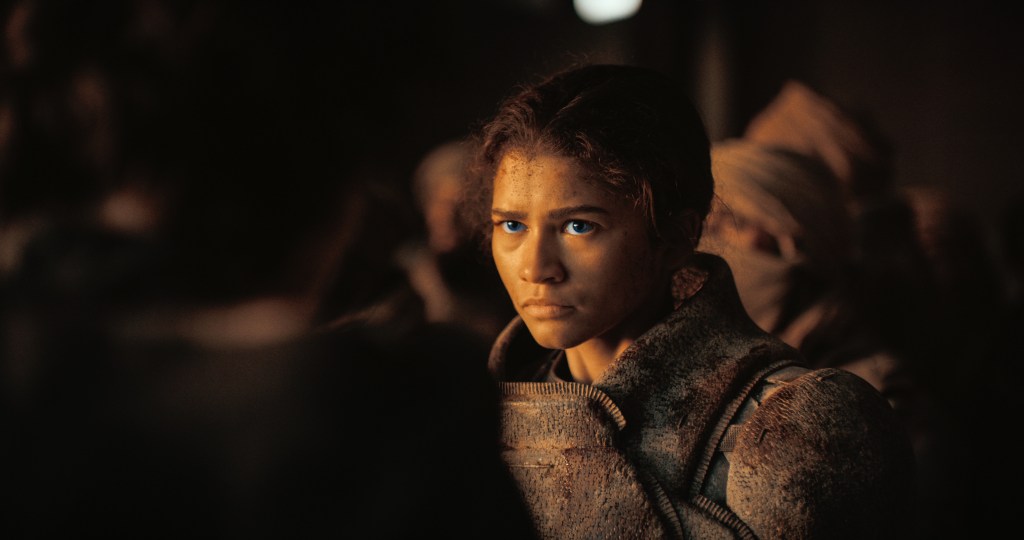
Dune: Part Two picks up directly after the events of the first film, which you probably could already tell. Paul Atreides (Timothée Chalamet) and his mother Lady Jessica (Rebecca Ferguson) have accustomed themselves with the Fremen. While they are not without their doubters, the Fremen’s leader Stilgar (Javier Bardem) has almost blind faith in Paul as a spiritual messiah. Lady Jessica soon is made to become a spiritual leader for the Fremen, while Paul begins fighting on the battlefields against the Harkonnens. Paul also has a growing romance with Chani (Zendaya), the young Fremen woman who would frequently appear in his dreams in the first film.
In the meantime, Baron Harkonnen (Stellan Skarsgård) adapts a change in strategy, recruiting his younger nephew Feyd-Rautha (Austin Butler) as his true successor and the one to take down Paul.
Much like Frank Herbert’s novel and the first film, Dune: Part Two is incredibly dense and complex. It’s much smarter than other sci-fi tentpole films, and it is also much weirder than its predecessor. Yet, one of the most shocking elements of the sequel is just how accessible it feels. While viewers should watch the first movie before heading to the theater to see Part Two, it’s not mandatory. Yes, those who are unfamiliar with the world of Dune would probably feel alienated by this sequel, with some of it flying completely over your head, but the film does give time to refresh viewers on what happened beforehand.
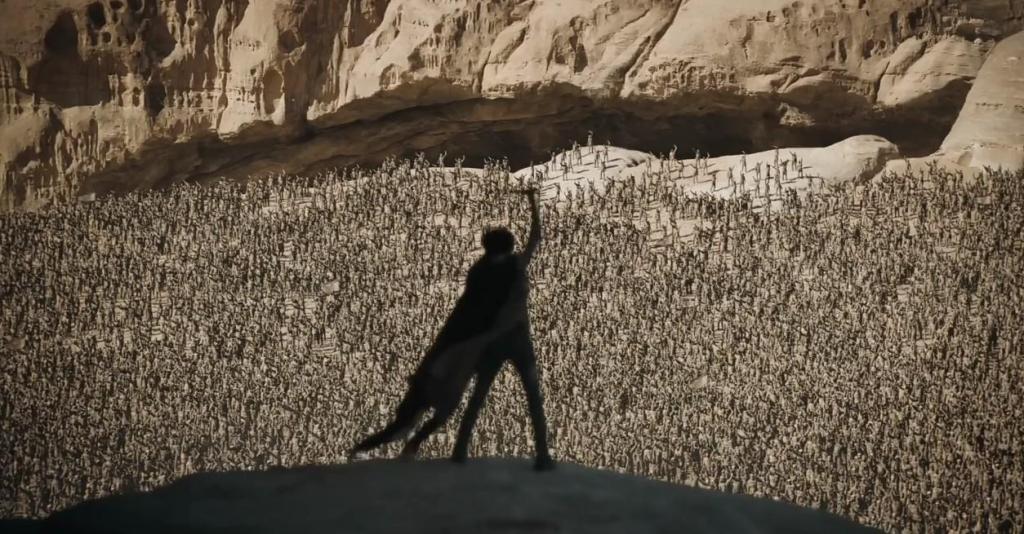
This almost feels like an intentional move by Villeneuve, a filmmaker whose confidence has only grown exponentially with each passing movie. He knows what he’s doing behind the camera, and it’s nothing short of genius. Villeneuve might not yet be the household name that Christopher Nolan has become, but it’s bound to happen, especially after this film. Villeneuve’s meticulous direction makes the world of Dune: Part Two feel immersive and dreamlike. There is never a fraction of insincerity; this is a director who feels fully comfortable telling a story that isn’t afraid to push some buttons.
Dune: Part Two is a commentary on religion, false prophets, revenge, and family. While there are plenty of epic tales of good vs. evil, Dune has never viewed its characters as black-and-white; yes, the Harkonnens are nothing but pure evil, but House Atreides are also not the most trustworthy protagonists. There has been criticism lobbied against the franchise as some sort of white-savior narrative, but Part Two feels as if Villeneuve has set out to completely obliterate that theory.
From a technical level, Dune: Part Two is masterful. Everything from the visual effects to the production design – which both won Oscars for Part One – feels lifelike and tangible. A particular black-and-white arena sequence featuring Feyd-Rautha comes to mind, not only giving purpose to the aesthetic, but adding to the world, and making it feel fresh. Oscar-winner Greig Fraser has also outdone himself with the film’s sweeping cinematography, perfectly capturing gladiatorial battles and fights in the sandy desert. Sand has never looked quite as good on the big screen as it does here. Hans Zimmer’s score is another top-notch addition, recapturing the feel of the first movie, but also continuing to experiment, with an almost techno flavor.

While the first Dune movie didn’t always take full advantage of its star-studded cast, Dune: Part Two does the opposite. Chalamet has proven himself time and time again to be one of the greatest actors under 30 and his second go at playing Paul Atreides is some of his most impressive work to date. While the Paul of Part One was mostly naïve and soft-spoken, the Paul of Part Two begins to show the cracks in his perceived heroic status, and Chalamet easily pulls it off. He may not have the build of the kinds of actors who usually headline a blockbuster of this ilk, but he is still able to feel intimidating and fierce when he needs to be. He feels as if he poses a threat to those standing in his way, shedding that arthouse heart-throb persona that some have him associated with.
Right on par with Chalamet is Butler’s role as Feyd-Rautha, which takes on another wacky voice – not unlike his Oscar-nominated role in Elvis – but here gives the kind of gonzo and aggressive performance that would make Sting (who played the same role in Lynch’s version) blush. While this might sound like his role comes off as cartoonish and distracting, it doesn’t, and it’s because Butler is able to take the back seat when he needs to. He’s used in the right amount and gets several of the movie’s stand-out set pieces.
While Bardem didn’t get much to do in Dune: Part One, his role here is some of his finest work since Skyfall. Bardem’s Stilgar brings a refreshing levity to the film; much like Butler, he’s not afraid to get a little weird and kooky, but he still does feel grounded, and he’s able to pull off the complexities of his character like a seasoned veteran.

It’s still too early to say, but Dune: Part Two may become one of the greatest sci-fi movies and one of the greatest sequels ever made. It’s the kind of follow-up that successfully builds upon everything that worked before, while still being able to innovate and feel fresh and new. This is something that demands to be seen on the biggest screen you can find.
Dune: Part Two will release in theaters nationwide on February 29.
OSCAR POTENTIAL:
- The 96th Academy Awards haven’t even occurred yet, but one does have to wonder whether or not Dune: Part Two and Denis Villeneuve would have thrown a wrench in Oppenheimer and Christopher Nolan’s continued dominance if it had kept its original release date. It’s hard to say. But in the end, it benefitted from being pushed back.
- Much like the first movie, Dune: Part Two will likely receive nominations for Best Picture and Best Adapted Screenplay.
- Also like its predecessor, it’s an early front-runner in many of the technical categories including Best Visual Effects, Best Production Design, Best Score, Best Cinematography, and Best Sound.
- While Denis Villeneuve infamously missed a Best Director nod for the first film, it already feels safe to say that he should be able to secure a nod next year (and possibly his first win.)
 The Movie State
5 thoughts on “Dune: Part Two – Movie Review”