


Past Lives
- Director: Celine Song
- Writer: Celine Song
- Starring: Greta Lee, Teo Yoo, John Magaro
Grade: A-
Fate. Love. Identity. Regret. Longing. All of these ideas are familiar devices in films when filtered through certain genres. Some of the best romances, like In the Mood for Love and the Before trilogy, deal with a number of those themes while creating memorable moments and dialogue. But those films came from celebrated, seasoned veterans who had years of experience under their belts. For writer/director Celine Song, she tackles these ideas in her searing debut Past Lives, and makes it look easy. The result is one of the best films of the year so far.
A film will always resonate more if it’s based in the filmmakers’ firsthand perspective, and Song reportedly crafted the film from her own experiences. One of Past Lives’ greatest assets is in the way it lovingly and delicately creates its drama. This is a genre that tends to paint its characters with broad brushes, but everyone within the film is a fully realized person, with interior and exterior lives that feel like they’ll continue on after the film ends.

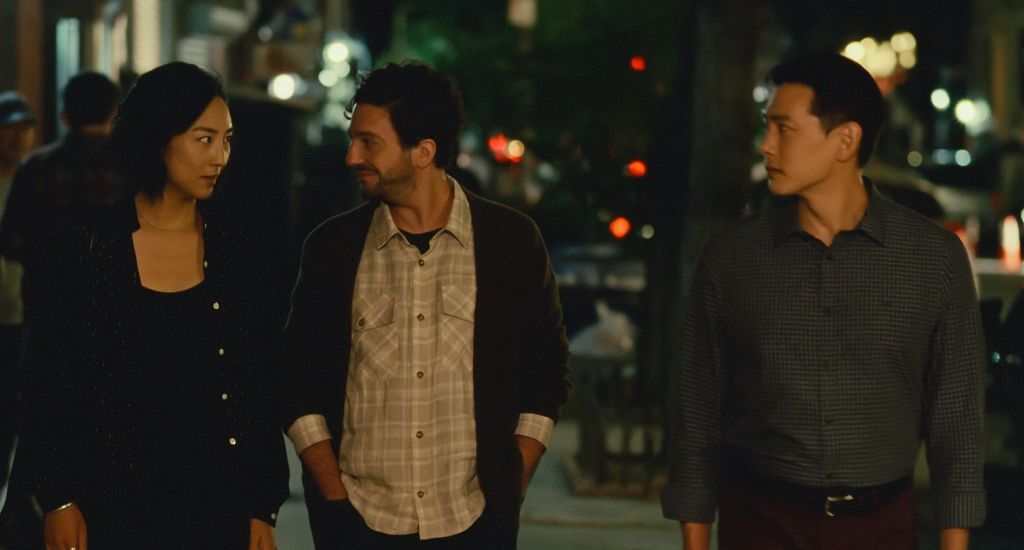
The film begins in Seoul where two classmates, Na Young and Hae Sung, begin a flirtatious relationship that dissipates as quickly as it develops when Na Young’s family immigrates to Canada. Fast forward twelve years and Na Young (played as an adult by Greta Lee), who now goes by her western name of Nora, is in New York undergoing a residency as a playwright. Out of sheer curiosity, and thanks to the wonders of Facebook, she reconnects with Hae Sung (Teo Yoo). They begin a long-distance pseudo-courtship, and begin to wonder if they can finally see each other in person again. Song’s magic trick of the second act is in how she develops this romance, taking place almost exclusively via Skype, and fills it with a sense of longing, while adding in minute character details. We, as an audience, are preternaturally determined to root for Nora and Hae Sung to be together, but it’s the borderline subliminal moments that pass between them that give us a reason. He remembers how she used to cry often when she was younger. She wakes up early to call him because it fits with his schedule.
But life gets in the way, and Nora’s ambitions outweigh trekking back to Korea, which she sees as a distraction to those plans. Whereas most films would treat this development as an artificial plot device, Past Lives sees it simply as a progression of life. Twelve years pass and Nora has moved on, marrying author Arthur (John Magaro), but she never fully lets go of Hae Sung, in spite of their increasing distance. Both Lee and Yoo are wonderful in their roles, fully inhabiting their characters’ deepest desires, both freely and unspoken.

Song uses a recurring visual element of mirrors and reflections throughout the film, without drawing attention to it. It represents the inevitable push and pull that Nora feels, between her home country of Korea, her husband, her desire to live and create on her own terms. Among the film’s other strengths, Song’s camera choices, and the way she visually tells the story, belie a supremely confident director with a promising future ahead of her.
One can’t help but think of mirrors when considering the script as well, as certain verbal motifs are brought out and back again later in the film, in different contexts that suggest much more than what is on the surface. Similarly, the drama never unfolds unnaturally, or in superficial manners. There is no superficial external force that keeps Nora and Hae Sung from being together, apart from the relentless churning of their daily lives. If there’s a single false note to be seen, it’s in a meta-textual moment between Nora and Arthur, when he calls out the storybook nature of Nora and Hae Sung’s star-crossed affair. However, given the pair’s artistic background and affinity for storytelling, it’s only a brief, minor complaint.
I’ve spoken at length about how the best films contain a certain universality while feeling incredibly specific and personal. Whether you have “the one that got away” or simply lost touch with a platonic friend or family member over the years, Past Lives has something that virtually everyone can invest in. It’s high praise to put Song’s film in the conversation with Wong Kar-wai and Richard Linklater’s masterpieces, but Past Lives stands on its own, a toweringly assured debut film.
Past Lives is now screening in select cities and will be in theaters nationwide on June 23.
OSCAR POTENTIAL:
- Tough call. A24 certainly knows how to mount a campaign, and the first half of 2023 has been short of potential Best Picture nominees, compared to last year. In a year of 10 Best Picture nominees, I think a nomination for Past Lives could be attainable, especially with the almost universal critical praise.
- It’s hard to say what shape the Best Actress lineup will take by the end of the year, but a nomination for Greta Lee would certainly be deserved.
- The same goes for the Original Screenplay category. Song’s personal connection to the story certainly helps. Don’t forget that Charlotte Wells came close last year to a similarly personal story with Aftersun, another debut distributed by A24.
- Shabier Kirchner’s cinematography, and Christopher Bear and Daniel Rossen’s score, are understated but crucial elements to the film. However, expect them to be sidelined by more established names in bigger films coming later this year.
- Regardless of how the film does at the Oscars, expect it to clean up in critics’ groups and more independent-minded awards bodies.
 The Movie State
4 thoughts on “Past Lives – Movie Review”