

Gran Turismo
- Director: Neil Blomkamp
- Writers: Jason Hall, Zach Baylin
- Starring: Archie Madekwe, David Harbour, Orlando Bloom, Geri Horner, Djimon Hounsou, Josha Stradowski, Maeve Courtier-Lilley, Darren Barnet
Grade: C+
Before we can get started with the film proper of Gran Turismo, we’re treated to a miniature commercial on the history of the PlayStation game that the film is based on. Its creator, Kazunori Yamauchi, went to painstaking detail to recreate the feeling of driving a race car, to give players the most realistic experience possible. But why include this bit into a film at all? After all, we as viewers are experiencing an extra degree of separation from reality – we’re watching someone play a simulation of a real race. Because, first and foremost, Gran Turismo feels like a glorified commercial for intellectual property, and a true-life story second.
At times, this gambit manages to add some exciting visual elements to an otherwise droll underdog sports story, but it also tends to be a distraction. More often than not, it’s as if director Neil Blomkamp doesn’t trust the audience to understand what’s happening on screen. A visual motif will display whenever Jann Mardenborough (Archie Madekwe) advances in a race, or a graphic will come up during the final lap, sometimes stating something that a character literally says immediately before or after it appears. Take these out, and the film loses nothing; a race is inherently dramatic, and the characters’ actions should tell us everything we need to know without hammering it into our skulls.
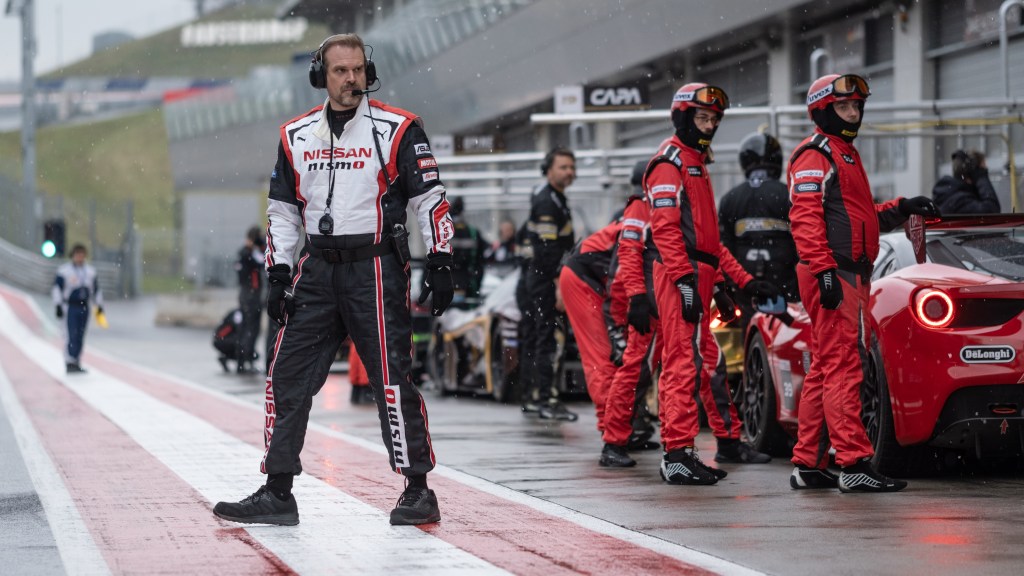
Regardless of the film’s commercialized nature, it does feature a genuinely worthwhile story at its center. Jann, a dedicated Welch gamer, dreams of trading in his gaming chair for the cockpit of a real race car, but his disapproving father (Djimon Hounsou) wishes he’d stick with reality and get a real job. But when Nissan decides to push a marketing gimmick, headed by the blandly ambitious Danny Moore (Orlando Bloom) by taking the best Gran Turismo players and giving them contracts to race on the professional racing circuit, Jann sees his opportunity. Jann, and a handful of bland characters that aren’t worth spotlighting, will be trained by Jack Salter (David Harbour), a former racer who’s slumming it as a mechanic for a blandly soulless team, led by a blandly malevolent driver played by Josha Stradowski, at the onset of the film. Salter never lets his disdain for the program wane, even after Jann survives and becomes the face of team Nissan.
Harbour and Madekwe provide the best human relationship in the film, as Salter slowly sees the potential in Jann, beyond a ticket out of the racing slums. There’s plenty of theoretically rich dramatic material worth exploring, but Jason Hall and Zach Baylin’s script barely pays them lip service once the racing gets going. Jann has a romantic connection to Audrey (Maeve Courtier-Lilley), a girl from his hometown who feels less like a character and more like a personified studio note to tack on when the film slows down. A great sports drama should be able to sustain itself both on and off the course, but it’s on the scenes surrounding them when the film struggles to find anything worth really digging into. At least the script doesn’t make Danny Moore into the slimy corporate weasel type that many sports-focused films often do – note the slicked back hairstyle that’s a calling card of the archetype – but it doesn’t make his character any more interesting.

Thankfully Blomkamp directs the racing sequences with the required amount of energy and verve, in a way that boosts the dramatic tension of an inherently tense event. Jacques Jouffret’s cinematography is a godsend in these sequences, as he finds creative ways to shoot the races – including some inventive drone camerawork – without getting too repetitive. Every once in a while, Blomkamp will insert a macro shot of an indistinguishable car part as Jann drives, adding to the experience as something that Jann is genuinely feeling, compared to the physical numbness of playing the game.
In addition to the aforementioned visual motifs, Blomkamp will occasionally shift perspectives, trailing the car from behind in the same way that players can. Early on, when Jann is still playing the game, Blomkamp visualizes the experience in a dynamic way by projecting the car around him, a smart way to go beyond simply watching someone play a game. Indeed, the visual effects throughout Gran Turismo are top-notch; several incredibly dangerous crashes occur, and I legitimately could not spot the difference between practical and computer effects.

When done correctly, the recent trend of commercials as films – consider Blackberry or Air or Tetris or Flamin’ Hot – manage to ground themselves in the characters behind the massively successful products. Gran Turismo at times either forgoes any character development, or takes shortcuts, instead relying on its admittedly thrilling action set pieces and visual aesthetics. The result isn’t a bad film per se, but for your hard-earning theater-going money, you probably want to get more than a feature-length version of the commercials that play before the real movie starts. One of the features of the Gran Turismo game is a line, which allows players to see the path of least resistance in order to navigate the difficult courses. For a film that often preaches finding success by straying from that line, its story and structure rarely drift away from it.
Gran Turismo will be released in theaters nationwide on August 25.
OSCAR POTENTIAL:
- I can see a legitimate path for Gran Turismo to at least get on the shortlist for Best Visual Effects. And, in a down year for superhero cinema, compounded by the potential of Dune Part Two being delayed until next year, a nomination would be possible. The same goes for Best Sound, as the sounds of the cars booming and crashing feels as explosive as it should be.
 The Movie State