
Below is my conversation with Brooke Berman, writer and director of Ramona at Midlife, ahead of its world premiere at the Heartland International Film Festival. We talk about female friendships, avoiding tropes of the genre, and the evolution of the film from Brooke’s mind to the screen. Our conversation has been edited and condensed for clarity.
Ben Sears: Before you made the film, you had written a number of plays. What was it about this story that you felt would be suitable for a movie?
Brooke Berman: That’s a great question. I had started writing movies earlier when I moved to LA in 2008. I went out there, and I had sold a play to a movie star, and I was getting these writer-for-hire jobs and really learning the form of screenwriting. I’ve always been in love with movie making, but what I realized as a screenwriter in LA is that the part of the process that really lights me up is watching the story move from the page to the actor’s bodies. As a playwright, the writer is involved in that process – we sit in the theater next to the director, and we’re included in all the decision making and all the conversations, and we get to watch the magic happen. And as a screenwriter, that isn’t true. When a screenwriter finishes a draft and they turn it in to their agent, or the studio, or whoever paid for the movie, the screenwriter’s work is then done. And the director takes over and makes the story happen, and I realized that I needed to be in on that. So I made a short while I was living in LA, to see if I had the chops to direct. When we had moved back to New York, I adapted one of my plays, Out of the Water, to film, thinking I was gonna make that for half a million dollars with my friends. I was in development with that movie, and the budget grew to just over a million, and I was in development for six years when the pandemic hit.
So at that point, I had already transferred my imagination from what can happen on the stage to what can happen on camera, and I was training myself to be the person that can direct that, and I had realized I had to do a different story. This story had been living in me for a while – I wrote it for Yvonne Woods, who plays Ramona. She was my classmate at Juilliard, and we were both living in LA at the same time. We had a bunch of conversations about life and love and success, and what it all means. So that character is someone I had been almost nourishing in the dark while I wrote this other story. I sat down and took a writing workshop as a student, and started on day one, and the character showed up. It was different than the story I had planned to write about her, but I wrote the first draft during those first few months between March and August of 2020. And then I just knew I had to make it. Because I had been in development with this other film, doing all the sort of conventional indie things, like attaching an executive producer and a star, and raising tons of money, I was like ‘well, we’re not going to do it that way. Let’s just do it small and simple with what we’ve got.’
BS: How was the story different from what you had planned out?
BB: In Los Angeles, the way that divorce laws work, if you’re a writer and you get divorced, your spouse is entitled to – I’m going to get this wrong, but I used to know it – it has to do with what your spouse is entitled to in compensation for royalties for the work you made during the marriage. It’s meant to protect the wife of the guy who wrote the big movie that made jillions of dollars, but I had a good friend of mine get divorced while I was there, and I was fascinated to learn that little quirk of California divorce law. So that went into the DNA of Ramona, and the first two scenes that came to my mind – one of which is in the movie, and one of which is not – is the scene with the three friends where she says “is this an intervention?” That scene came first. I knew that Ramona had this incredibly successful cohort that she used to be in charge of, and was now hiding from. In my original idea of the story, she was going to ask her friends for help and they didn’t know what to do with her. Also was the idea that she had stopped writing when she got divorced, and would do it out of spite because she was waiting for the time when her ex would no longer be entitled to royalties. Neither of those things really made it into the story; instead what happened when I started writing was that this Ramona was not divorced yet, she was yearning to get back together with her ex who she was still in love with, but she was really stubborn. But those were really the pieces that came first.
BS: You mentioned that you had written this specifically for Yvonne. What was it about her that made her the ideal fit for this part?
BB: Oh, I’m so inspired by Yvonne. Her and Rob Beitzel, who’s the actor that plays Mansbach, were in my final project at Juilliard. I’ve done so many plays with them both, and I always hear their voices in my head. I just love working with them so much, I work with the same actors again and again and again. Yvonne’s real-life husband Brian, who plays the hot dad on the playground, everybody says ‘why isn’t she with him? They have so much chemistry!’ And I say well, they’re married in real life, so actually she really is with him. Everyone in the cast is a friend, so it was really easy to hear those voices in my head. I love actors, and I also really particularly love the way that Yvonne – I know that a lot of the issues in the movie are very close to her heart and mine. So we had a lot of conversations during the development of the film about life and love and marriage and success and Patti Smith. My actors put so much of themselves into the movie, and into the roles.
BS: It feels like there aren’t many movies these days about women in their 30s or 40s, or that period of life, unless it’s something like 80 for Brady. How do you feel about the state of movies for that particular audience these days?
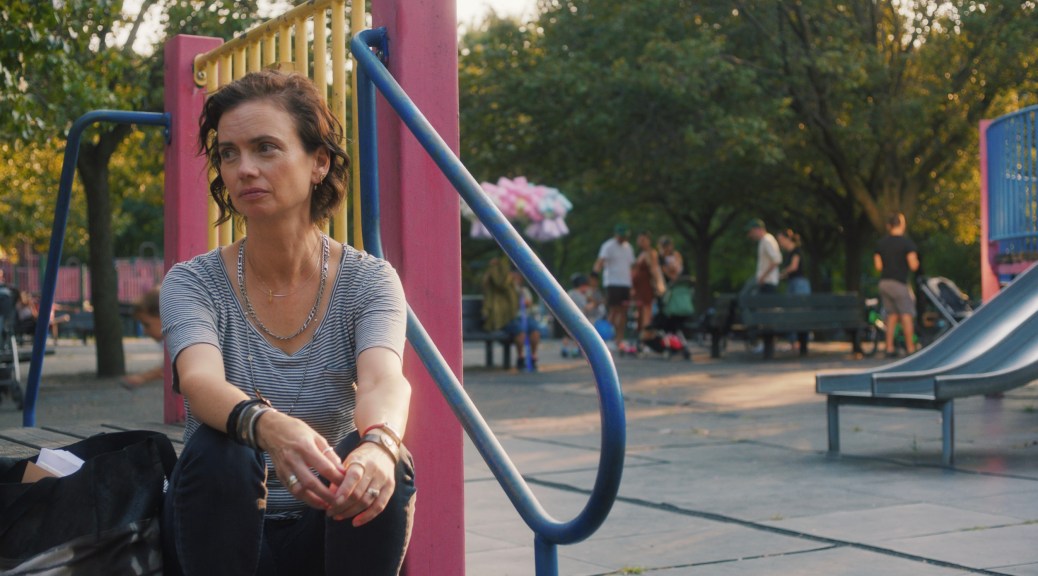
BB: I think we have these really pre-determined ideas about what happens at every decade of a person’s life. And I think that’s true across the genders, but it’s particularly true about women. We’re in a culture where young women start “anti-aging practices” at 28. When I lived in LA, I was shocked to learn they’re Botox-ing in their 20s preemptively, so there’s a terror around getting older, and I think it’s particularly tied to a fear of being obsolete, and a fear of no longer being beautiful, and a fear of no longer having power in the culture. Subsequently, you have a whole bunch of actresses who are terrified for anyone to find out how old they are. So we have no idea how old anybody actually is because you have movies about 40 year old’s being played by 60 year old’s, and the movies about 60 year old’s are being played by 80 year old’s, and everybody just wants to work, which is great – everybody should work. In my own life, I had a baby at 41, and I had two new mom friends was my age, and the other was 26, and we were going through the same thing. I spent my 40s sitting on the playground, like Ramona does, with the moms on the playground benches, just looking for common ground. It totally existed, but it blew my mind how every movie about women in their 40s were about empty-nest syndrome or 80 for Brady, or the movie where the rich ladies go to Sonoma and drink wine. None of that was my life! My life was, I had a job and I had a toddler, and I was at the playground and public school pickup. But I don’t look my age, whatever that means. My husband and I are both writers, we’re both self-employed. There weren’t movies that spoke to me. But I love Nicole Holofcener’s films, I think she really does a good job of addressing middle age for both genders. But most of our friends had our kids later, so I know a lot of people like me, but I don’t see us in the media.
BS: The movies that are in this genre, there’s a number of tropes and plot beats that you almost expect going into it. Ramona at Midlife mostly avoids those – were you cognizant of that when you were going into it, or were you just trying to make something honest without worrying about those plot beats?
BB: Number one, I was definitely trying to make something honest. But number two, which plot beats specifically?
BS: Usually the husband and wife are estranged, and there are whacky shenanigans that they’re involved, and whether they will or will not end up back together by the end of the film.
BB: It’s interesting, that part of the movie, I wish I had more time. We shot the movie in very few days, and I just didn’t have a lot of time with them. But I love that storyline so much because when I realized, when making it, the will-they-won’t-they isn’t really the biggest part of the story. It’s really about her reconciling with who she used to be and who she’s gonna be next. I think it’s so easy in midlife and in a committed relationship, to blame the other person for all of the choices you’ve made or all the things you have or have not become, and both of those spouses have to let the other one off the hook. And he really does it, so then we have to see her do it too. With a bigger budget and a big Hollywood studio behind it, it would’ve turned into a revenge comedy, where the point of the movie was to make that filmmaker eat his words and pay. And that was the least interesting part, for me, because I don’t think he’s the problem. For Ramona, the problem is the way she feels about herself, and if middle-aged women feel invisible, then my god, we have to see ourselves. And that’s what I wanted to explore. I wanted to explore her genuinely seeing herself and being ok with who she is. And that was my goal in the movie, so yes, I wanted to make something honest.
BS: The ending is purposefully ambiguous. Do you have any thoughts about what happens to Ramona after the movie ends?
BB: It’s so funny, my twelve year old son says, mom I don’t think there‘s a sequel. He said ‘I really like it, and I think there’s more to the story, but I don’t think there’s a sequel.’ You know, Ramona is able to make room for herself, so she does not go back to work at the animal shelter, she finds a job that uses her skills as a writer. She does reconcile with her spouse – he’s not going to move back in tomorrow, but they’re gonna patch up their marriage and be together. She does publish – Imani says to her in their scene, that she could write an essay exposing the whole thing. So she does do that, she says ‘in my next essay, where I thoroughly unpack showing up in some guy’s movie.’ She does write that essay, and she does start to put herself – I hate this phrase – but she puts herself out there as a writer, and she’s willing to take life on life’s terms.
BS: That’s all that you can ask for.
BB: I mean, right, what else is there?
BS: Whacky shenanigans abroad?
BB: [laughs] That’s right, she could marry Mr. Big in Paris. And who doesn’t want that? That was a really good episode! But you know what was really important to me, and I didn’t actually realize it until I wrote this movie, is I’m obsessed with female friendship. The more I worked on the movie, during production, and the edit, I could see how much the movie, for me, is about reconciling with old friends. I think the fact that Ramona goes back and says to those friends, sorry if I was a dick. That was really important.
BS: That’s another trope that this movie mostly avoids. Their whole friendship dynamic in other films would be much more heightened, especially the younger mom character.
BB: I love that character. I’ve never actually seen backstabbing in the way that Hollywood tells me to look out for. I’ve seen women who genuinely want the best for each other and struggle with their own shortcomings in the process. But I’ve never had a friend who was like, I really want you to fail.
Ramona at Midlife will have its world premiere at the 2023 Heartland International Film Festival on October 12. Buy virtual and in-person tickets here.
 The Movie State