
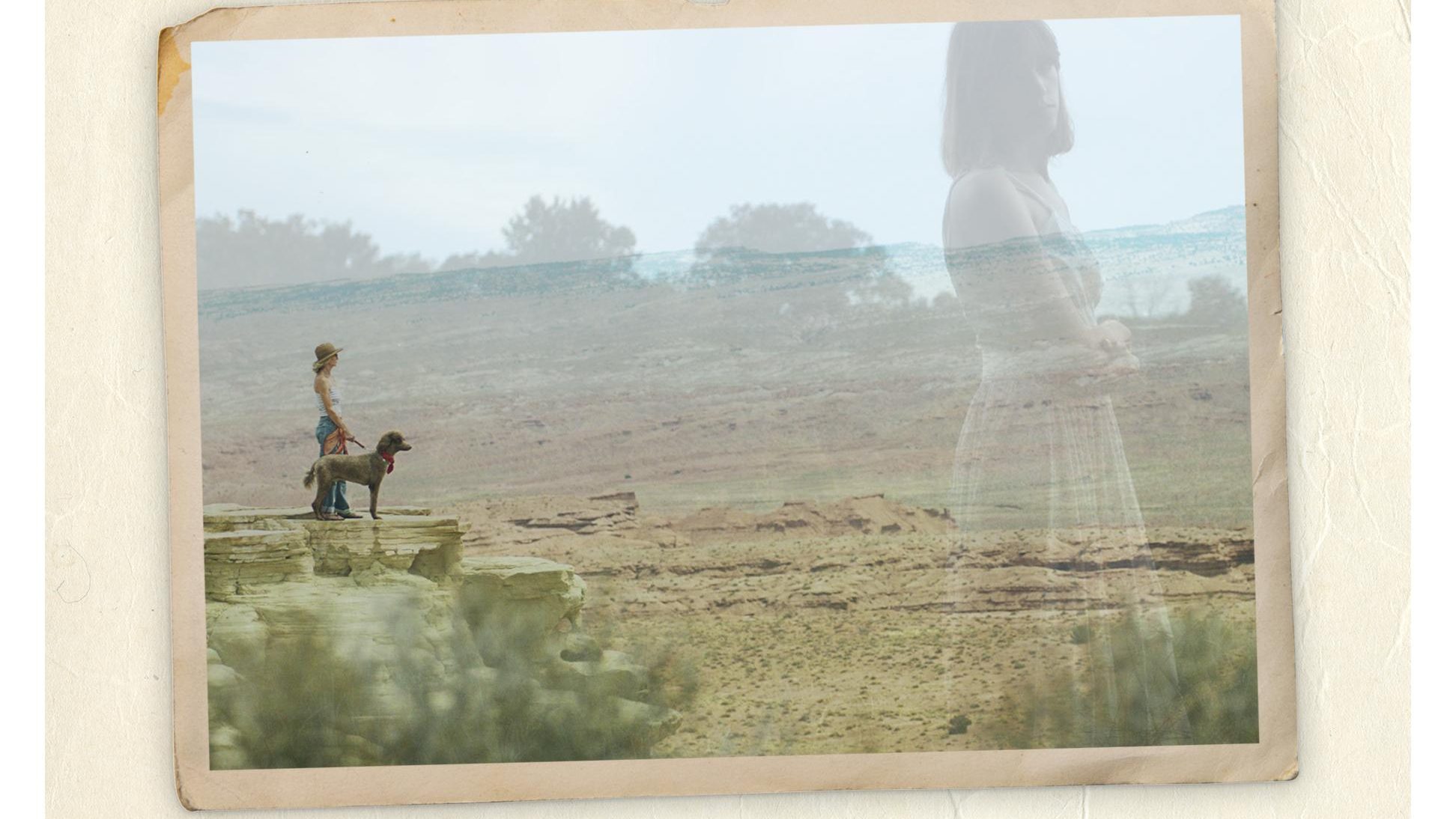
You could probably count the number of meaningful conversations had throughout the entirety of Bloom, on one hand, and that’s not a criticism. Writer and director Mark Totte structures the film as a kind of Malick-esque journey that places heavy emphasis on its visuals and the overall vibes in any given scene. Bloom tells the story of Kate (Kate Braun), a middle-aged grandmother in Milan, Indiana, and her inescapable desire to be free. On a whim, and without a word of warning to her husband, she sets out in her car with her dog Storm and heads west. When she talks to her son Brent, she lies by saying she’s stopped at his place in St. Louis (he’s out of town), and keeps on driving for a destination unknown. Along the way, we see flashbacks to her early, carefree days, touring the country in a van with her musician boyfriend/husband. Totte manages to effectively showcase the feelings at play in the present and past, but the film could have used a little extra narrative push to explain Kate’s sudden emotional turmoil. Still, Bloom doesn’t go for easy sentimentality in the way some micro-indies often do, and it’s all the better for it. In the few dialogue heavy scenes, the words come out naturally, without underlining the themes at play. This is a confident debut, featuring a solid performance from Braun, which will be well worth the price of admission.
Buy virtual and in-person tickets here.

You can never really go home again. That’s the enduring sentiment in Hellcat, the film from first-time writer-director Jack Lugar that explores one man’s long-simmering regrets, and how it’s manifested in those around him. Edward Paul Fry stars as Ricky Heller aka “Hellcat”, a musician who left his small town behind to make it big. When he returns back home, he has to come to grips with the life he left behind, and those he left in his wake. Why he forsook his hometown is best left unspoiled, but it touches on a man’s unspoken grief for lost love. The production quality won’t win any Oscars, but worse movies get made for more money every year, and it comes from a place of genuine emotion, which is what counts most at the end of the day.
Buy virtual and in-person tickets here.

When non-Hoosiers think of Indiana, they likely consider first the more notable aspects: the Indianapolis 500, our professional sports teams, and our often problematic politics. But what Liminal: Indiana in the Anthropocene explores are the more under-sung features. Entirely shot with drone footage and without any dialogue or talking points, it’s a documentary that forces you to consider newer perspectives on not just Indiana but our relationship with the land in general. The film is divided into various sections by the featured subject matter – one focuses on oil refineries, one focuses on transportation, one on farming, et cetera, and composer Nate Utesch’s score changes with each vignette. It’s a deceptively simple but effective concept for a documentary, and it shows outsiders and Hoosiers alike an idea of Indiana’s modern landscape.
 The Movie State