

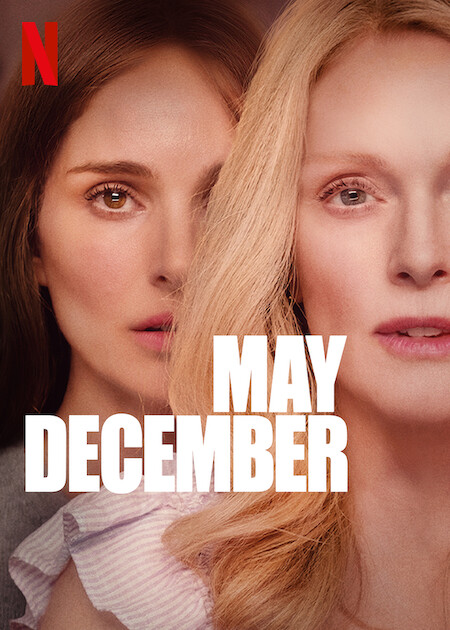
May December
- Director: Todd Haynes
- Writer: Samy Burch
- Starring: Natalie Portman, Julianne Moore, Charles Melton
Grade: A-
In a year when films have explored difficult subject matter like Native American genocide (Killers of the Flower Moon), artistic fortitude (Asteroid City), and tangled romance (Past Lives), May December may be the most complex of them all. It’s a film that deals with topics like identity, our American fascination with scandal, and personal authenticity – all while being one of the darkest comedies of the year.
Todd Haynes has dipped his toes into many genres throughout his career, from the legal thriller in Dark Waters to the music documentary in Velvet Underground, but he’s always approached his subject matter with a deft hand. With May December, he handles fame and infamy through a tricky lens that feels uniquely American. His focus – courtesy of screenwriter Samy Burch with a story credit from Burch and Alex Mechanik – comes in the form of an actress preparing to play a role based on a scandalous real-life figure (in the world of the film).

Elizabeth Berry (Natalie Portman) is a recognizable actress, stuck in the hellscape of primetime network procedurals (I won’t give away the title of her show, but it’s perfectly stupid). She believes her next great role will come in the form of her newest project, based on the life of teacher Gracie (Julianne Moore), who fathered a child with Joe (Charles Melton), one of her 13-year old students, in the 90s. What begins as a way for Elizabeth to understand the mentality of Gracie and what would lead to something so disastrous quickly becomes the stuff of psychological torment, as Elizabeth’s presence begins to unravel pains that had remained dormant for too long.
Portman gives one of the best performances of the year as Elizabeth, as she slowly begins to adopt Gracie’s mannerisms, while maintaining her own perspective on everything. She’s more than a casual observer, openly flirting at times with Joe. Is it part of her method, or is she genuinely developing feelings for him? Is she a good actress, or is she clinging to the hope that the resulting film will be her big break? Haynes provides no easy answers, and May December is all the better for it.

Moore is no less impressive. She is, for lack of a better word, the villain of the story. (Obviously. She had an improper relationship with a student.) But beyond this, she shows that Gracie is as naive as she is controlling. One incredibly blocked scene shows Elizabeth tagging along with Gracie as her daughter shops for a graduation dress. Moore subtly body-shames her own daughter out of buying a certain dress, and we can easily infer that it’s not her first attempt.
But the real revelation in the film is Melton, who plays Joe as a kind of man-child, whose development was essentially stunted after the affair. When he’s not working as a nurse, he’s at home watching Bob Villa or taking care of his monarch butterflies. It’s not the most subtle metaphor, but it provides for an interesting gateway into Joe’s psychology when Gracie’s not around.

After its world premiere at the Cannes Film Festival, the buzz about May December was that it’s a darkly comedic, campy ride. While I wouldn’t go so far as to qualify the film as camp in the traditional sense, there are some incredibly heightened, incredibly funny moments littered throughout that lighten the proceedings. This is a film that treats Gracie opening a refrigerator with the same amount of gravitas as a cancer diagnosis. You wouldn’t expect a film with such a thorny subject matter to be so funny, but it’s part of what makes May December one of the most unique films of the year. Of course, Marcelo Zarvos’ overly dramatic score does some heavy lifting, often underlining even the most minor plot developments.
That doesn’t mean that Haynes feels above these characters or portrays them in a mocking tone. On the contrary; he manages to make Gracie sympathetic, especially when more is revealed about her life before and in the aftermath of the affair. The way Burch’s screenplay slowly trickles out information is truly impressive. Gracie and Joe live a normal life, with an incredibly dark secret lying under the floorboards, and it’s spread like a cancer to their loved ones.

At its best, May December feels like Haynes’ riff on Bergman’s Persona, with an underlying power play between Gracie and Elizabeth – and, to some extent, Joe. You’d believe that Elizabeth has all the power, since she’s the Hollywood celebrity and has the ability to judge the past. But as the film progresses, power dynamics shift, relationships wither, and emotional truths are revealed. It’s as riveting as it is juicy, and how you react to any given plot reveal will probably reveal a great deal about yourself.
May December will be released in select theaters on November 17 and premiere on Netflix on December 1.
- Haynes is no stranger to the Academy, but he’s not in the inner circle, as someone like Aaron Sorkin or David Fincher are. In a perfect world, he’d be looking at a number of nominations, but May December just feels too off-beat for the Academy’s tastes, in an almost unquantifiable way.
- Original Screenplay is a bit of a wasteland this year, so I can see a way for Samy Burch to slide into a nomination, especially if Netflix campaigns hard enough for it.
- It feels strange to say that, of its three lead actors, the one with the highest chance of receiving a nomination is the one without a previous Oscar win. Everything is hinging on how well The Color Purple does right now, so if it’s a flop, Melton and Moore could possibly make it into the field.
 The Movie State
4 thoughts on “May December Review”