

The Boy and the Heron
- Director: Hayao Miyazaki
- Writer: Hayao Miyazaki
- Japanese Voice Cast: Soma Santoki, Masaki Suda, Yoshino Kimura, Ko Shibasaki, Kaoru Kobayashi, Jun Kunimura
- English Voice Cast: Luca Padovan, Robert Pattinson, Gemma Chan, Christian Bale, Mark Hamill, Florence Pugh, Willem Dafoe, Dave Bautista
Grade: A
Over the course of his 40+ year career, animation master and Studio Ghibli co-founder Hayao Miyazaki has made some of the most transcendent films ever made, animated or otherwise. They’re films like My Neighbor Totoro, Princess Mononoke, and Spirited Away that have crossed oceans and cultures to remind audiences of what storytelling can be. They’re films that casual movie fans and diehard cinephiles alike can enjoy, and they provide a much-needed rebuke to the often predictable storytelling mechanisms of Western animation. His latest, and possibly last film, The Boy and the Heron, feels like the film that he’s been building towards his entire life, a culmination of a lifetime’s philosophy in a beautifully rendered package.
Yes, Miyazaki has famously retired and un-retired many times before, most famously after the success of Princess Mononoke, which yielded the Oscar-winning masterpiece Spirited Away. But at 82 years old, perhaps we should take him a little more seriously. Especially when the message of The Boy and the Heron, loosely adapted from Genzaburo Yoshino’s novel How Do You Live?, is a kind of farewell message, a passing of the torch to the new generation. Look closely enough, and you’ll see similarities and references to almost all of Miyazaki’s films, if not in imagery, in sentiment. But The Boy and the Heron isn’t simply a retread of past ideas, it’s something new, fully formed and beautiful.

The film opens as a kind of side-plot to Miyazaki’s last film, The Wind Rises, as a boy Mahito (Soma Santoki, Luca Padovan in the English voice cast) wakes to find his mother’s hospital burning during WWII. Not long after the disaster, Mahito’s father (Takuya Kimura; Christian Bale) remarries Mahito’s aunt Natsuko (Yoshino Kimura; Gemma Chan) and relocates to the countryside. Once they arrive, Mahito is menaced by a talking grey heron (Masaki Suda; Robert Pattinson), who tries to convince him his mother is, in fact, alive.
He’s soon transported to another world where he meets varying versions of people he knows in the real world, including Kiriko (Ko Shibasaki; Florence Pugh), who he knows as an elderly maid at Natsuko’s home, but here is a younger, feistier version. I’ll stop recounting the plot here, not because of spoilers but because, as with all Miyazaki’s films, the magic is in the experience, and it can’t be easily replicated in mere words. Every plot detail, while perhaps nonsensical out of context, is all a part of a beautiful whole when seen together. It’s been a long time since a film has kept me guessing where it will go from one moment to the next, and The Boy and the Heron is another whimsical fantasy adventure from one of the world’s greatest filmmakers.

Miyazaki has created an abundance of memorable fantasy creatures throughout his career, and his latest is no exception. Whether it be the adorable sprite-like warawara, the goofy army of parakeets, or the titular heron – who’s more like a weird old man trapped in a heron costume – there’s enough uniquely rendered characters, human and otherwise, to marvel at.
And when the story slows down – not a criticism – it’s a marvel to behold on the big screen. Of course, Miyazaki famously animates thousands of his film’s frames by hand, which is part of why he’s only made 12 films since 1979, but is part of the reason why his films are so special. The Boy and the Heron simply would not exist without Hayao Miyazaki. Every frame of the film bursts forth with a vibrancy and creativity that just doesn’t come along often enough, a reminder of what makes hand-drawn animation so special, and what’s lost when we rely so heavily on computer generated films.
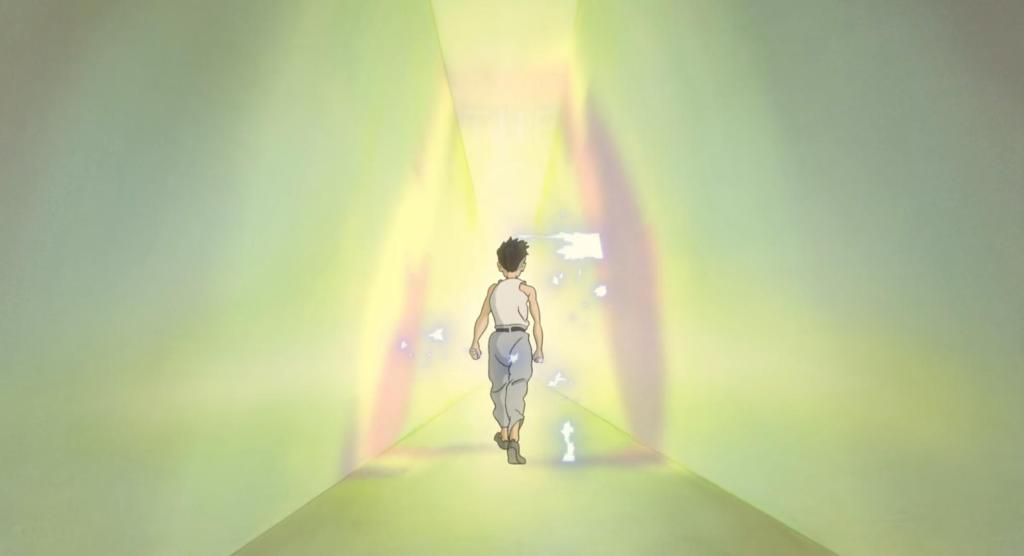
I can see Western audiences that have been force-fed Disney and Dreamworks films potentially becoming frustrated by The Boy and the Heron‘s rigid rules: X is not always a metaphor for Y, and A does not always lead to B. But it all works together to fit into Miyazaki’s thesis, as he looks back on his own legacy. Of course, there’s another read on the film as a kind of environmentalism fable – one of Miyazaki’s favorite subjects – as Mahito is tasked with preserving his world, in spite of its evil tendencies. Leave your surroundings better than when you found it, as they say.
Whether The Boy and the Heron is indeed Miyazaki’s last film or not, it remains a towering masterpiece in a career full of them, and a grand statement for animation and filmmaking in general. The world won’t be the same whenever Miyazaki actually decides to call it quits, but what The Boy and the Heron posits is that he’s done the work to create a sense of wonder and excitement in films. Now it’s up to us to carry the torch.
The Boy and the Heron will be released in theaters nationwide on December 8.
- You can bet the farm on The Boy and the Heron receiving a nomination in Best Animated Feature. A win could happen as well, as a kind of parting gift to Miyazaki. But it remains to be seen whether the Academy prefers the box-office hit of Spider-Man: Across the Spiderverse, or the more artistic The Boy and the Heron.
- Composer Joe Hisaishi, who’s collaborated with Miyazaki on nearly all of his films, has created one of his greatest scores here. A nomination would be well deserved, but unfortunately unlikely.
 The Movie State
3 thoughts on “The Boy and the Heron Review”