

I Saw the TV Glow
- Director: Jane Schoenbrun
- Writer: Jane Schoenbrun
- Starring: Justice Smith, Brigette Lundy-Paine, Ian Foreman, Helena Howard, Lindsey Jordan, Danielle Deadwyler, Fred Durst
Grade: A-
Everyone wants to be seen. Everyone wants to feel like they belong. Everyone just wants to feel like they’re not alone. In I Saw the TV Glow, belonging takes the form of a young adult television show, and it’s filtered through writer-director Jane Schoenbrun’s unique filmmaking style, creating a wholly original and entrancing work. It’s a purposefully bizarre film which swings for the fences, and it likely won’t work for large swaths of the moviegoing public, but it’s no less refreshing to see something original executed so confidently.
Schoenbrun’s debut feature, the micro-budget We’re All Going to the World’s Fair, received moderate praise and gathered some attention their way. I Saw the TV Glow sees them playing with house money (A24’s house, to be precise), and they use it to get weirder but no less poignant. There’s a number of themes to be found within the film, and one of Schoenbrun’s magic tricks is keeping the story from feeling overstuffed. From queer identity, to teenage loneliness, to childhood nostalgia (and more), it’s possible to get a number of reads on the film.

On its surface, I Saw the TV Glow concerns two teenagers, Owen (Justice Smith) and Maddie (Brigette Lundy-Paine) who find solace within a TV show called The Pink Opaque. It’s a kind of mystery-of-the-week show like Are You Afraid of the Dark? and Eerie, Indiana, where two teen girls sharing a psychic connection across dimensions fight monsters. Owen’s parents (Danielle Deadwyler and Fred Durst) don’t allow him to watch since it airs past his bedtime, so he has to sneak over to Maddie’s house or watch the VHS tapes she records.
But when the show is suddenly cancelled and Maddie disappears, Owen feels like his life has lost purpose. We don’t see Owen interact with too many people his own age, but we sense through Justice Smith’s understated performance that he doesn’t feel comfortable in his own skin. Smith portrays Owen as a kind of kid being forced to play a grown up, and it’s his best performance yet. The Pink Opaque provides a kind of safe haven for him, an escape from his dull reality where he can forget about his absent father or his mother, who eventually dies from cancer. But the great revelation in I Saw the TV Glow is in Brigette Lundy-Paine, who plays Maddie as someone who knows exactly who she is, but still struggles to find her place in the world.
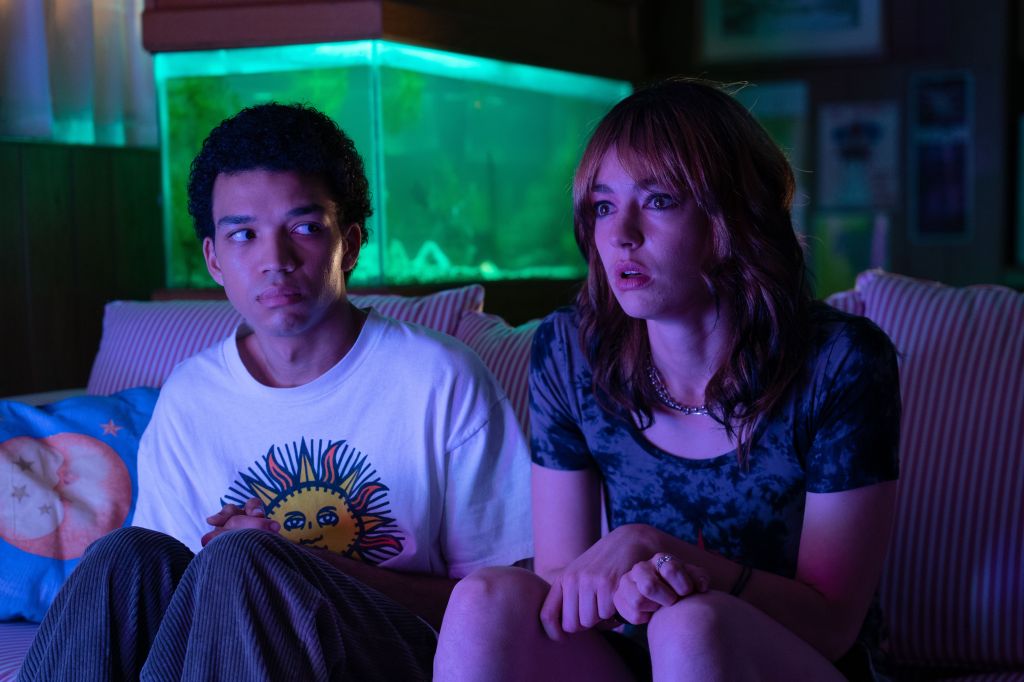
It’s always refreshing when a film can keep you guessing from scene to scene, and though the ending provides emotional catharsis for Owen, it ends abruptly, as if Schoenbrun didn’t know what the ending of this story could be and just decided to end it before things spiraled out of control. Still, there’s enough engrossing elements throughout I Saw the TV Glow, like Eric Yue’s neon-soaked cinematography or Brandon Conner-Tonnolly’s period-specific production design. The few glimpses we see of The Pink Opaque feel rooted in specificity, as if Schoenbrun took those formative 90’s Nickelodeon shows and twisted them through their own twisted worldview.
Before the screening began, a friend and I discussed how I Saw the TV Glow is labeled as a “drama/horror”. While lite on scares, the film is drenched in dreadful atmosphere and occasionally chilling imagery for all of its 100 minute runtime. We all have unique relationships to the specific media we consumed in our formative years, whether it be for something obscure or widely beloved. Though it’s easier than ever today to connect to people with shared interests, I Saw the TV Glow posits that few things feel as life-affirming than the experience of finding a community of like-minded individuals.
I Saw the TV Glow will premiere in theaters on May 3 before expanding nationwide on May 17.
OSCAR POTENTIAL:
- None.
 The Movie State
6 thoughts on “I Saw the TV Glow Review”