

“III”
- Creator: Alfonso Cuarón
- Starring: Cate Blanchett, Kevin Kline, Sacha Baron Cohen, Kodi Smit-McPhee, HoYeon Jung, Louis Partridge, Leslie Manville
Grade: A-
Warning: The review of episode 3 of Disclaimer will contain spoilers.
Only three episodes in, Disclaimer has boldly tackled a number of complex themes, sometimes within the same scene, even when the plot doesn’t progress very much. Set against the backdrop of these two parallel families, and the two timelines, it’s a fascinating look at perspectives, power, and truth. The scene that brings all of this together takes up the bulk of the second half of “III”, at the conclusion of young Catherine’s (Leila George) first day with Jonathan (Louis Partridge), and Cuarón uses it to inform not just their past interaction, but reveals a great deal about Catherine in the present.
What was it that initially attracted Catherine to Jonathan? Partridge, every time we’ve seen him since meeting Catherine, has been little more than a wide-eyed dope, hypnotized by her beauty and sex appeal. That doesn’t change in the aforementioned scene, as Catherine seduces him into slowly revealing his fantasies, and the following explicit scene in her hotel room. He’s under her spell, and she’s relishing every moment of it. It’s also a sharp contrast to his introduction in the opening of the series as an unrepentant horndog.
I hadn’t realized this until later, but Catherine’s seduction of Jonathan works on a number of thematic levels for the series as well. By framing their foreplay around what he would do to Kylie Minogue, and not her, she’s removing herself by a degree to the proceedings of what’s actually going on around her. Perhaps this gives us a clue as to why she felt so safe all these years from the long-standing consequences, and the guilt, of her affair. Through this lens, Disclaimer clues us in to her marriage to Robert (Sacha Baron Cohen) and why she would be so attracted to someone like him. On paper, he has all the power, coming from generational wealth, but she must have seen a power dynamic she could exploit.

Which is why she must feel so out of sorts after he takes some of his power back, ignoring her calls and texts. I imagine they have had fights in the past where she knew he would come crawling back to her, regardless of whether she was at fault or not. The change in power dynamics still persists through Catherine’s voiceover as he rides the bus, silently judging the normies around him. We don’t spend a ton of time in the present day in episode 3, but that’s fine, since we need to understand the past in order to understand why it hangs so heavily over all the major players.
The only other major development is a bit of filler, when we see the moment when Stephen and Nancy Brigstocke (Kevin Kline and Lesley Manville) learn when and how Jonathan died. A parent losing a child will always be traumatic and cause them to question their circumstances, but it’s understandable how Stephen and Nancy’s suspicions are raised when they learn of his unusual demise (he drowned, even though he’s a good swimmer) and its unusual aftermath (the police allowed Catherine to leave the country even though she was a witness). In this way, Stephen’s complex plan for revenge can be seen as him seeking to shift the power imbalance between him and Catherine. What remains to be seen is whether this revenge is truly justified or not.
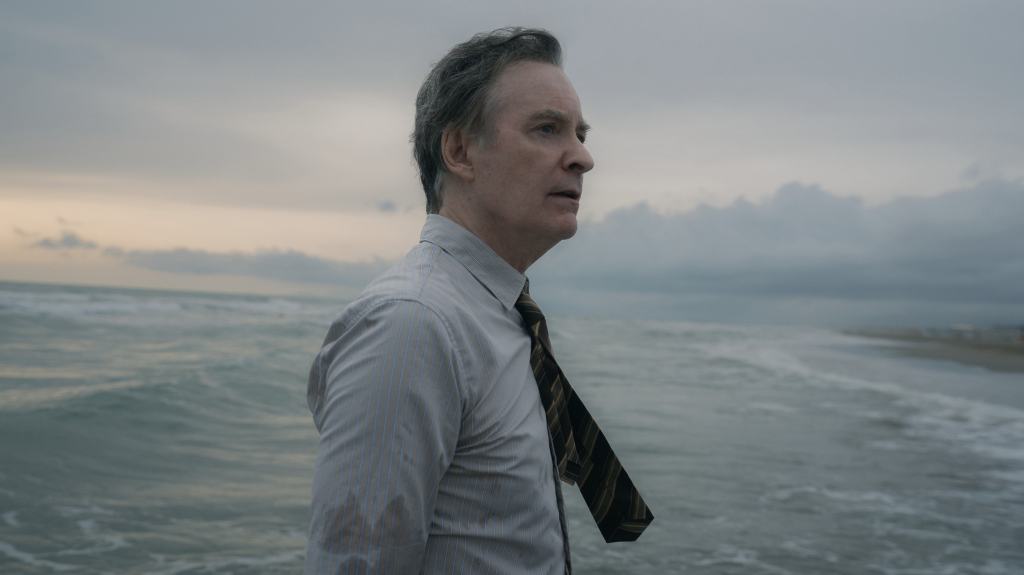
What’s stood out to me so far, beyond Disclaimer‘s story and the performances is how purposeful Cuarón’s camera is. Every once in a while, it will zoom or shift abruptly, as if a real person is documenting what we’re seeing. It’s certainly no accident that Catherine’s profession is a documentarian; yes, you’re dealing with the truth on film, but the truth can be edited and trimmed to suit the maker’s best interests. Just like the damning photographs of young Catherine, or Stephen’s novel, Disclaimer is a maze where each of the characters, and us, can’t seem to escape.
 The Movie State