Maria
- Director: Pablo Larraín
- Writers: Steven Knight
- Starring: Angelina Jolie, Alba Rohrwacher, Pierfrancesco Favino, Kodi Smit-McPhee, Haluk Bilginer
Grade: B-
During his introduction of his latest film Maria, director Pablo Larraín espoused a childhood fondness for the opera, and a hope that the art form could return to its more welcoming, populous roots. With this in mind, it’s clear that Larraín’s film has great reverence not just for the opera itself, but for its subject, Maria Callas. It’s a thread that has connected a number of his films, especially his unofficial trilogy exploring the inner lives of the 20th century’s most misunderstood women, but there’s something missing from his latest entry, and part of it may be because of her unfamiliarity.
Though she was world renowned as the opera singer of her generation, Maria Callas (Angelina Jolie) is largely unknown to the world of 2024, especially compared to Jackie Kennedy and Princess Diana, the subjects of Larraín’s Jackie and Spencer, respectively. But Larraín has never been explicitly interested with the exterior lives and accomplishments of his subjects, often eschewing the hallmarks of traditional biopics. Maria is at times the most conventional of his films, with a few surreal touches thrown in, but still maintains the director’s unflinching curiosity.

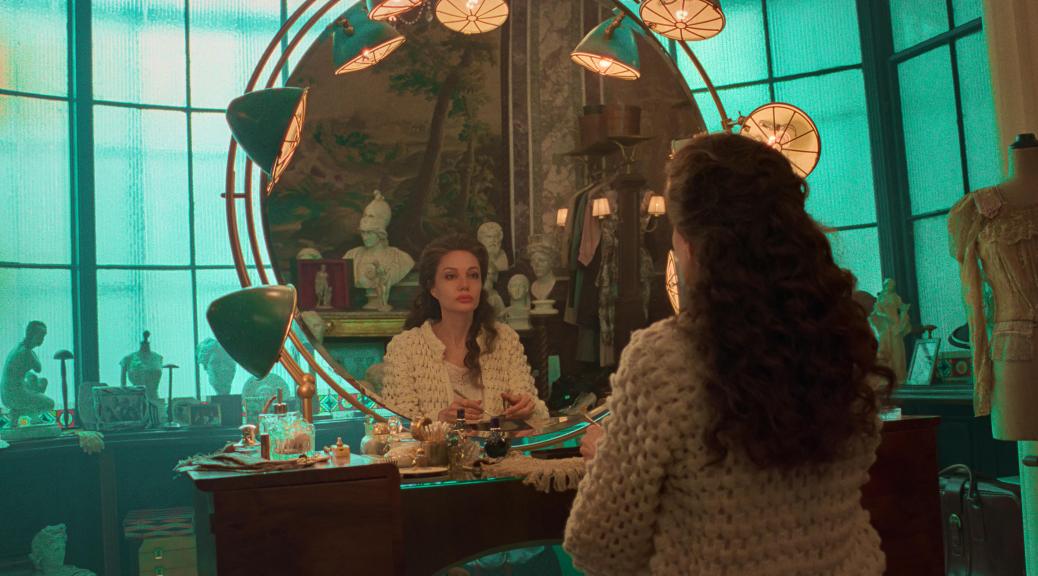
The film mostly concerns the final weeks of Maria Callas’s life in 1977, about four years after she essentially retired from singing professionally. Mostly removed from all of her friends and collaborators, Callas stews in her Paris home that feels fittingly ripped from Amadeus, as she relies on her housekeeper Bruna (Alba Rohrwacher) and her butler Ferruccio (Pierfrancesco Favino) for comfort. She’s losing her grip with reality, though the pills, which she has to hide from Bruna and Ferruccio, probably aren’t helping. Though Larraín has flirted with the surreal before, Maria is more overtly so, to mixed results. It’s a running joke between Maria and Ferruccio that the film crew arriving to interview her about her life is a figment of her imagination, but Larraín makes it clear early on that they are.
This allows Maria to dive into the past as she recalls bits of her childhood in Greece, and her flirtation with Aristotle Onassis (Haluk Bilginer), in spite of both of their marriages. Onassis is instantly smitten and believes they’re destined to be together, but their paths cross too late. Steven Knight, who writes the screenplay here and has collaborated with Larraín on Spencer, hints frequently at Callas’s notorious history as a prima donna, but we see a more muted version of it in Maria. Resigned to die, Callas still has fits of diva behavior but longs, above all else, to be loved. She espouses a hatred for hearing herself sing, but blasts her own records at home. It’s in these moments when Maria is at its best, but they’re never the central focus of the film.

Even with the melodramatic and often meandering material, Jolie is outstanding as Callas. It’s been too long since she was given a leading role worthy of her talents, and Maria is a solid reminder that she can carry a film with gravitas. Though not an overly showy performance – a subversion of expectations, given the dramatic nature of opera – Jolie fully inhabits Callas’s spirit. There is a conflicting duality within Maria, as she tries to reckon with her persona as “La Callas” and her own reality. In her final days, Callas appears more skeletal, more worn down, as if a lifetime in the spotlight has manifested physically.
Because we are less familiar with Callas, and I’d venture to guess, opera at large, Maria has to do more heavy lifting to introduce Callas and her reputation. Knight and Larraín admirably hint at how the world perceives her without too much heavy-handed exposition. Still, the film stretches just past its breaking point with long-winded conversations and flashbacks. Regardless, Maria is no less refreshing to see, as Larraín remains committed to empathetic, original depictions of fascinating women.
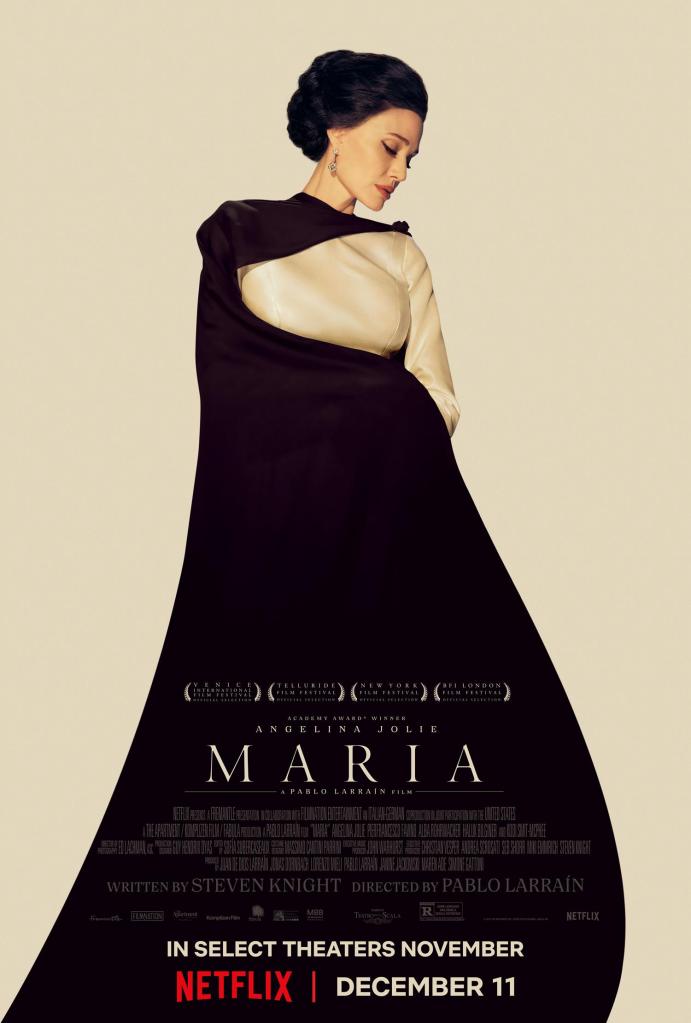
Maria will premiere in limited theaters on November 27, and premiere on Netflix on December 11.
- Angelina Jolie’s performance, and her “comeback” narrative – plus the backing of Netflix, makes her a virtual lock for a Best Actress nomination. As it stands, she’s essentially the frontrunner to win.
- Though Larraín has surrounded himself with past collaborators, including DP Ed Lachmann, who received an improbable Best Cinematography nomination for Larraín’s last film El Conde, and production designer Guy Hendrix Dyas, I see those fields as tougher to crack for Maria.
 The Movie State
One thought on “Maria Review”