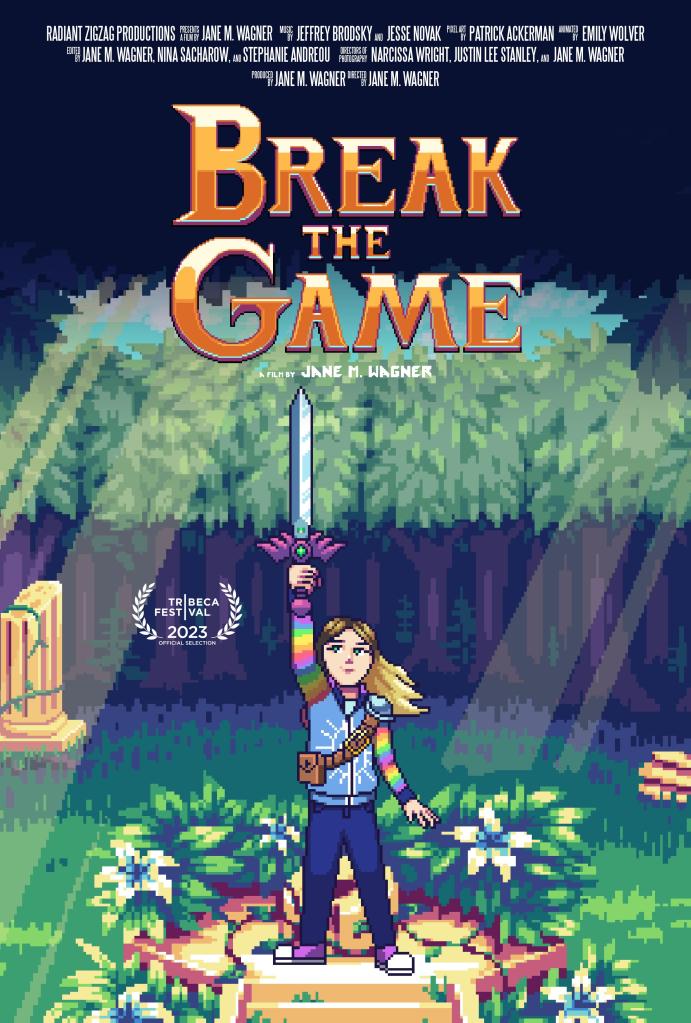
Break the Game shows a brutally honest first-person portrayal of Generation Alpha’s relationship to the internet, but it doesn’t have much new to say on the subject. It’s the kind of documentary that feels almost immune from criticism because of its deeply human observations, and what it says about the youth’s sense of community and belonging. Still, the film’s thesis on this matter essentially boils down to “internet equals good and bad”, and one can’t help but wish it was more nuanced than that.
Filmmakers have tackled the coming of age genre through countless ways and methods over the years, which makes the Coming of Age block at Indy Shorts one of the more enticing options available. Caught on Tape, written and directed by Chris Alan Evans and Alexander Jeffery, plays into the inherent awkwardness faced by teenage boys in the VHS era. When Finn first learns about the glories of pornography, he hatches a scheme to find his father’s collection. There’s a number of laughs and genuine truths to be found, in a film all about staying true to yourself during a time when everyone seems to tell you how the world works.
Ebb & Flow, written and directed by Nay Tabbara, takes a decidedly more dramatic and feminine approach, setting one young girl’s desires against the turmoil in Beirut. The threat of violence, referenced frequently throughout the film, works nicely as a metaphor as kids are forced to grow up more quickly than they should be. Of course, Loulwa and her friend are more concerned with sneaking away to meet up with a few boys on the beach, as she pines for her first kiss. Even if you don’t live in a warzone, there’s something universal about the film, where something like a teenage crush can feel like the end of the world at times.
Another non-English entry brimming with heart, Tomorrow, looks at the bonds of brothers as they come to terms with their differences. One younger brother prepares to go to school while his older brother, who has Down Syndrome, is left behind. The film is sparse in its plot, but it’s full of touching details that feel genuine, and the young performers are simply lovely, as if director Estefania Ortiz simply observed the actors in their natural habitats.
Easily the most comedic of the block is We Met at Camp, from MCPlaschke, about a group of friends as they obsess over their various summer camp crushes. Plaschke infuses the film with plenty of delightful period details (it takes place in 2004) that feel inherently specific, but with a genuinely queer sensibility. Even if you haven’t had a summer camp crush, there’s something relatable for everyone in the film if you’ve ever had an unattainable crush at a young age. Silly, smart, and heart-warming, We Met at Camp is a gem of the festival.
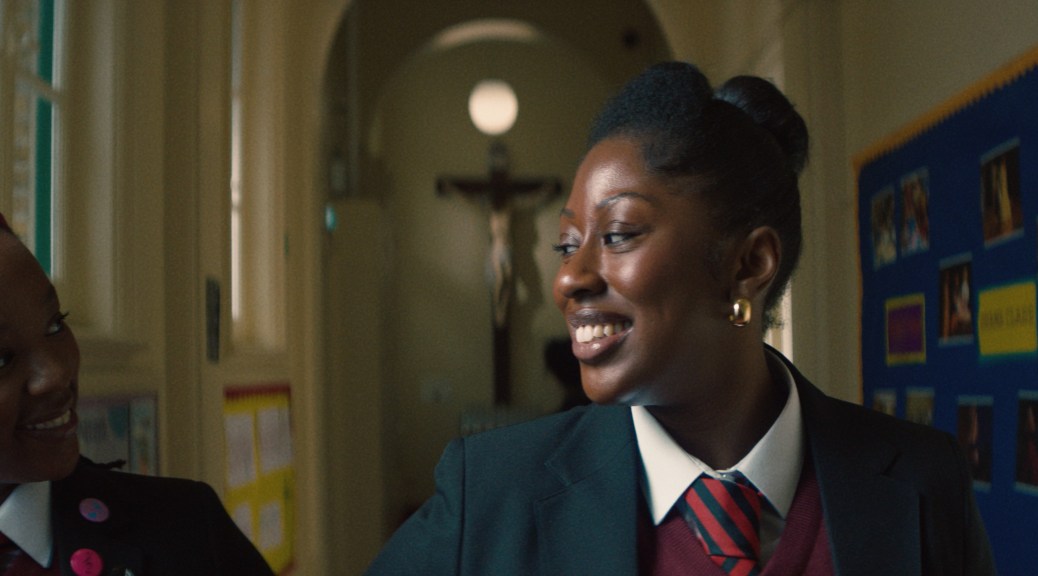
Finally, Essex Girls speaks to another universal experience of young adulthood. That is, finding the right social circle where you truly belong. Yero Timi-Biu’s film follows Bisola, a young Black girl who finds solidarity with another group of Black friends from a different school, since she is the only Black girl in her grade currently. Think of it as a live-action British version of Inside Out 2, where raging hormones and any number of intangibles lead to questioning loyalty between long-standing friends and the new, cool kids. Timi-Biu gives the film a real sense of care from the film’s opening, even when it veers into predictable character and story beats.
The Coming of Age block will screen at Indy Shorts Film Festival on July 28 at 2:45pm at the Living Room Theaters and in Indianapolis, and virtually through July 28.Buy tickets here.
Be Right Back follows a seven-year-old girl left alone in her home. When someone knocks on her door, she struggles to believe it is her mother or something sinister. Through excellent production design and cinematography, this film successfully captures what it is like for a child to be left alone and the horrors of what may proceed. The lack of editing during the scenes of tension brought a sense of uneasiness, which paralleled how the protagonist was feeling. The long, narrow hallways provide a feeling of discomfort and claustrophobia, which enhances the mood of the scenario. Despite the ten-minute runtime, the filmmakers bring the stakes to the tier of a feature-length film.
What brings this movie down for me is the ending. While I enjoyed the final moments as a twist, I feel the narrative would’ve improved if it stuck to a child’s nightmare rather than the more sinister approach. Nonetheless, there is real promise from Lucas Paulino and Gabe Ibáñez as they have already mastered the craft of suspense through slow but impactful tension-building.
La Croix sees Jade, a young graphic designer, encounter strange phenomena after practicing a ritual with her friend. While I loved the presentation and imagery-centered scares, this needed to be feature-length to complete the story. Joris Fleurot developed a practical world of ghostly happenings that needed more time to become effective. The first half of the film feels more like the audience is playing catch-up rather than building something of emotional merit. The second half is where the film goes all in on the scares. Through integral sound design and ominous lighting, Fleurot shows true talent in portraying ghostly horror, which I would put on par with most Hollywood filmmakers of today.
Even though I found many aspects to be rushed and underdeveloped, I found the experience as a whole to be worthwhile due to Fleurot’s vision. If this premise became a feature-length film, I would be sure to check it out.
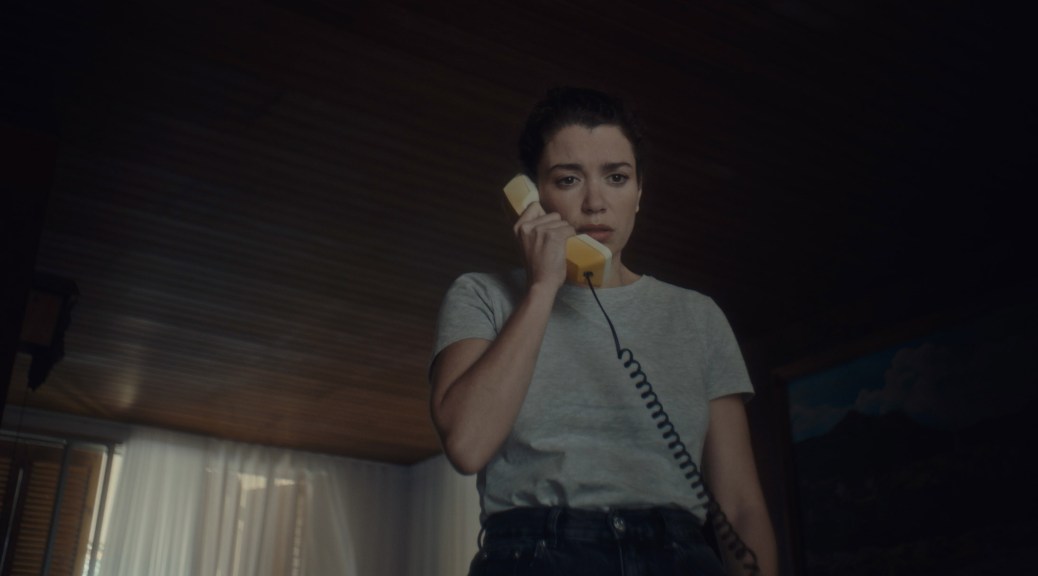
Dark Mommy follows a 911 operator whose average night on the job turns sinister after a group of prank calls turn deadly. I loved how this film utilized body horror. Through articulate sound design and committed physical performances, the film created an uncomfortability that I was not expecting when the movie began. The repetitious nature of the script makes it easy to believe that the protagonist has worked this job for years while building tension for the latter half of the film. The child’s voice performance is just as impactful as the work done physically by the rest of the cast, conveying the emotion needed to build the scares.
The acting in the first few minutes is one of the major setbacks of Dark Mommy. The co-workers bring an unclear tone to the film through their diction and facial expressions, feeling haphazard compared to the level on which the rest of the cast is operating. The final reveal isn’t anything spectacular, mainly staying to genre conventions rather than doing something more powerful. While it isn’t the most powerful or horrific watch, it is worthy of a short film length due to the technical elements and some standout performances.
Nubes sees a daughter who discovers a dark secret in her father’s house, leading her to choose between right and wrong. Watching this film was an empty experience for me. Even though I was taken aback by the beginning reveal, I found the rest of the film to lack the heart and sense of urgency needed for a genre film like this. The film attempts to tackle ideas of familial trauma, but there isn’t enough development to make the experience worthwhile. The orchestral score and colorless production design help convey the mood of the environment, but the story didn’t deliver the thrills or thematic concepts necessary to be called fulfilling.
While I didn’t find many overall takeaways, I did appreciate the style that Edu Escudero utilized to tell the story. Most of the horror is viewed through the atmosphere, and I found it to perfectly complement the bleak and dreadful tone. Even though I wasn’t attracted to the story, I enjoyed it as an exercise in horror filmmaking.
The Horror block will screen at Indy Shorts Film Festival on July 25 at 7:45 at the Living Room Theaters and in Indianapolis, and virtually through July 28.Buy tickets here.
The Indiana Spotlight block offers almost 20 short films, providing a potent mix of narrative and documentary short films which showcase Indiana’s unique personality, and the talents of Indiana filmmakers. Though Saving Superman concerns an autistic man from Glen Ellyn, Illinois, its directors, Samuel-Ali Mirpoorian and Adam Oppenheim, are Hoosiers. Mirpoorian has tackled similar subject matter in films like Safe Place and Greener Pastures; namely, the deeply human stories which often fall between the cracks of the small towns that make up this country. The film serves as a character study of Jonathan, an autistic man who idolizes Superman, even going so far as to dress up and march in the Glen Ellyn Fourth of July parade every year. Oppenheim and Mirpoorian arrive at a place of genuine emotion, but if anything is missing from Saving Superman, it’s more time.
Just as individuals make up a community, individual neighborhoods have the ability to exude their own personalities, and that’s exactly that ¡HAWTHORNE! an indy west side story is all about. Josh Chitwood’s film explores the Indianapolis west side community of Hawthorne by digging in to its past, present, and future. The neighborhood has dealt with all manner of socio-economic issues over the years, from a brush with the Klan to its current status as a melting pot of ethnicities and backgrounds. Since I’m also making a documentary about a specific Indianapolis west side neighborhood, ¡HAWTHORNE! shows that there’s no shortage of varied stories to be found, even within a few square miles of each other.
Just a few square miles from where Daniel screens, you can find the subject and the venue showcased in Alex Rodgers’ documentary. For better and worse, the film feels first and foremost like a project amongst friends, as it tells the quirky story of Daniel Jacobsen, one of the founders of the Kan Kan Cinema in Indianapolis. Though the film could easily be expanded more to dive into all of the nooks and crannies of Daniel’s life, Daniel remains a fun look at creative passion and how it can be manifested to better the community.
Just like Daniel, The Invisible Crown approaches an inside look at an Indiana creator. In this case, Hannah Lindgren (who also co-produces the film) takes us inside her struggle with endometriosis, and the struggles which women often face in medical diagnoses. Lindgren holds nothing back, displaying all her vulnerabilities as she approaches a fourth surgery to get a handle on her disease, and the results are emotionally rewarding.
One of the block’s few narrative films, Places We Knew, actually doesn’t even take place in this country, much less this state. Writer and director Oliver William Staton shows that you really can’t go home again, even when your home is halfway across the world. It’s the semi-familiar story of a Japanese-American young adult returning to his boyhood home in rural Japan as he tries to reconcile with his mother. Though the set-up is well worn territory, Staton lets the drama play out naturally, which is especially rewarding in a genre where emotions are frequently heightened.
Speaking of unique films, Kurtis Bowersock’s Physical Matters is one of the festival’s most unique offerings, in both style and substance. The film’s threadbare story follows a pair of marine biologists as they dissect a beached whale. Animated with a kind of watercolor aesthetic, Physical Matters is short, sweet, and to the point, but there’s an intangible heart that bleeds through after the credits roll. Indie animation is rare on this scale, and Bowersock makes it look easy.
The Indiana Spotlight blocks will screen at Indy Shorts Film Festival on July 23 at 7 and 7:30pm at the Living Room Theaters and in Indianapolis, and virtually through July 28.Buy tickets here.
Seven episode season, seven episodes watched for review
Grade: C
If you came to Lady in the Lake just to see some exquisite 1960s era production design and Natalie Portman chewing scenery, you’ll be in for a treat. If you came to find a fresh, new angle on race relations, anti-semitism, sexism, et cetera in the volatile city of Baltimore, you should probably just watch The Wire instead. There’s genuine emotion, intriguing stories, and filmmaking choices to be found within the AppleTV+ limited series, but the streamer already has plenty more captivating offerings that should be watched first.
Starring: KiKi Layne, Thomas Doherty, Melanie Nicholls-King
Grade: B
If nothing else, writer and director Nicole Riegel’s film Dandelion serves as another reminder that musicals don’t have to be lavish, extravagant productions in order to hook an audience. Really, all you need is some catchy songs, some well-written characters, and an engaging situation to put them in. Riegel has most of those components, even if none are the most special in the genre, but the film still manages to be a worthwhile experience because of Riegel’s attention to detail.




 The Movie State