

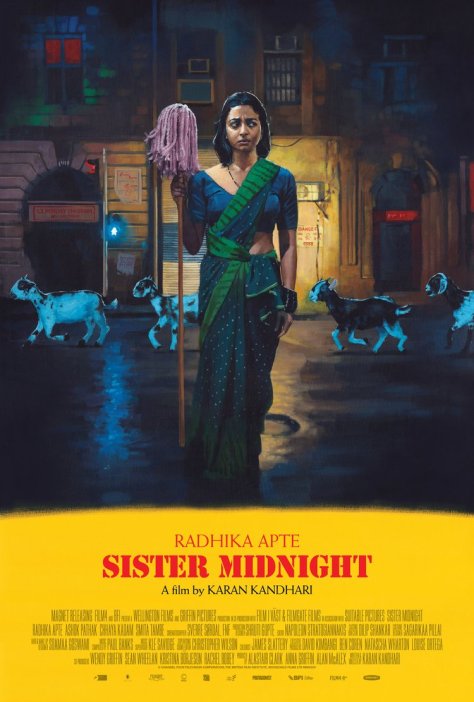
Sister Midnight
- Director: Karan Kandhari
- Writer: Karan Kandhari
- Starring: Radhika Apte, Ashok Pathak, Chhaya Kadam, Smita Tambe, Navya Sawant
Grade: B+
As soon as Howlin’ Wolf’s “Moanin’ at Midnight” starts to play over the opening credits of Sister Midnight, it’s clear we’re in for a wild ride. It’s a strange juxtaposition, with a janglin’ blues song that would be more at home in a deep-fried Southern noir, and not a surrealist comedy about life on the fringes in Bombay, India. But somehow it works, and Karan Kandhari’s film continues to ride this tricky tightrope for its remaining 107 minutes.
“Moanin’ at Midnight” is only the first of several asynchronous needle-drops which feature both Eastern and Western music to be found in Sister Midnight, and it adds to the feeling that nobody within the film really belongs where they’re at. This mostly applies to the film’s hero, Uma (Radhika Apte), a newlywed with no sense of purpose in her young life. She’s recently married Gopal (Ashok Pathak), a loveable doofus who’d rather spend his nights after work drinking himself blind than share what little space there is in their comically tiny apartment.

I generally despise giving characterization to an inanimate object in films, but Kandhari mines a great deal of humor out of Uma and Gopal’s living quarters. It’s an inescapable space on the fringes of the city where Uma can only dream of the outside world. Nevertheless, she befriends Sheetal (Chhaya Kadam), her middle-aged neighbor where they commiserate over their unfortunate lots in life, and she gets cooking tips. Uma is so helpless at being a housewife that she needs pointers to cook rice and cut vegetables properly. Most films would overplay the mismatch of Uma and Gopal, but Kandhari knows they’re both fairly flawed but likable people who know they’re victims of circumstance. Gopal tries hard to please his wife, but something inevitably goes wrong in the process.
One day, after trying to escape by literally taking the train to the end of the line, Uma gets an overnight job as a cleaner at an office. There’s times where Sister Midnight feels like a bizarro-world companion piece to Payal Kapadia’s All We Imagine as Light (coincidentally, both films premiered at last year’s Cannes Film Festival), as Kandhari uses the film to comment on female friendship, loneliness, and purpose within modern India. Even Sverre Sørdal’s naturalistic cinematography gives the film a similar visual style at times. Uma settles into a routine with her work – she even befriends a gang of trans sex workers near the office – but then she becomes ill, as if her body is rejecting the routine.

It’s here where Sister Midnight ventures into the surreal, and where Apte’s performance really shines. Kandhari throws a number of varying tonal shifts at the wall, and they mostly stick because of Apte and her understanding of the film’s physical humor and social commentary. Not everything within Kandhari’s script lands with the intended effect, including a relatively slow stretch in the second half and some purposefully student-grade CGI effects, but the film’s high points make up for these lower moments. Thankfully, Sister Midnight never loses sight of its thesis of marriage and all its insufferable, but sometimes worthwhile, aspects.
It’s easy to compare Kandhari’s style to Wes Anderson’s deadpan humor and quick-cut editing, but this is a film that rides its own wavelength. And much like Wes Anderson’s films, Sister Midnight likely won’t resonate with everyone because of its wildly shifting tones. Sure, most of the second half of the film may not take place on a recognizable planet earth, so to speak, but it’s the emotions that matter most, and Kandhari and Apte make them count. Those that can get on that wavelength will find a great discovery of talent, and one of the best films of the year so far.
Sister Midnight will play in theaters nationwide beginning May 23.
- None
 The Movie State
3 thoughts on “Sister Midnight Review”