
Frankenstein
- Director: Guillermo del Toro
- Writer: Guillermo del Toro
- Starring: Oscar Isaac, Jacob Elordi, Christoph Waltz, Mia Goth, Felix Kammerer, Charles Dance
Grade: B-
Netflix has multiple auteur-driven films set to release throughout the rest of the year. From Noah Baumbach’s Jay Kelly to Kathryn Bigelow’s A House of Dynamite and even the Sundance breakout Train Dreams, the streaming studio has numerous films gunning for Oscar nominations. Arguably the biggest contender is Guillermo del Toro’s Frankenstein, a $120 million spectacle that adapts one of the most foundational horror novels of all time.
Frankenstein follows Victor Frankenstein (Oscar Isaac), a brilliant scientist in pursuit of greatness. Failing to receive the proper love and care for his family, mainly due to the early demise of his mother, he becomes obsessed with bringing a dead creature to life, seeing it as his one purpose in life. Finding success after years of work, Victor’s life begins to fall apart as the Creature’s (Jacob Elordi) intelligence begins to overpower him.

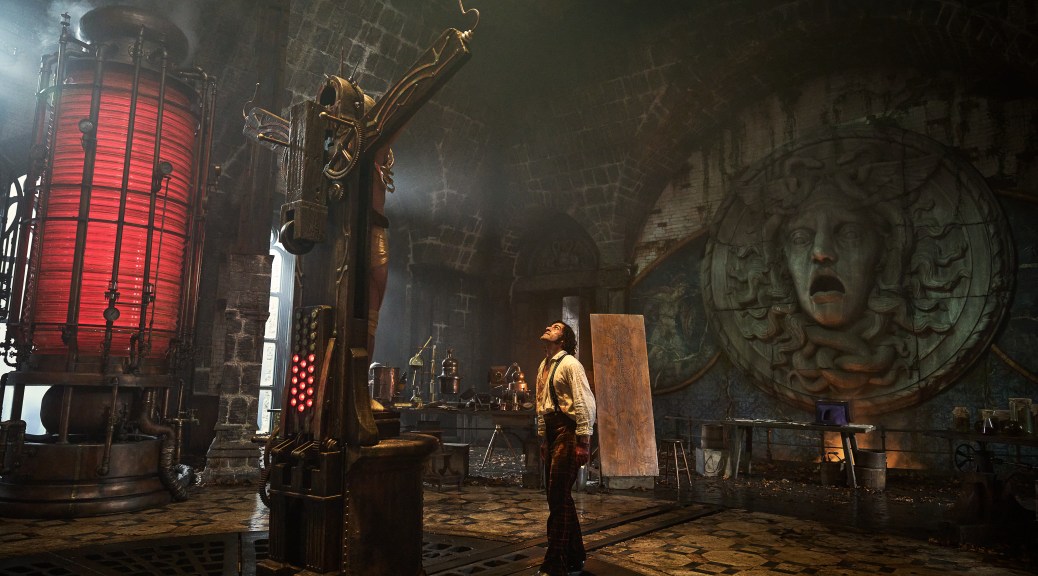
There have been numerous Frankenstein adaptations in the past, reaching back to the 1931 version by James Whale; none have captured it on as large a scale as del Toro’s. Dan Laustsen’s wide-angle cinematography perfectly captures the ambition and insanity of Victor’s experiment, with numerous striking compositions that seamlessly convey elements of horror and spectacle. The production design contributes just as much to the scale as the cinematography, with the mammoth castle and expansive city sets portraying the gothic tone while fully realizing the fantasy world. When it comes to set design and technical elements, no one is perfecting it like Guillermo del Toro’s team.
The color red has often represented themes of attraction and evil in film, and that continues in Frankenstein. Red consumes Victor in every way, disclosing how he is so wrapped up in his creation that it drives him mad. His red bed represents how his dreams have infatuated him, pushing him to believe that his creation will drive him to success. Victor’s gloves are also red, symbolizing the deadly consequences his work will have for himself. Although most of del Toro’s work has used color in a nuanced way, the attention to detail in Frankenstein ranks easily among his best.

The design of Victor’s creation is quite fascinating. The Creature is covered in scars, and while other adaptations viewed them purely for aesthetic purposes, del Toro’s use of scars conveys an inherent sadness for the character. Frankenstein’s monster not only represents Victor’s broken state but also themes of generational trauma, as his father/creator rejects the monster, and the makeup does an excellent job of conveying that. The monster’s paleness strikingly resembles the design of Prometheus, tying back to the book’s original subtitle, The Modern Prometheus, in a highly satisfying manner.
Oscar Isaac is great as Victor Frankenstein, portraying the overtly insane scientist through shaky mannerisms and an absurd voice, but Jacob Elordi efficiently delivers the strongest performance as Frankenstein’s monster. Lacking dialogue for much of the film, Elordi conveys strong empathy through his quiet facial expressions. Although he is covered in makeup, his eye acting and constant attentiveness in his scenes convey empathy unlike any other character in the film. Elordi’s physical size also makes a massive impact on the film, using his tall body to create a formidable presence in every scene. Although Andrew Garfield, who was originally set to play Frankenstein’s monster, would’ve done a commendable job, Elordi’s physicality and youthful nature made the character far more compelling.

While Frankenstein has numerous Oscar-worthy aspects in the technical department, the script lets the movie down in more ways than one. For the first time since Hellboy II: The Golden Army, del Toro is the sole credited screenwriter. Attempting to tell the entire Frankenstein story, the film is extremely overstuffed, particularly in the first half. The film takes far too long to get to the birth of Frankenstein’s monster, spending too much time on Victor’s experiment when the real heart of the film is the Creature learning about the world and its darkness. Victor is a compelling character on paper, but not convincing enough to devote the entire first hour to.
Mia Goth’s Elizabeth, the soon-to-be sister in-law of Victor, plays an engaging role in the Creature’s understanding of the world, but her character has a weird presence in the film overall. At first introduced as a piece of romantic tension between Victor and his brother, William (Felix Kammerer), the arc is entirely ignored in favor of the Creature’s development. The film then uses her to tease a potential Bride of Frankenstein adaptation, which goes absolutely nowhere by the time the film concludes. Although her inclusion in the film is reasonable, del Toro’s writing failed to realize her character’s potential fully.

Frankenstein also lacks an emotional payoff. While the film dives into themes of forgiveness and regret that are easy to relate to by the end, its execution falls flat. Victor is an unlikable character for most of the runtime, making for a difficult protagonist to root for. The film attempts to redeem Victor by the end, but because he was such a despicable person for most of the movie, it wasn’t easy to connect with his character’s conclusion. Elordi and Isaac have massive moments in the film meant to spark emotion, but because there was so little attachment to Victor, they feel underwhelming.
Overstuffed and lacking emotion in some areas, Frankenstein still finds success through its dazzling spectacle and a career-best performance from Jacob Elordi. Del Toro proves once again to be one of the strongest directors working today through his phenomenal production, even if his writing isn’t as strong as his other projects.
Frankenstein will be in theaters nationwide on October 24, and Netflix will release the film for streaming on November 7.
- Frankenstein is highly likely to be nominated and win Best Production Design, Costume Design, and Make-up/Hair Styling. Because of its massive spectacle, it could also be considered in other technical categories, such as Best Sound, Best Cinematography, and Best Visual Effects. If audiences respond well to the film when it releases on Netflix and it becomes the studio’s number one campaign push, it could land nominations for Best Picture, Best Adapted Screenplay, and Best Supporting Actor for Jacob Elordi. If Netflix doesn’t prioritize this movie over its other contenders, then it will likely only receive nominations in the technical categories.
 The Movie State
4 thoughts on “Frankenstein Review”