
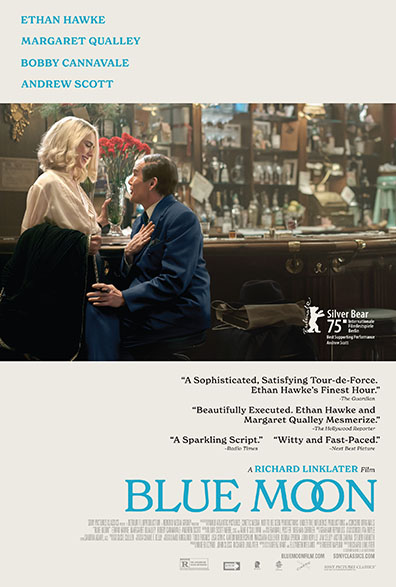
Blue Moon
- Director: Richard Linklater
- Writer: Robert Kaplow
- Starring: Ethan Hawke, Andrew Scott, Bobby Cannavale, Margaret Qualley, Jonah Lees, Simon Delaney
Grade: B
Richard Linklater’s long and illustrious career has taken him across genres, decades, countries, and styles to make one of the most varied filmographies since his rise on the indie scene in the 1990s. For his latest, Blue Moon – the first of his two films to be released in 2025 – Linklater reunites with his most constant collaborator, Ethan Hawke, to produce a new spin on the biopic. I had written in my review of Linklater’s last film that he’s always been interested in exploring the private persona versus public, and while this certainly applies here, he’s perhaps just as fascinated with the passage of time and how it can distort those same perceptions.
Time plays a pivotal role in Linklater’s Before trilogy, and how it affects the growth of a relationship. Time was essentially its own character in Boyhood, as the film was shot in bits and pieces over the course of 12 years. In Blue Moon, time stands still, with the film occurring over the course of a single night in a single location. The date is March 31, 1943 – opening night of the Broadway show Oklahoma! – and the location is Sardi’s bar in New York, where Lorenz Hart (Hawke) has gone to drown his sorrows.
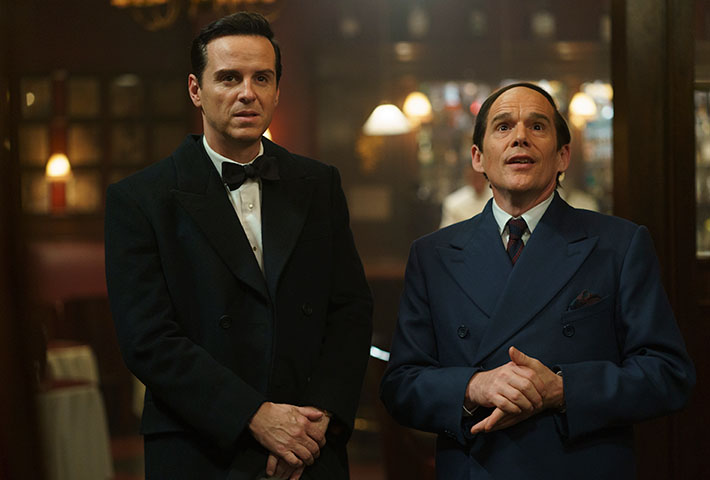
First-time screenwriter Robert Kaplow (who wrote the novel Me and Orson Welles, which Linklater adapted in 2008) somehow manages to confine the entire 100 minutes of the film to one location and still keep it propulsive with an evolving story. Hart arrives at the bar, distraught that his former writing partner Richard Rodgers (Andrew Scott) has found new success and adoration without him. Though, as we learn early and often, Hart has a bit of a self-destructive streak, which is only exacerbated the more he drinks.
Despite his unlikeable nature, we never stop caring for Hart’s well-being thanks to Hawke’s charismatic performance. Here is a character whose mind never stops churning, and who never stops yearning for someone to care about him. He’s enjoyed great success throughout a long career, but he never stops wanting to create something more fulfilling that finds a deeper universal truth. It’s no coincidence that he shares his favorite line from Casablanca with Eddie (Bobby Cannavale) the bartender: “Nobody ever loved me that much.” Though he has no qualms about accepting himself for who he is, he desperately seeks validation and companionship from others.
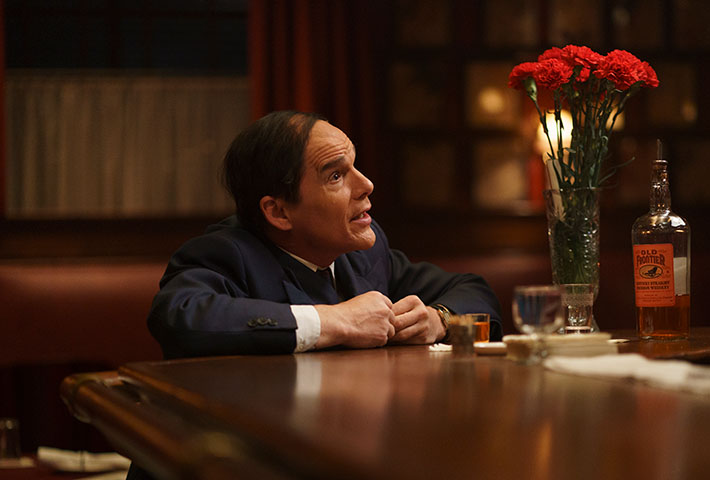
Perhaps befitting its subject matter, Blue Moon can never fully escape the “could’ve been a play” accusations. Characters come and go for extended periods, and they wax rhapsodic about their love of creating and creativity. But Linklater’s direction, and Hawke’s performance, justify the film’s existence in its current format. Lorenz Hart, bombastic as he could be, is too meek within the film to reach to the cheap seats in a Broadway theater. There’s a deep-seeded sadness to Hart that simply wouldn’t translate as well to the stage.
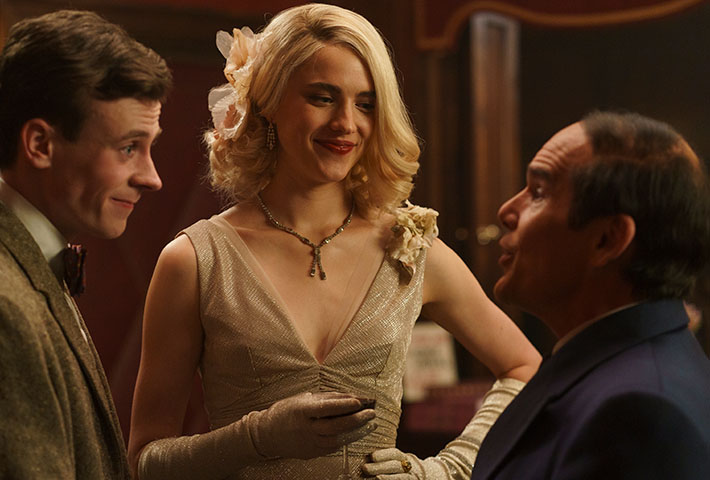
Part of that sadness comes from Hart’s yearning for Elizabeth (Margaret Qualley), a talented poet and Yale student whom Hart is unequivocally smitten with, in spite of their large age difference (he’s 47 and she’s 20). Hart is open enough with himself to know their romance would never work – never mind that he’s bisexual. But she sees through him in a way nobody else in Blue Moon does, and their scenes together are highlights of the film.
Perhaps the film would land harder if I was more familiar with the long lore of Broadway. Perhaps I’d like it more if I didn’t have a general distaste towards single location films. Thankfully Linklater and Kaplow make the film accessible enough to appeal to simpletons like myself, though I’m sure certain references went over my head. Though it ultimately doesn’t feel like a full departure within Linklater’s filmography, Blue Moon doesn’t carry the same heft, or the same re-watchability, as his best films.
Sony Pictures Classics will release Blue Moon in theaters nationwide on October 24.
- After a premiere at the Berlin Film Festival (a festival which rarely produces any Oscar buzz) in February, Blue Moon has gone on a surprisingly deep run thanks to distributor Sony Pictures Classics. Still, the film faces a bit of an uphill battle in finding eyeballs. It doesn’t help that Linklater is essentially competing against himself with his other film Nouvelle Vague with Netflix. Blue Moon‘s best chance for Oscar is in Best Original Screenplay, which is already stacked with virtual locks for nominations.
 The Movie State