


Train Dreams
- Director: Clint Bentley
- Writer: Clint Bentley, Greg Kwedar
- Starring: Joel Edgerton, Felicity Jones, William H. Macy, Kerry Condon, Clifton Collins Jr., Will Patton
Grade: A
In the entire history of the universe, since matter was first created, the time which humans have occupied on Earth has been microscopic. And the average life span of an average human fractures that already tiny number into an even smaller percentage. In other words, the modern world which you or I are seeing and experiencing is just a small bit of what’s come before and what will come after. This is, ostensibly, a review of Clint Bentley’s Train Dreams, the best film of the year, but because it’s a film that spoke to me on a deeper, more human level than any film in a long time, I feel it warrants a more philosophical and personal discussion.
Sure, the film has the requisite components like character, story, and technical wizardry. It is based on Denis Johnson’s novella of the same name, and adapted by Bentley and Greg Kwedar (the pair are regular collaborators and worked on last year’s similarly great Sing Sing). But when I left the theater and drove home, I wasn’t left just ruminating on the arcs of Robert Grainier (Joel Edgerton), his wife Gladys (Felicity Jones), or any of the other unique personalities he encounters. Rather, I walked out seeing everything, big and small, from a fresh perspective.

I thought about the changing trees in the autumn season, and how they’re not dissimilar to the ones which Robert fells as a logger in early 20th century Washington (after a brief prologue, Train Dreams mostly takes place after 1917). His occupation is logging, but he dreads having to leave because it separates him from seeing Gladys and their young daughter Katie grow older, because life is fleeting and precious, and we only get one chance to experience things for the first time. Indeed, Robert’s true calling is a caretaker, probably because he was abandoned as a boy and had nobody to take care of him himself. This isn’t explicitly stated, of course, but it’s deeply felt through Edgerton’s best performance of his already stellar career. It’s in the way he longs to hold his wife and daughter, the smiles and laughs that come when remembering the most passing memories. It’s in the way he achingly asks Gladys, when Katie’s a baby, if she already knows that he’s her dad.
During the film, I thought a lot about my mom and dad, especially once Robert meets Peeples (William H. Macy), a fellow logger with stories to tell, wisdom to share, and songs to sing. Macy isn’t around for much of Train Dreams, but his gentle presence is felt long after an accident robs him of his memory. My parents are fortunate enough to still be in good health, but I found myself thinking of their own stories of people they knew, places they’ve been, and dreams they once had. And the same for their parents, siblings, and friends, all mostly lost once they passed on. This may sound like my mind wandered throughout Train Dreams, but its meditative, leisurely pace easily allows for moments of reflection.
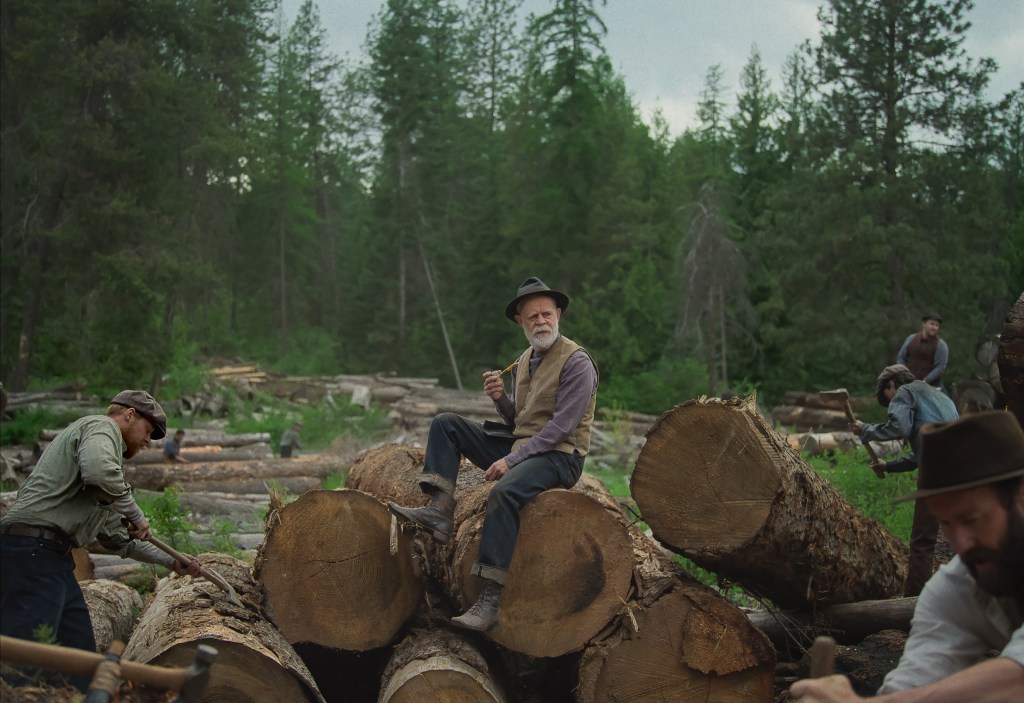
I thought about my regrets: friends I’ve lost touch with over the years, opportunities I’ve passed on, ways I could’ve improved the world around me. For Robert, this manifests when a Chinese man working on the Spokane railroad with him is killed simply because he’s Chinese (though there’s a tacit attempt to blame it on his stealing). Though Robert tries to stop it, he’s haunted throughout the rest of Train Dreams simply because he feels like he could’ve done more – or, thanks to an ingeniously ambiguous bit of staging, he feels like he actively contributed. He’ll only be haunted more, and filled with even deeper regrets, after a tragedy that occurs when he returns home from a job. But he finds some solace once he meets Claire (Kerry Condon), a fellow loner also reeling from grief, who’s accepted a post for the newly formed National Forest Service. She helps him to see that though their time on this planet is short, it’s no less meaningless. Even dead things serve a purpose.
I thought about the Earth, and the ways we’ve changed it for better, but mostly for worse. Should I recycle more? Should I eat less meat? Should I speak up more for local and global environmental protections? (The answer to all is, obviously, yes.) Train Dreams isn’t necessarily an environmentalism fable, nor does it feel like a glorified PSA, but Bentley makes every fallen tree feel impactful and important. Yes, every cleared tree allows for the creation of railroads, which connect people and places, and the wood can be used as tools to build and create, but those same railroads cause death and destruction.
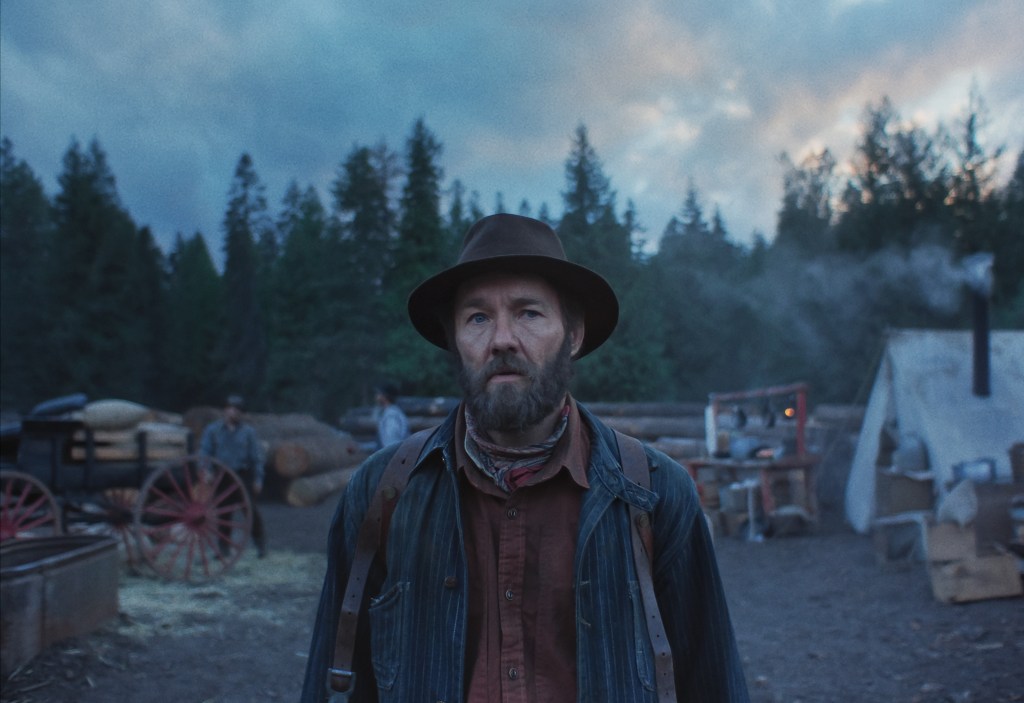
Since leaving the theater, I’ve thought about American progress, or lack thereof. There’s an easy read on Train Dreams as a meditation on the American Dream, where any man can make his own destiny if he works hard enough and believes. Gladys tries to convince Robert to expand on their idyllic property (which they bring into life together with their own hands) and build a saw mill. But that requires money, which requires him to be away. The film’s climax brings Robert’s unique experience in a changing world full circle. Life is easier for everyone, with technological and cultural advancements beyond his wildest beliefs in his younger days, but it almost makes him feel more alone. I thought about the similar ways in which the world has progressed and regressed since I was born in 1987. Would I go back, if I had the chance? Would anyone?
I don’t suppose that most people will have the same profound experience with Train Dreams as I had. Unfortunately, they’ll have to settle for seeing it at home, on Netflix, where Adolpho Veloso’s luscious cinematography won’t be properly appreciated as it should in a theater. A film concerned with the impermanence of everything, and the infinitesimal nature of mankind, sounds like it should be a real downer, but Bentley’s film is one of quiet beauty, a life-affirming discussion-starter that’s lingered deep within me long after leaving that theater. I can only hope it will do the same for you.
Train Dreams was screened as a Special Presentation film at the Heartland International Film Festival. Netflix will release the film in theatres on November 7 before it’s available to stream on November 21.
- I’m doing my best not to get my hopes up with Train Dreams. Netflix has a fuller slate than past years with high-profile, auteur-driven films. Bentley’s film, so far, is the most highly acclaimed, but it’s not exactly a film tailored to the Academy’s radar. Sing Sing was slated as a potential Best Picture nominee last year, and while this year’s crop is less contentious, I don’t know how hard Netflix will campaign for the film. At best, I think its most likely chance is to repeat with Sing Sing and nab a Best Adapted Screenplay nomination.
- If the wind starts blowing and audiences and critics really respond to Train Dreams, Joel Edgerton might find himself as a Best Actor nominee. Some of the earlier presumed nominees have started to fall off lately, and the film’s late release strategy might help his chances.
 The Movie State
4 thoughts on “Train Dreams Review”