

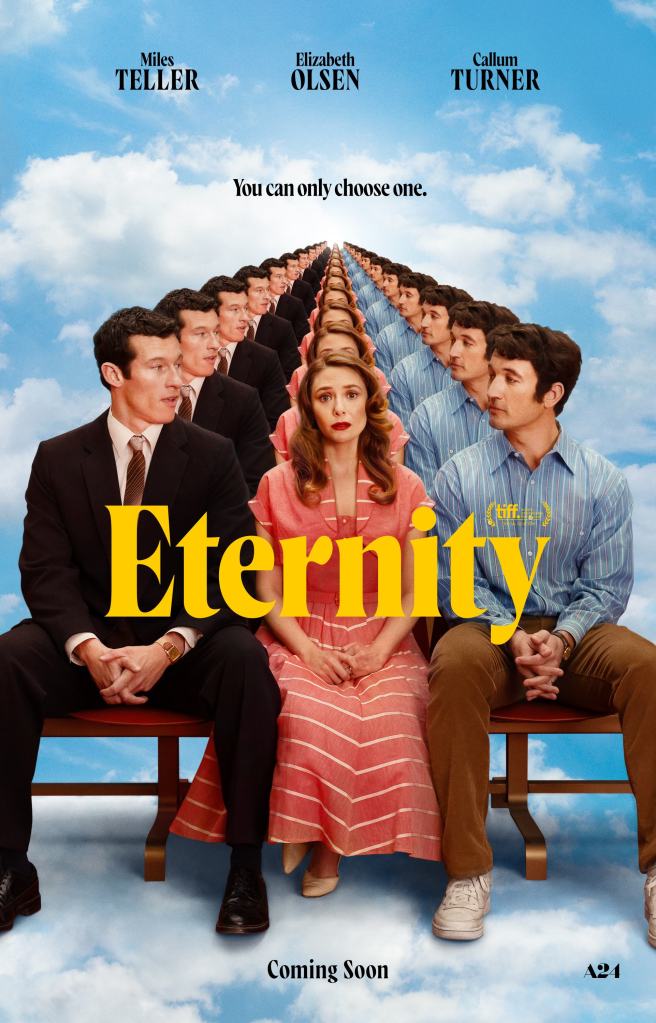
Eternity
- Director: David Freyne
- Writer: David Freyne, Pat Cunnane
- Starring: Elizabeth Olsen, Miles Teller, Callum Turner, Da’Vine Joy Randolph, John Early, Olga Merediz
Grade: B
In recent years, romance films have failed to receive theatrical releases. Unless it’s an adaptation of a Colleen Hoover novel like Regretting You or It Ends with Us, the film will more than likely be released straight to a streaming service. A24 is looking to change that this year, with the recent release of Materialists as well as the upcoming film Eternity, a romance story following a heated love triangle between Miles Teller, Callum Turner and Elizabeth Olsen.
The film follows Larry and Joan, played by Miles Teller and Elizabeth Olsen, a recently deceased couple who were married for 67 years. In the afterlife, their souls have one week to decide where they want to spend eternity, ranging from the cold mountain side to a warm beach. Initially struggling to choose what eternity to go to, things get worse once Joan runs into her first husband Luke (Callum Turner), who died during the Korean War. Joan discovers that Luke waited roughly 70 years for her arrival in the afterlife, and begins to struggle if she wants to spend eternity with her long-time husband, or her first love whom she never had a full life with.
The concept behind Eternity is ingenious. Not only does the afterlife setting bring for a wholly unique setting for a rom-com, but it allows the film to be creative in ways that most films in its genre are unable to. Because the film immediately puts the viewer in a world that is separate from theirs, it gives director David Freyne (who wrote the screenplay with Pat Cunnane) the ability to be as bizarre as possible. Most of its craziness comes from the different eternities that are offered, ranging from simple suburban life to something as wild as marxism homes. Moments where a commercial is played or a pamphlet is passed out about the different eternities easily made for some of the funniest moments in the film, expressing the film’s creative side as well as contributing to the characters’ tough decisions.

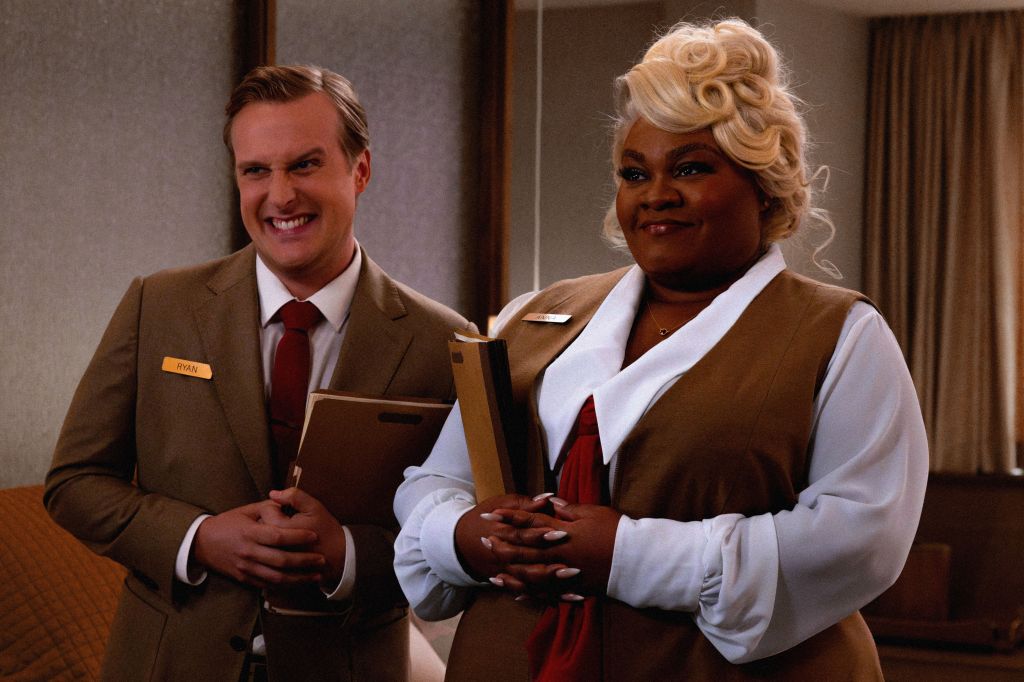
Films like Soul and Coco have had colorful and wondrous depictions of the afterlife, but Eternity goes in the opposite direction. While the production design has elements of dystopian wonder, the afterlife is structured like a real town. Littered with large apartment buildings and a train station that connect the souls from the different eternities, the film uses its production in a humorous manner to express how it’s not much different than the real world. The booths that advertise for the different eternities have a striking resemblance to a job fair, with the marketers for the eternities acting like salespeople, making for some of the standout scenes in the film. Although the film likely had a small budget, Freyne still finds ways to make the sets fun and lively.
Miles Teller, Elizabeth Olsen, and Callum Turner are some of the most popular actors in their age range, and they prove that they are more than worthy of their status in Eternity. Turner perfectly inherits the brave soldier persona driven by love in a surprisingly complex manner. Although the film constantly pokes fun at his physical and spiritual perfection, Turner adds a healthy amount of weight to the character that makes him more than just a pretty face. Olsen and Teller are given much more challenging roles compared to Turner, having to play characters with the minds of a 90 year old and the bodies of much younger people. This juxtaposition made for many hilarious moments, with Teller in particular nailing the grumpy old man caricature with the correct amount of charm. Olsen captures a woman who grew up in a different time with ease, but there were moments where it felt like her performance was too reminiscent of her work in WandaVision rather than it feeling like an original take on a character.
Love triangles are often a recipe for disaster in rom-coms, with there always being one relationship the audience is rooting for compared to the other. Surprisingly, Eternity justifies the positives of both men that Joan could end up with, making for a choice that is just as difficult for the audience to pick than it is for Joan. At face value, one would think it would be obvious for Joan to choose the person who she devoted her entire life to, but after some revelations and choices made in the beginning and middle portions, this choice turns out to be much more difficult, making for a refreshing take on the genre.
Who Joan ends up with could make or break the film, and while the ending makes sense in regards to the character’s happiness, it did come across a little too conventional. For a film having such a unique and subversive take on the genre, seeing the film end in such an obvious manner takes away the spark that the rest of the film is operating on. What’s made even worse is that the film has an emotionally grueling sequence before the third act regarding Joan’s decision that perfectly matches the unconventional nature of the film, but is eventually disregarded for a more tidy and traditional finale. Although the ending makes sense in terms of the characters’ happiness, it wasn’t nearly as emotional or surprising as the rest of the film.
Despite its basic third act, Eternity delivers on its high concept with a comedic, yet endearing look at life and love beyond life itself. With excellent performances from the ensemble and multiple emotionally charged sequences, this broadly appealing genre bender hits all the right beats. Even if Joan’s choice doesn’t appeal to everyone, there is enough else happening that will keep audiences entertained.
Eternity will be in theaters nationwide on November 26.
- None
 The Movie State