Below is my conversation with Lauren Z. Ray, the director of Winter Fantasy, a documentary about the small town of Logansport, Indiana, and the theater program that forms a kind of backbone throughout the community for its young artists. The film is making its World Premiere at the Heartland Film Festival. We discuss her thought process behind inserting herself in the film, the universality of small-town theater programs, and life in the arts post-high school. Our conversation has been edited and condensed for clarity.
Ben Sears: Logansport is such a unique place, and the film really captures that nicely.
Lauren Z. Ray: That was part of the goal. I always wanted to showcase Winter Fantasy, but I wanted to make this film very Logansport and very Hoosier as well. I kind of had this bucket list of items that I wanted to include, whether it’s a quick B-roll shot or a scene, just to give that texture and vibe to everything. In Indiana, I always think they have fantastic sunsets, so I wanted to include that, or a bonfire, which were very special to me when I was growing up.
BS: Did you have a goal in mind when you first conceived of the film, besides featuring the program? Did the story change at all throughout production?
LR: Totally, the initial idea was a micro-doc, under 20 minutes. I just wanted to showcase what Winter Fantasy is, and that’s it. But I hadn’t really been back to my high school, or talked to anybody in 10 years. But upon arriving, as I started setting up interviews and going through all my old things, I didn’t even really think of myself at first, but I started getting nostalgic.
My first interview is with the manager of McHale, and after that interview, I wanted to just explore everything with high school and Winter Fantasy, so I went through everything in my bedroom. That’s when I realized how much of my story needed to be included in this story in order for it to make sense. From there, I also wanted to include the stories of people who went on to become professionals after going through Winter Fantasy. Every documentary I’ve done is like detective work, it’s journalism. You learn more about the story through the interviews you do; it became a lot longer in the process of all the interviews and learning everyone’s stories. I initially wanted it to be just about Winter Fantasy, but it ended up being about my acting career, Winter Fantasy, and all the decades of people who have done the show.
BS: It’s interesting that you never even considered inserting yourself into the story because it helps to ground the story through your eyes.
LR: That’s how it felt at the time. It became more of a first-person documentary, which I had never done before. That really challenged me because I didn’t know how I could make it happen. Normally I’m the one behind the camera, so I knew I’d have to allow someone else behind the camera and help them to understand my vision. I hadn’t seen too many first-person documentaries, so I watched a lot, and I had to learn how this style is done. It was definitely a big process.
BS: You stay focused on Logansport and this specific program, but do you see this program as a microcosm of similar small town arts programs? Do you think there are similar stories like this across the country?
LR: I think so, I think it’s totally relatable. I remember when I did my first documentary, which was about a small town in Indiana, and I thought ‘this town’s really quirky and unique.’ And then everyone who saw it had a relationship to a small town across America somewhere, and it was relatable to a lot of people, even if they weren’t from this particular town. I think with this one, it was the same thing. People had either gone through their own musical theater program, or someone they knew went on to become someone from their theater program. Any time I’ve explained to someone what I was working on, people say they relate to it and they tell me stories about their programs, or their experiences with it. People totally understand that theater kids and staff tend to be very quirky by design, so I definitely think it’s a relatable topic, even though it’s just about Logansport, Indiana.
BS: You also have, later in the film, the experiences from you and your friend in Chicago, and the struggles with finding work in the arts after high school. Was that another avenue that was unplanned as well?
LR: Yes, actually, I was hoping I could get a hold of Dannie Smith. She didn’t know who I was, but I knew who she was because I went to all of her Winter Fantasy shows. I was absolutely obsessed! [laughs] I had never met her before, and the conversation we had on her couch was so crazy because of how similarly our stories had aligned. I had no idea, when I had called her initially, that she had retired from acting; I thought she was still acting. To learn that it was for similar reasons to me was really interesting.
BS: A development like that could be seen as a kind of mood killer, but in Winter Fantasy, it’s kind of hopeful, and a celebration of theater, and what people can do when they work together.
LR: I think a lot of people can relate to that as well. I know a lot of people that pursued theater after high school but couldn’t find any success, so I hope they can find something relatable in that. I think, accidentally, I always try to make my stories a feel-good story of some type. Those are the types of stories that I prefer to see, myself.
BS: Have you shown the film to the Logansport community at large yet?
LR: I haven’t. I’m very excited to do that, though. In January of this year, literally a week after I had finished, I had the cast come and see the film. Heartland is taking place during the school’s fall break, so that didn’t work out for them to screen it. But on November 8th, I’m going back to Logansport again, and I’ll do a public screening at McHale auditorium. I’m very excited, and this year’s Winter Fantasy is the following weekend, so I’m hoping it’ll hype up the town to show up and support that show this year.
Winter Fantasy will have in-person screenings at the Heartland Film Festival in Indianapolis, and will be available to stream online throughout the festival.Buy tickets here.
Below is my conversation with Travis Wood, Alex Mallis, and Weston Auburn. Travis and Alex serve as the directors of The Travel Companion, and the two wrote the screenplay along with Weston. The film is an indie comedy making its Midwest Premiere at the Heartland Film Festival about a pair of long-time friends and the chaos that comes when a romantic interest enters their lives. We discuss how the duo began working together, the real-life parallels that inspired the story, and the logistics of filming in airports. Our conversation has been edited and condensed for clarity.
Ben Sears: Alex and Travis, you both did a short film together, but this is both of your first times directing a feature. How did you come together on this, and what was the process like co-directing a film? Was it any different than making a short film?
Alex Mallis: We came together when we were part of a filmmaking collective called Meerkat Media, and we started making shorts together, and I think we just have a similar mentality and desire to be improvisational. Ultimately, one thing that I was attracted to about Travis is he was down to just do it. With any artistic process, there’s always hurdles, either existential or self-made creative hurdles, and Travis had this energy about him and I really appreciated that. We both came from skateboarding and this DIY practice, and we were just hanging out at a film festival and he was telling me that he was potentially going to lose his flight benefits because his buddy, who works at an airline, got a new girlfriend. So that was the launching point for this project, and more generally, we were both at a place where we thought ‘let’s do this’. It really synced up, and pretty quickly, Travis introduced me to Wes, and it all came together pretty quickly.
Travis Wood: I think it all came pretty natural. We didn’t sit down at a table and say “here’s what co-directing looks like.’ We were both very invested to make this, and we both just had that same energy to get it done. It’s like a natural dance and we’re usually pretty aligned to think of what works.
BS: Travis, it sounds like one of the characters was kind of a proxy for you; did you write that character from your perspective, or did it require some input from both of you?
TW: I think the general framework was certainly inspired by my life, but when we got to writing it, we were all three just telling each other different stories about life experiences and jobs that we’ve had. I feel like we just made an amalgamation of our experiences and put those into each character. Simon’s (Tristan Turner) day job was inspired by Alex’s job of filming taxis, and then there’s Wes’s day job and dealing with bosses and an advertising environment.
Weston Auburn: I would also say that Travis is way more chill than Simon is. He has a much smoother way of operating than what Simon does.
BS: You filmed a few scenes in airports and on planes. Was it difficult, logistically speaking, to get access to those airports, or were there a lot of regulations to go around?
AM: You’d be surprised, our airport footage was broken up into two sections. The more locked-down, dialogue heavy scenes were filmed at the West Chester airport in upstate New York, and that was a negotiation with them, getting permits, and it was all pretty straightforward. But the more montage-y footage was all filmed at JFK in New York City. That was basically just me and the actor. I had a fully refundable ticket in order to get through security, a small camera, and a gimbal, and we started shooting some sneaky shots. By the end of the four hours we spent at the airport, we were running full speed through the terminal getting shots. Turns out that, once you’re through security, it’s kind of a utopia where you can do whatever you want. Nobody blinked an eye, security didn’t look at us, nobody seemed to care what we were doing. In the age of influencers and travel bloggers, I think they assumed that’s what we were doing.
The only person who approached us was another filmmaker. He ended up PA’ing for, like, two hours. [laughs] I was sprawled out on the ground, trying to balance the gimbal, and he came up to me and said ‘hey, can I help you?’ Pretty quickly, he was carrying batteries and extra bags and running interference. He was the only person who noticed us.
BS: Tell me a little about how you landed on casting Tristan and Anthony [Overbeck].
TW: I think Anthony was an early person we had in mind. He’s very much in the independent film scene like this. We reached out, he sent an awesome tape, and I think he was the first person we had locked down. Tristan was a pretty big search; we worked with an awesome casting director, Alan Scott Neal. The film was non-union, so that limits your pool, and you have to find a new path. With Tristan, it was like, this dude totally could be an experimental documentary filmmaker, he just had that look.
BS: They believably play friends who have known each other for most of their lives. Did their chemistry together come naturally?
AM: They briefly met during the casting process, but their acting styles just came together and it was very natural. I think Tristan’s background is a bit more by-the-book, and I think it all felt really natural from the first take. It wasn’t something we even had to navigate, it was almost instantaneous.
TW: We had a really fantastic AD, and she read the script and understood it so she was able to create a schedule that allowed us to create a level of intimacy that they needed to express. They were able to build up their relationship during the shooting process, so by the time we got to more heavy, intimate scenes, they were able to do that even better.
WA: We also should mention Naomi Asa, who crushed her scenes, and we were super fortunate to have found her. She’s a bit of an undiscovered talent who acts during her free time.
AM: She was fantastic. All of our actors, we were super fortunate to find because of our tiny budget. We were squeezing every ounce of juice out of the lemon, so to have everyone ready every day so that we didn’t have to exert any energy making sure they understood what was going on. I really respect them for that.
BS: To talk about the meat of the film, what do you think that the flights that Simon gets ultimately represent to him? Is it a way for him to hold onto his friendship with Bruce? Is it simply a way for him to get out and travel the world and escape his dead-end life? Does he actually see it as a way to get his project made, or is it something else?
AM: I think we discussed that a lot throughout the writing process, and shooting and editing. I think it’s all of those things. On the one hand, it’s a very practical, very incredible resource that anybody would love. Free flights, and making a travelogue, those go together extremely naturally, and to potentially lose that benefit would be devastating. And then at the same time, it’s representative of this untapped potential, like when something is still a possibility in your head, it can feel calming. The imperfections haven’t shown up, the shortcomings haven’t shown up, so I think for him the flights give him a creative purpose.
The flights are also a connection to his best friend, and he and Bruce (Overbeck) met a long time ago, and though their lives have started to diverge, the flights are like this glue that binds them. Simon maybe doesn’t see that explicitly, but he starts to wonder, if they don’t have these flights, then what are they to each other? It’s this central piece of their friendship, and when that starts to come into question, he feels frantic, even if he doesn’t quite understand what’s happening, he does understand on an emotional level that the careful balance of his life is being threatened.
TW: I think, even in real life, I didn’t realize until I was about to lose them how much of an actual thing they were to me. When you have a successful film, for example, it’s something to talk about in a conversation. But, especially in Simon’s case, it’s a crutch to lean back onto. If you can’t talk about the film, you can at least talk about that time you went to Tokyo.
BS: Travis, since this is based, at least partially, on your experience, was it difficult to write that character and uncover some uncomfortable truths about yourself?
TW: I’ve had this friend who works at the airline for 10 years, and I know him well enough to have both sides of the conversation. In real life, it was not a thing at all, so it was actually really fun to explore those conversations and take it to this extreme. Even early on, when he started dating someone, I wondered ‘does she like to travel? Maybe I should keep it’, so it was nice to have an outlet to process and see those things through like an alternate universe. It was a good coping mechanism, if nothing else.
BS: The film skewers the independent film world, but it never feels like it’s mean-spirited. Was it difficult to strike the right balance of parody without making it seem too cartoonish?
AM: One of our guiding principals while writing this was that it has to feel real and grounded. I think with comedy, that’s a decision you can choose to accept or ignore. For us, we wanted it to feel lived-in and real, so that informed the type of comedy that we tried to incorporate.
TW: I think it was a little easier to write, too, because we are all these independent filmmakers, chatting with other filmmakers, and going to screenings. A lot of that stuff is really present for all three of us; I don’t think we had to dig too deep to find those moments that are both true and funny.
The Travel Companion will have in-person screenings at the Heartland Film Festival in Indianapolis, and will be available to stream online throughout the festival.Buy tickets here.
Below is my conversation with Katie Dellamaggiore, the director of Small Town Universe, a documentary about a small town in West Virginia, where cell phones and wireless internet are forbidden. But beyond the quirky origins of the town, the film explores the people within it, and their reliance on the funding that makes the space telescope possible. The film is making its Indiana premiere at the Heartland Film Festival. We discuss her origins with the project, the state of science in America, and belief in extraterrestrials. Our conversation has been edited and condensed for clarity.
Ben Sears: With any documentary, I’m always curious about how you initially came across the subject matter. So what was it that got you interested in making Small Town Universe? Do you have a personal connection to the town?
Katie Dellamaggiore: Actually, I had no prior relationship to the topic. For better or worse, I didn’t get much of a science education when I was younger. My husband, who’s my filmmaking partner, he’s very much into science fiction, like Star Wars and Star Trek. So I didn’t have that background going into it, but I think that’s probably why I was somewhat attracted to the story. Because it’s fun to learn something as an adult, making a film about a subject that you didn’t get a chance to learn about when you were younger.
In 2015 or 2016, I had just finished a film called Brooklyn Castle, and we had just had 2 kids, and my mom had died that year as well. But one night, my husband and I were chatting, and I asked, ‘do you think there’s a town with no cell phones?’ It wasn’t really clear to me at the time, but I was addicted to my cell phone, and it was the ramp up to the election. I had two babies at home but wasn’t getting out of the house a lot, and I think I was missing my mom a lot and her phone calls. So I googled it, and that’s how Green Bank, West Virginia came up. I couldn’t believe it! As I got more excited about the topic, it just evolved into something more than that. At the beginning, I thought maybe there could be a story about the fact that there are no cell phones, but it became more interesting to tell a story from the point of view of how the science was connecting people in the town.
BS: One of the segments of the documentary is about the people who move there specifically because they have the Electromagnetic Hypersensitivity. Did they have any kinds of reservations around you filming with them? Did it take any convincing to get them to be part of this?
KD: It’s interesting, because when I did that initial google search, a lot of the videos were news pieces that tended to hyper-focus on them because it’s kind of sexy and gets clicks. Some of them were desperate, for good reason, to want to tell their stories. Sometimes, maybe they weren’t aware that people were taking advantage of them, but they were very open because they want to be heard and have their story told. So I’d say there wasn’t a lot of trepidation because they wanted to get the word out. That being said, it was really important for me to figure out how to tell this story without having it ever feel like some sort of “gotcha” piece. It’s not my job to figure out the science behind this.
Sue, the person we ended up filming with, we hit it off because we’re both from New York. There was just an instant connection, and she was really happy to share her story. There wasn’t a lot of trepidation, but I think I felt like it could easily go in a bad direction. They will tell you that there are members of the community who maybe shouldn’t be on camera. So I just chose not to film with them. But it made me really happy, and they’ve all seen the film, and they’re really happy with it because there’s not much worse than having the subjects not feel good about the end product. The film isn’t about specifically their issue, so I’m happy for them to use it as much as they want. But Small Town Universe isn’t out there trying to convince people that cell phones are bad.
BS: Were there any technical limitations that made it difficult to shoot with them?
KD: The whole town, actually. For the majority of the time, we weren’t allowed to use wireless microphones. It wasn’t just Sue, but it was part of the rules that existed in Green Bank. Whenever we were filming in and around the telescope, we had to use a boom microphone. Not just a boom mic, but it had to be plugged into the back of the camera. So we had to make really small movements and couldn’t get far away from the action. It kind of challenged the way that we captured things. We were always really close to everything that was going on.
Looking back, we have some B-roll of wide shots, but the action was never happening in a wide shot. We always had to be right next to people, so that added some intimacy, but it was really because we had no choice. If we were really far away from the subject, we wouldn’t be capturing sound and I’d have no idea what was going on.
BS: When you first started filming, did you have a set idea of who you were going to follow, or did that change as you got more oriented into the town?
KD: My first trip to Green Bank, I went by myself as a research trip. I met George on my first trip, and then I met the folks who worked at the telescope and a woman named Karen early on. There were a few people I wanted to film with, and it didn’t pan out. Within a year of going down there, I met Ellie and her family, and Sue.
BS: One of the recurring questions that comes up throughout Small Town Universe is whether anybody believes in extraterrestrials, or life on other planets. Did you believe in that before shooting the film, and did that change all once you were done?
KD: I didn’t really think about it much before I started working on this. If you had asked me, I’d probably say ‘yea, I hope so!’ But like I said, I wasn’t the person who devoured a lot of content about it. My husband watches stuff like Ancient Aliens [laughs], but that wasn’t me. Now, I think, how can you believe that there’s not? Or at least scientifically speaking, when you understand the science behind it, there’s nothing kooky about it at all. I’m all-in about the Dirac equation now, and I just think that, as a species, there’s nothing better than continuing to challenge what we think and what we know. That’s what science is, and the science of extraterrestrial life is, like, a constant search for something that we don’t know the answer to. I think that just makes us better human beings, to not stop asking.
BS: Part of the backbone of the film is how the American government treats science as a priority. Did making this film change how you view our prioritization of science and exploration?
KD: It doesn’t appear that it’s a priority right now. I’m not an expert on this, but I think we tend to prioritize things that make money. Basic scientific research often doesn’t make money, so what’s wonderful about this telescope is that they have this program called Open Skies, where anybody who has an idea can apply for time on the telescope. So when federal funding gets taken away from something like this, that’s the thing that goes away first. For this facility to remain open now, from the National Science Foundation and Breakthrough Listen, it’s great, but it’s not a big government priority. Any kind of space exploration today is being funded by billionaires, for better or worse.
Small Town Universe will have in-person screenings at the Heartland Film Festival in Indianapolis, and will be available to stream online throughout the festival.Buy tickets here.
Filmmakers have tackled the coming of age genre through countless ways and methods over the years, which makes the Coming of Age block at Indy Shorts one of the more enticing options available. Caught on Tape, written and directed by Chris Alan Evans and Alexander Jeffery, plays into the inherent awkwardness faced by teenage boys in the VHS era. When Finn first learns about the glories of pornography, he hatches a scheme to find his father’s collection. There’s a number of laughs and genuine truths to be found, in a film all about staying true to yourself during a time when everyone seems to tell you how the world works.
Ebb & Flow, written and directed by Nay Tabbara, takes a decidedly more dramatic and feminine approach, setting one young girl’s desires against the turmoil in Beirut. The threat of violence, referenced frequently throughout the film, works nicely as a metaphor as kids are forced to grow up more quickly than they should be. Of course, Loulwa and her friend are more concerned with sneaking away to meet up with a few boys on the beach, as she pines for her first kiss. Even if you don’t live in a warzone, there’s something universal about the film, where something like a teenage crush can feel like the end of the world at times.
Another non-English entry brimming with heart, Tomorrow, looks at the bonds of brothers as they come to terms with their differences. One younger brother prepares to go to school while his older brother, who has Down Syndrome, is left behind. The film is sparse in its plot, but it’s full of touching details that feel genuine, and the young performers are simply lovely, as if director Estefania Ortiz simply observed the actors in their natural habitats.
Easily the most comedic of the block is We Met at Camp, from MCPlaschke, about a group of friends as they obsess over their various summer camp crushes. Plaschke infuses the film with plenty of delightful period details (it takes place in 2004) that feel inherently specific, but with a genuinely queer sensibility. Even if you haven’t had a summer camp crush, there’s something relatable for everyone in the film if you’ve ever had an unattainable crush at a young age. Silly, smart, and heart-warming, We Met at Camp is a gem of the festival.
Finally, Essex Girls speaks to another universal experience of young adulthood. That is, finding the right social circle where you truly belong. Yero Timi-Biu’s film follows Bisola, a young Black girl who finds solidarity with another group of Black friends from a different school, since she is the only Black girl in her grade currently. Think of it as a live-action British version of Inside Out 2, where raging hormones and any number of intangibles lead to questioning loyalty between long-standing friends and the new, cool kids. Timi-Biu gives the film a real sense of care from the film’s opening, even when it veers into predictable character and story beats.
The Coming of Age block will screen at Indy Shorts Film Festival on July 28 at 2:45pm at the Living Room Theaters and in Indianapolis, and virtually through July 28.Buy tickets here.
Below is my conversation with Alex Rodgers, the first-time director and writer of Last Days of Summer, a drama shot in and around Indianapolis. We discuss the state of the film industry in Indiana, the inspirations for the film, and learning experiences from making his first film. Our conversation has been edited and condensed for clarity.
Ben Sears: You’re an Indiana native and you’ve been working in and around the film scene for many years. How do you feel about the state of Hoosier filmmaking today?
Alex Rodgers: I would love to highlight the work that my colleagues Kurtis Bowersock, Zac Cooper, Victoria Britton, Zachariah Haske, and Matt McMahon are doing with A Few Friends. What they do is really cool for the narrative space. Zac’s feature It Happened One Weekend was a real inspiration point for our film. I think it really showed what the community can do when it comes together and works within the constraints of a small budget. Our biggest resources and strengths are our collaborations with each other and I think Indy is really good about showing up for its own.
There’s also a lot of really interesting work being done in the documentary space by people like Will Wertz, Kolton Dallas, Hannah and Myers Lindgren. Seeing their work really inspired me to dip my toes into the short doc space going forward. A few other people whose work I admire are Jake Huber who continually raises the bar for music videos and spec pieces in the city. Matt Spear’s short film Love, Grandma was one of the most beautifully shot things I’ve seen come out of Indy and just an incredibly impressive narrative debut. I’ve also had the pleasure of being on set with Joe Frank, an incredible DP, cam-op, 1st AC, you name it. He’s the man. Nick Kartes is a gaffer who I got to be on set with once who is just a treasure trove of knowledge and skill. I could go on. All in all, Indy is filled with massively talented people who are producing work that inspires me on a daily basis. My relationships with the Few Friends crew in particular are what led me to be able to do this film at all. They were there every step of the way and just as responsible as I am for getting another narrative feature in the books for Indy. I hope that our community continues to collaborate, grow, and uplift each other while raising the bar for the level of work we are known for. Indy is a great film city. The rest of world just might not know it yet, but we do.
BS: You filmed most of Last Days of Summer in the Indy neighborhood of Woodruff Place. Was there any creative choice that went behind that, or was it more because of logistics?
AR: I lived in Woodruff Place for 4 out of the 10 years that I’ve lived in Indianapolis. It’s a beautiful neighborhood, it used to be its own town, it’s very historically preserved, so a lot of the houses are incredibly interesting and historical. So from an aesthetic standpoint, we couldn’t have picked a better spot. Kurtis, the cinematographer, has lived there with his family for I don’t know how many years, but he knows everybody in the neighborhood, so it was easy to secure the locations and film on the street. It was like we were filming in our neighborhood, so it never felt like we were trespassing in any way, or co-opting a space.
BS: You didn’t feel like you didn’t belong there.
AR: Yea, it felt like we were just making a movie in the neighborhood, and we got a lot of support from the people in the neighborhood. Everybody that we talked to about the project seemed excited by the idea of it. I think people who know of Woodruff, and live in Woodruff, are pretty passionate about it. It’s a real gem in Indy.
BS: Just from driving through the neighborhood, it seems kind of unique here in Indy. It’s a historic place, with really old, really beautiful homes. But there’s a newer vibe to it, without being gentrified, so there’s that extra juxtaposition that you get within the film, which you’d get if you’re in Indy.
AR: I grew up in a small town, and something about the suburbs of a small town was really interesting as a setting to me. And I feel like Woodruff supplied that. It matched the vision in my head. Plus, I was living in Woodruff when I was writing the film, so I kind of wrote with the idea of filming there.
BS: Your crowdfunding page states that you wanted Last Days of Summer to feel like a “love letter to the Midwest”. How did you envision that coming out in the film?
AR: I think, in the small town feel, and the sensibilities of the characters, especially the young characters. In Summer’s character, and Johnny’s character, there’s a sort of sense of something more being out there. Growing up in a small town, I relied on my imagination a lot, like wanting more from the world than you have on your plate. There’s something about that which was interesting to me, and the beauty and simplicity of a small town life. There’s something really nice about knowing all of your neighbors on a first-name basis, but there can be cons to that as well. I’ve always been interested in exploring that within small communities.
BS: There is that kind of feeling when you grow up so close to family and relatives. One of the biggest takeaways I had with the film was in the generational trauma, passing the mistakes of the adults down to the their kids. That’s something that’s kind of midwestern, but not exclusively so.
AR: Exactly. I think an example of that would be in Summer’s character, and her mom, Kim, has a really bad taste in men, and I think Summer kind of reflects that.
BS: When I was watching the film, it reminded me a lot of some of Sofia Coppola’s films. And you had listed on the crowdfunding page that The Virgin Suicides was an inspiration for the film. Would you say Sofia Coppola has been an influence for you?
AR: Absolutely. I think, especially her earlier work like The Virgin Suicides and Lost in Translation are some of my top films of all time. The Virgin Suicides was maybe the single biggest influence on this movie, out of any other film that we were influenced by. It influenced a lot of the creative decisions we made, from certain frames to the colors. The tonality of The Virgin Suicides, some of the storytelling techniques, like looking back on an event that had such an impact on some of these characters and this community, those were some things that I took in the writing process pretty early on. Initially, the narration was going to be from Ricky’s point of view, but that changed over the course of production.
BS: What made you want to shift the focus of that?
AR: I don’t remember what we came up against, but there was some limitation from Ricky’s point of view, so it didn’t make sense for him to have all of the information I wanted the narrator to communicate. So making the narrator omniscient, or making it someone from the neighborhood that’s telling it from a future perspective, after they have all the details, that made more sense from an informational standpoint.
BS: Much like The Virgin Suicides, adding the omniscient narrator, and looking back at something which is, in essence a tragedy. But there’s also something kind of beautiful about it all, and there’s that juxtaposition within Last Days of Summer.
AR: I think that film just has so many things I admire. I just rewatched it again recently. It’s so heavy, but it’s so good at communicating these feelings of love and yearning and being young, but feeling trapped. I was really drawn to how it was able to communicate those things. The parents’ relationship to the children in that movie is really fascinating. They love their children, and they’re trying to do right by them, but it leads to the worst outcome. I think there’s something really interesting about trying and failing within those relationships.
BS: Last Days of Summer is your first feature, and you’re working with a lot of newer and first-time actors. Did you learn anything about yourself while making this, or what to do/what not to do on future projects?
AR: The whole process was a lot of learning, and trying and failing on my end. This was my first time working with a team of this size, and being at the head of the ship. We were super blessed with who we got; I’m incredibly proud of the cast and the performances they gave.
My buddy Arman, who plays Johnny, we went to college together. We’ve been friends for 10 years now, and he’s been in anything I’ve made since then. He’s like the De Niro to my Scorsese, so I always write with him in mind, and his younger brother Refik has been getting into theater, and I was able to see a couple of his performances. So when I wrote the film, I wrote it with them in mind for the brothers. We used Backstage to cast a lot of the talent. That’s how we found Celina, who plays Summer, and Teresa, who plays her mom. We were able to find people who had more experience than what I was used to working with, so that was really cool to work with them and see their ideas and methods. With every actor, and every crew member, everyone’s got their own mode of thinking, and their approach, so a lot of the directing was communication and people management. Trying to figure out what the person needs from you to get to their best place. I don’t know if I have any specific takeaways, but I think it’s a case-by-case basis, and I think for us, the relationships were such a huge part of this movie. It was like a family dynamic; we shot almost every day for 20 days, so everyone got really close really quickly.
I wish we had more time for rehearsals, I think in the future, I’ll do more rehearsals, and a lot of the people I worked with on this liked that idea. So that’s one thing I’d be curious to do, trying to work out some of the kinks in a safer environment. It’s a high-wire act.
Last Days of Summer will premiere as the opening night film at Indy Film Fest on April 24 at 7:30pm at the Living Room Theater in Indianapolis.Buy tickets here.Alex Rodgers’ documentary short film Daniel will also screen at the festival and can be watched virtually and in-person.Buy tickets here.
Below is my conversation with Brooke Berman, writer and director of Ramona at Midlife, ahead of its world premiere at the Heartland International Film Festival. We talk about female friendships, avoiding tropes of the genre, and the evolution of the film from Brooke’s mind to the screen. Our conversation has been edited and condensed for clarity.
Ben Sears: Before you made the film, you had written a number of plays. What was it about this story that you felt would be suitable for a movie?
Brooke Berman: That’s a great question. I had started writing movies earlier when I moved to LA in 2008. I went out there, and I had sold a play to a movie star, and I was getting these writer-for-hire jobs and really learning the form of screenwriting. I’ve always been in love with movie making, but what I realized as a screenwriter in LA is that the part of the process that really lights me up is watching the story move from the page to the actor’s bodies. As a playwright, the writer is involved in that process – we sit in the theater next to the director, and we’re included in all the decision making and all the conversations, and we get to watch the magic happen. And as a screenwriter, that isn’t true. When a screenwriter finishes a draft and they turn it in to their agent, or the studio, or whoever paid for the movie, the screenwriter’s work is then done. And the director takes over and makes the story happen, and I realized that I needed to be in on that. So I made a short while I was living in LA, to see if I had the chops to direct. When we had moved back to New York, I adapted one of my plays, Out of the Water, to film, thinking I was gonna make that for half a million dollars with my friends. I was in development with that movie, and the budget grew to just over a million, and I was in development for six years when the pandemic hit.
So at that point, I had already transferred my imagination from what can happen on the stage to what can happen on camera, and I was training myself to be the person that can direct that, and I had realized I had to do a different story. This story had been living in me for a while – I wrote it for Yvonne Woods, who plays Ramona. She was my classmate at Juilliard, and we were both living in LA at the same time. We had a bunch of conversations about life and love and success, and what it all means. So that character is someone I had been almost nourishing in the dark while I wrote this other story. I sat down and took a writing workshop as a student, and started on day one, and the character showed up. It was different than the story I had planned to write about her, but I wrote the first draft during those first few months between March and August of 2020. And then I just knew I had to make it. Because I had been in development with this other film, doing all the sort of conventional indie things, like attaching an executive producer and a star, and raising tons of money, I was like ‘well, we’re not going to do it that way. Let’s just do it small and simple with what we’ve got.’
BS: How was the story different from what you had planned out?
BB: In Los Angeles, the way that divorce laws work, if you’re a writer and you get divorced, your spouse is entitled to – I’m going to get this wrong, but I used to know it – it has to do with what your spouse is entitled to in compensation for royalties for the work you made during the marriage. It’s meant to protect the wife of the guy who wrote the big movie that made jillions of dollars, but I had a good friend of mine get divorced while I was there, and I was fascinated to learn that little quirk of California divorce law. So that went into the DNA of Ramona, and the first two scenes that came to my mind – one of which is in the movie, and one of which is not – is the scene with the three friends where she says “is this an intervention?” That scene came first. I knew that Ramona had this incredibly successful cohort that she used to be in charge of, and was now hiding from. In my original idea of the story, she was going to ask her friends for help and they didn’t know what to do with her. Also was the idea that she had stopped writing when she got divorced, and would do it out of spite because she was waiting for the time when her ex would no longer be entitled to royalties. Neither of those things really made it into the story; instead what happened when I started writing was that this Ramona was not divorced yet, she was yearning to get back together with her ex who she was still in love with, but she was really stubborn. But those were really the pieces that came first.
BS: You mentioned that you had written this specifically for Yvonne. What was it about her that made her the ideal fit for this part?
BB: Oh, I’m so inspired by Yvonne. Her and Rob Beitzel, who’s the actor that plays Mansbach, were in my final project at Juilliard. I’ve done so many plays with them both, and I always hear their voices in my head. I just love working with them so much, I work with the same actors again and again and again. Yvonne’s real-life husband Brian, who plays the hot dad on the playground, everybody says ‘why isn’t she with him? They have so much chemistry!’ And I say well, they’re married in real life, so actually she really is with him. Everyone in the cast is a friend, so it was really easy to hear those voices in my head. I love actors, and I also really particularly love the way that Yvonne – I know that a lot of the issues in the movie are very close to her heart and mine. So we had a lot of conversations during the development of the film about life and love and marriage and success and Patti Smith. My actors put so much of themselves into the movie, and into the roles.
BS: It feels like there aren’t many movies these days about women in their 30s or 40s, or that period of life, unless it’s something like 80 for Brady. How do you feel about the state of movies for that particular audience these days?
BB: I think we have these really pre-determined ideas about what happens at every decade of a person’s life. And I think that’s true across the genders, but it’s particularly true about women. We’re in a culture where young women start “anti-aging practices” at 28. When I lived in LA, I was shocked to learn they’re Botox-ing in their 20s preemptively, so there’s a terror around getting older, and I think it’s particularly tied to a fear of being obsolete, and a fear of no longer being beautiful, and a fear of no longer having power in the culture. Subsequently, you have a whole bunch of actresses who are terrified for anyone to find out how old they are. So we have no idea how old anybody actually is because you have movies about 40 year old’s being played by 60 year old’s, and the movies about 60 year old’s are being played by 80 year old’s, and everybody just wants to work, which is great – everybody should work. In my own life, I had a baby at 41, and I had two new mom friends was my age, and the other was 26, and we were going through the same thing. I spent my 40s sitting on the playground, like Ramona does, with the moms on the playground benches, just looking for common ground. It totally existed, but it blew my mind how every movie about women in their 40s were about empty-nest syndrome or 80 for Brady, or the movie where the rich ladies go to Sonoma and drink wine. None of that was my life! My life was, I had a job and I had a toddler, and I was at the playground and public school pickup. But I don’t look my age, whatever that means. My husband and I are both writers, we’re both self-employed. There weren’t movies that spoke to me. But I love Nicole Holofcener’s films, I think she really does a good job of addressing middle age for both genders. But most of our friends had our kids later, so I know a lot of people like me, but I don’t see us in the media.
BS: The movies that are in this genre, there’s a number of tropes and plot beats that you almost expect going into it. Ramona at Midlife mostly avoids those – were you cognizant of that when you were going into it, or were you just trying to make something honest without worrying about those plot beats?
BB: Number one, I was definitely trying to make something honest. But number two, which plot beats specifically?
BS: Usually the husband and wife are estranged, and there are whacky shenanigans that they’re involved, and whether they will or will not end up back together by the end of the film.
BB: It’s interesting, that part of the movie, I wish I had more time. We shot the movie in very few days, and I just didn’t have a lot of time with them. But I love that storyline so much because when I realized, when making it, the will-they-won’t-they isn’t really the biggest part of the story. It’s really about her reconciling with who she used to be and who she’s gonna be next. I think it’s so easy in midlife and in a committed relationship, to blame the other person for all of the choices you’ve made or all the things you have or have not become, and both of those spouses have to let the other one off the hook. And he really does it, so then we have to see her do it too. With a bigger budget and a big Hollywood studio behind it, it would’ve turned into a revenge comedy, where the point of the movie was to make that filmmaker eat his words and pay. And that was the least interesting part, for me, because I don’t think he’s the problem. For Ramona, the problem is the way she feels about herself, and if middle-aged women feel invisible, then my god, we have to see ourselves. And that’s what I wanted to explore. I wanted to explore her genuinely seeing herself and being ok with who she is. And that was my goal in the movie, so yes, I wanted to make something honest.
BS: The ending is purposefully ambiguous. Do you have any thoughts about what happens to Ramona after the movie ends?
BB: It’s so funny, my twelve year old son says, mom I don’t think there‘s a sequel. He said ‘I really like it, and I think there’s more to the story, but I don’t think there’s a sequel.’ You know, Ramona is able to make room for herself, so she does not go back to work at the animal shelter, she finds a job that uses her skills as a writer. She does reconcile with her spouse – he’s not going to move back in tomorrow, but they’re gonna patch up their marriage and be together. She does publish – Imani says to her in their scene, that she could write an essay exposing the whole thing. So she does do that, she says ‘in my next essay, where I thoroughly unpack showing up in some guy’s movie.’ She does write that essay, and she does start to put herself – I hate this phrase – but she puts herself out there as a writer, and she’s willing to take life on life’s terms.
BS: That’s all that you can ask for.
BB: I mean, right, what else is there?
BS: Whacky shenanigans abroad?
BB: [laughs] That’s right, she could marry Mr. Big in Paris. And who doesn’t want that? That was a really good episode! But you know what was really important to me, and I didn’t actually realize it until I wrote this movie, is I’m obsessed with female friendship. The more I worked on the movie, during production, and the edit, I could see how much the movie, for me, is about reconciling with old friends. I think the fact that Ramona goes back and says to those friends, sorry if I was a dick. That was really important.
BS: That’s another trope that this movie mostly avoids. Their whole friendship dynamic in other films would be much more heightened, especially the younger mom character.
BB: I love that character. I’ve never actually seen backstabbing in the way that Hollywood tells me to look out for. I’ve seen women who genuinely want the best for each other and struggle with their own shortcomings in the process. But I’ve never had a friend who was like, I really want you to fail.
Below is my conversation with the cast and crew of To Fall in Love, which includes director Michael Foster, writer Jennifer Lane, and actors Eric Cassalini and Beth Gallagher, ahead of its world premiere at the Heartland International Film Festival. We talk about adapting the original play into a film, the challenges of filming extensive dialogue, and Beth & Eric’s ability to channel their characters’ grief. Our conversation has been edited and condensed for clarity.
Ben Sears: You all have some familiarity with each other from working on different projects together. Did that familiarity and chemistry help out with any part of the process?
Beth Gallagher: It certainly helped with trust, like artistic trust. Michael, had we worked together before?
Michael Foster: Yes, we worked on the trailer, we worked on the first iteration, and that was pretty much it.
BG: Jenny and Eric and I had worked worked on the play together, Eric and I had worked on other plays together. Michael and I had worked on the trailer for the play, and a first iteration of the film together, so there wasn’t any – for me – any feeling of ‘oh, is this person going to get my work?’ It just kind of happened nicely, and I don’t have anything to compare it to, but it felt great.
Eric Cassalini: Yea, I would make the similar statement that the issue of whether we were going to accomplish our goals or not was nothing that ever got in the way of production.
BS: It’s always easier to work with people you know than someone you’re just meeting for the first time.
MF: From my point of view, working with the people in this room, was definitely not an issue, especially with Beth and Eric. A lot of the takes, I could just let them go, knowing that they had done the play and the previous movie, and they knew their lines and their characters. But I haven’t even thought about this until now, but I had never worked with the crew before. We only shot for 5 days, but it took me a couple of days to learn how to communicate with them. I’m kind of having some PTSD right now [laughs] because the first day was not easy. There was definitely some communication issues happening, like wrong lenses being rented, the wrong camera was rented; there were some things going on. Then I found out the crew was really loyal to the DP [], and so they weren’t really going to take my direction without going through her, so there were some weird things going on that first day, but I think by the second or third day we got things figured out.
BG: Well as a producer, I would have loved to help, but as an actor, I’m so glad that Michael had the capacity to keep that from us.
MF: Beth needed to focus on the acting, which is where I needed her. But it was not ideal for her to be producing while acting.
BG: Well I think you did a great job of allowing us to separate those two because you can’t be speaking up about the wrong lens during the take.
MF: [Laughs] You guys don’t even know about half the behind the scenes stories.
BS: You had mentioned the play a little bit. Jenny, at what point did you decide to adapt your play into a film?
Jennifer Lane: That’s a great question, I think it was Michael’s idea, at least initially. He heard a reading and then was like ‘this could be a movie.’
MF: It was actually the second reading, the first reading really, really moved me. But there was something about the second reading when Jenny had revised it a little bit – and I think it had to do with Eric and Beth being more into character. I don’t know what happened, but all I know is that by halfway through the second reading, I had visuals in my head and I was thinking of Before Sunrise, and that trilogy, and I think after the reading I was moved, and said ‘this should be a movie,’ and then we all got excited.
JL: That’s exactly what happened, and at that point, do you guys remember how far into development we were?
EC: I don’t think we were that far at all. We only did five rehearsals before the first performance, which is insane. It was well before we actually mounted it the first time, which was at the 2017 San Diego Fringe Festival. Michael had already expressed his interest, and we were like, ‘yea, let’s figure out how to get this thing done.’ It all kind of bubbled up together once we started working on a production. Jenny brought it to me a year before.
JL: That’s another interesting tidbit, I had written the part of Wyatt for Eric. We had been working on a different play a year before, and as I was working on this play, it was his voice in my head as I was creating it. He was the first person I showed it to.
EC: Yea, and then we had built it into the Fringe for the following season, and then it just started gathering. Michael was the only filmmaker that I was psyched to be working with at the time. There was only one other person I had worked with before him, and they weren’t really making films at that point anyway. His interest made it such an obvious thing.
BS: It sounds like most of you have a mostly theatre-based background. Was it difficult at all to make that transition to film?
BG: For me, it was not difficult because the way we did the play at Fringe was in small rooms, and then we did it site-specific twice. That is so close to on-camera acting. What was different, and is always different about film, is filming out of sequence. But Michael allowed us to go back as far as we wanted, sometimes, I want to say, about 10 minutes, and ramp up into the scene that he was actually trying to capture. That made a world of difference. I think that’s why the performances are decent because he didn’t just make us go. All of that made it not difficult for me.
EC: I agree, it really, as far as the aesthetic, it didn’t feel very different. In part because we had done it as a site-specific play a couple times, so the reality of it was very much baked into our process of learning it as actors. Yes, it was in a different location, but it was still a house. We didn’t have to imagine being in a different space. All of that leant itself to being able to transition our experience into a different location. There are moments on stage, even in a close setting, when I personally feel like I need to project more in the moment. So the process of switching over to a film leant itself to the intimacy of the story.
BG: It’s like doing a site-specific show, but the audience is holding a boom mic.
EC: Or like one of those satellite dishes, from the football field.
BS: Michael, the technique that Beth had mentioned of performing a scene before what you’re actually filming – how did you get to that process?
MF: I don’t think I came up with that, I think Beth and Eric did. One of our earliest takes, one of them said ‘can we start earlier?’ And I was like, sure, we’re not shooting on film, so the only thing we’re dealing with is time. We had plenty of time on each day, but it was never a problem. Since we were doing long takes, it just made sense to me that since we’re doing these long takes, that they’d be able to ramp into it. My personal feeling is that the actors are the ones on camera, and they’re the ones that people are watching, so I was more than happy to go with whatever process they wanted to go with.
BS: This is a film that’s almost exclusively dialogue. Were there any specific challenges to filming so much dialogue and still making it dynamic?
MF: The biggest challenge was the technical part of it. Once we worked with Eric and Beth, blocking the scene how we wanted, that was the easy part. The hard part was figuring out where the camera and the crew were gonna be. Because the camera was kind of floating or moving in some scenes, so the hardest part was getting all of that worked out. We didn’t do that many takes per scene, but when we did have to do a second or third take, usually it was for a technical reason, like something going out of focus for too long. And I’m ok with those things, but it was always technical, it was never performance related.
JL: I think I was more sensitive to that in some ways, just because I really wanted it to not feel like we were just filming a play, and I don’t have as much experience in screenwriting as I do in playwriting. So I was like, ok, does it feel too stagnant? Where can we cut back on dialogue just a little, and let it just be a physical reaction or something. I was very sensitive to it, maybe I worried too much about it. But I was very cognizant of the fact that this needed to be different in some meaningful way.
EC: And the rest of us were like, ‘put in a transition! We want more dialogue!’ Because dialogue is so fun, and that actually happens multiple times.
BG: In the pre-production process we did go from one location to five, and that came from a combination of Michael and Jenny saying what’s realistic and dynamic enough. Michael also edited the film, and that’s a huge part of what makes it dynamic.
EC: In fact, there was a process there, with the opening sequence. You did it one way, and made some changes to make it more dynamic.
MF: My original intention was to shoot it wide-screen, almost like looking at it straight on, as if it were on a stage but on the real world. That was kind of the original idea behind it, and I shot the opening scene in a master, but we did a lot of coverage. But in the editing process, I thought I would stick to my original idea, which was to let it play out in one long take. And we screened it for friends, and nobody liked it, so I had to go back and edit it like a movie, with all the different cuts and cutting back and forth to reactions. After I did that, I haven’t had a single person say that it doesn’t work.
BS: There are so many movies that are play adaptations, and it’s a common technique to throw in a flashback or something to expand the world that can’t be done on stage. Was there ever a moment when you considered doing that?
JL: I think that I probably wanted to go overboard on stuff like that, and Michael was the one to reign me in. Like I said, I was just very sensitive to the fact that it was a play, and I didn’t want it to feel sluggish. I was very concerned about that, and fortunately he talked some sense into me. So the only time we use any sort of flashback is to great effect.
MF: I just felt that if you peppered in some flashbacks, the ending would have less impact. It’s like not showing the shark, so when you finally see the shark, it’s more impactful. I felt like the audience had gotten used to seeing everything in real time, and then all of a sudden they’re seeing a different type of imagery, then it would be a little more impactful.
BS: Beth and Eric, was it difficult at all to tap into this very specific type of grief that your characters have experienced?
BG: Yes, difficult to know that it’s authentic to someone that has actually experienced it. But no, not difficult to authentically feel grief or sadness or pain or love. To me, the greatest compliment is when someone sees it and says ‘I lost my child, and you portrayed what I experienced authentically.’ I also will never stop saying ‘oh, that’s how I should have said that line.’ It’s never done right, you never get it exactly perfect.
JL: To their credit, I’ve seen them do this many times, and it feels fresh and authentic every single time I see them do it. Whether it’s the film, or a million different versions of the play. I wrote it, and I’m like ‘oh, this is really exciting to watch!’ Because they’re incredible to watch every single time.
EC: I’m the lucky one in this story, because my grief is sitting in front of my the whole time. So all I have to do is rely on my training as an actor to put all my attention on my partner, and get stuff from her, and try to do stuff to her. Part of the reason it ends up fresh is because we’re both really in a moment together when things are working. We’re just following each other’s lead. It’s not so much about what we say as it is how we say it. For my part, it wasn’t so much about the loss of my son. Nobody can play more than one thing at a time because nobody does that in real life. It’s like, you don’t understand, that’s what happens in reality. So I didn’t have to think so much about Jake, except in the moments when we’re talking about him, and then it’s just a matter of connecting to loss. And then it doesn’t really matter what kind of loss you’ve experienced in your life, as long as you know the level of loss. That’s like a 10, so I just had to go find in my imagination, the places where I could connect to that, and then just talk to her. It is a challenge, but it’s a challenge that I’ve been working on building as a craft for 10 years. I’m lucky to have a partner with Beth; she made it really easy.
Below is my conversation with Sam Mirpoorian, the director of Greener Pastures, a documentary feature being screened at this year’s Heartland International Film Festival. We talk about Sam’s connection to the subject matter, finding trust in the film’s subjects, and the length of the film’s shoot, among other things. Our conversation has been edited and condensed for clarity.
Ben Sears: What was the process like of finding the subjects of the film?
Sam Mirpoorian: It started in the spring of 2018 after doing discovery and speaking to well over 100 farmers over a 6 or 7 month period. I just identified farmers that had some kind of direct or indirect correlation to suicide, whether they had suicide ideation or a suicide attempt themselves, or a family member had died by suicide. That’s kind of the genesis of the film started, and from there, it kind of just happened very serendipitously where Jeff was featured in an HBO & Vice piece on farmers and mental health in August. I reached out to him on Facebook. It was a shot in the dark, I didn’t think he would get back to me, but he responded 10 minutes later, and I was out filming with him in October. And then I went to a couple farmers’ union events in Indiana, and I pitched the story to some folks there, and they mentioned Chris Peterson. Chris was a former Iowa President of the farmers union, he’s a board member, he’s kind of like the Godfather of agriculture of the Midwest. You see in the film where a lot of Democratic candidates – Barack Obama, the Clinton’s, Jon Edwards, Al Gore – they would always come and seek his endorsement because they’d always want to start off the Iowa caucus in the right direction. So while I was filming with Chris, he didn’t know who Jay was, but he sent me an article to a Modern Farmer magazine article that was about Jay. From there, I reached out to Jay on Facebook, and he responded. Juliette, I had reached out a couple times on a dairy farmers group on Facebook. She had gotten back to me after a friend had died by suicide.
BS: I imagine you’ve got to have a lot of patience, having to weave through so many potential candidates until you finally find the right one.
SM: Well, you see how Becky is like a main character in the film – she didn’t become a thought in my mind until, like, a year and a half into filming. So that’s one of the examples of being patient and following the story, seeing what naturally and organically unfolds. It worked out really well, and this was a perfect situation where the passing of the torch, and this multi-generational look at how a parent can pass down the legacy to their child. I thought she depicted that really well.
BS: So did you have any interest in farming before you started this?
SM: I had no interest in farming, I had no idea, no relatives that were farmers. I’m Iranian-American, so my culture has always been around going to college and getting your degree, and sticking to something practical. Never thought about filmmaking, never thought about farming, never thought about any of these things. And then my mentor, Andrew Cohn, who did Medora and Night School, was helping me with some projects and pushing me in the right direction, and he told me to make a feature, and I can get you funding for it. So he introduced me to the Catapult Film Fund in San Francisco. I received a $20,000 development grant to start developing the project and the story. So Andrew was really instrumental in helping me get in the mindset of a feature because I didn’t really know what to do.
But I heard an NPR story based on CDC statistics that farmers and agriculture workers have the highest rate of suicide among any profession in the US. My buddy Adam, who’s also a cinematographer on the film with me, mentioned the same concept and story from a guy that he was working in a warehouse with. So it all just started as an idea, and then Andrew gave me some inspiration and motivation to turn it into something, and I did the legwork and research.
BS: How long did the research portion of it take?
SM: Well, the concept of development is kind of like the bridge between research and production. Research and development started roughly around March of 2018 and it went all the way until 2019, while still shooting and moving the needle forward.
BS: Did you always plan on shooting for so long?
SM: No, Covid played a really big role. We were looking to wrap shooting in 2020 because of the election, and Becky was the arc. We shot in 2021 and 2022, and it just helped to put a bow tie on the end of the film. But the climactic moment is the election in 2020, and then the wrap-up and the aftermath was in 2021 and 2022. I was 24 at the time when I started it, and I’m 30 now, so I never anticipated or imagined the film being as longitudinal as it was.
BS: Did you ever think about cutting it short, or thinking you had enough already when the pandemic started?
SM: That’s a great question because it was my debut feature, and first time editing something like this. I had no idea how to go about it, so I edited the film and we got rejected at every single festival. We thought we were there, and we absolutely weren’t. We brought in another editor, she worked on it for another 9 months, really left no stone unturned, and that’s when we were able to identify extra things that we needed to go get, like extra sound bites, and things to fill in the gaps and the holes. So it was a really thorough process about understanding story and the timeline and the process of where we are, thinking we were done and we’re absolutely not. That happens a lot with features, and this was no exception.
BS: I imagine that when you’re in the thick of it, you don’t have as clear of a sense of what the narrative of the film is going to look like.
SM: No, you have no idea. I think you go into it with the hopes that it’s going to develop the way you envision it, but almost every single time, it evolves and morphs and shapes into something you wouldn’t even imagine. You have to craft it as best as you can because that’s how you get money and funding. A few weeks ago, I was looking at some of the older decks that I wrote, and the only thing that was the same was Jeff. Chris and Becky weren’t on there, Jay wasn’t on there, Juliette wasn’t on there – it changed entirely. I thought that was really funny, and it makes a lot of sense because that’s just how it works. But obviously the construct and the foundation was there of mental health, globalization, mechanization, and climate change.
BS: Did you set out wanting to make a statement with this, or did just want to tell the stories of these peoples lives, and then the statement kind of makes itself?
SM: One thing that Andrew taught me is that information overload, to a certain extent, can get boring and overwhelming as a viewer. You can make these informational documentaries that have talking heads, or you can do these character studies, and that was the thing I was most attracted to. When you do talking head and informational pieces, you don’t have to build trust. You just pop in, shoot what you get, and you get out. There was a huge sense of pride, and love and respect about the process of getting them to trust you, and letting you into their home. That’s something earned and not given, and I think that’s why I really wanted to tell this film in the most humanistic way as possible. Those bigger, day-to-day issues, they easily presented themselves. It came so naturally, and we didn’t have to worry about it.
BS: Was it hard for your subjects to trust you to the extent that they did?
SM: Some were harder than others. I would say Jay and Juliette were the easiest. They were very trusty, and they gave us access to everything. Chris and Becky got to that point, but it probably took a year or two. Jeff had boundaries – every now and then I’d flirt with him, I’d cross over, and he’d get really upset, but ultimately he’s really happy with the film. The biggest thing with the film, is that you can see everyone’s family except Jeff. He had boundaries, and we respected that, but obviously as a filmmaker, you want to get access to every single nook and cranny of someone’s life. I think it worked out well though. Who’s to say if it would have worked out better or worse if we did or didn’t have more access?
BS: Do you still keep in touch with everyone?
SM: Yea, they’ve all been to at least one festival screening except Juliette because we just haven’t been in Kansas. I talk to them probably a couple times a week on Facebook. They’re all very responsive, and they’re all really happy to see the updates – every time I share something on Facebook, they like it or they love it. They’re really proud of it.
BS: All of the subjects are in the Midwest. Did you seek to stick to the Midwest, or did you want to go nationwide at any point?
SM: That was something we had, not necessarily fears, but concerns about how it would be received. I think, initially, I just tried to do whatever I could possibly do with the largest reach when I didn’t have any money. I said ok, I can drive to this state, then this state and this state, and I know that going to dairy farms in upstate New York or Vermont, or Georgia, it would have been more expensive and less tangible. Adam has family in Chicago, and I would stay with them for an extended period of time and bounce between Wisconsin, Iowa, and Minnesota. It’s like a perfect halfway spot, so logistically it just made the most sense. But we definitely thought about trying to extend the story, but we just found a good patch of people to follow here.
BS: Maybe that’s what the sequel can be.
SM: [laughs] Yea, before the film, I never really thought about how important soil health is, or how important farmers are. Without them, we’re not eating. It’s as simple as that, but it’s very complex as well with policy, and the weather, I just have a strong appreciation for it now.
BS: A lot of people have a kind of preconceived, simplified notion of farmers and who they are and what they want.
SM: People don’t really understand how brilliant they are, too. They’re biologists, they’re engineers, they’re chemists.
BS: It’s more than just planting seeds in the ground.
SM: Right. Equipment breaks down every hour, on the hour. They can’t wait for a John Deere representative to come out on Monday if something breaks down on Friday. They have to figure it out then and there, and I got to see that several times. It just gives you a new appreciation as far as how great they are.
Below is my conversation with Milana Vayntrub, the director and star of Pickled Herring, a comedic short film being screened at Indy Shorts 2023. We talk about personal experiences that led to the creation of the film, comedic influences, and the difficulties of being funny while being physically restricted. Our conversation has been edited and condensed for clarity.
[Note: This interview was conducted before the SAG-AFTRA strike went into effect]
Ben Sears: Tell me a little about the collaborative process with Marina (Shiffrin), after she had written the script. You’ve spoken about how you have a kind of similar relationship with your own father as your character in the film.
Milana Vayntrub: Marina and I conceptualized the movie together years ago, though we were just chatting. We had been friends for a while, we met working on @Midnight, and we bonded over our Soviet dads. She had just gotten hit by a car, and I had just had a baby, which is a lot like getting hit by a car. She had her dad come and help her, and I had mine come and help me, and we were just talking about all the ways we love them, and all the ways they drive us crazy. Which I think is relatable for most parents. Then we were like ‘this is a story, this is too relatable,’ and we came up with the idea for the short and she wrote it all out, and we were able to make it really quickly.
BS: How much of your character in the story came from you and your experiences, and how much came from Marina?
MV: I think we have a lot of common experiences, both our dads are joke-tellers, they’re both hyper resourceful in ways that we’re like ‘how did you do that, and why?’ They have a lot in common, so I’d say there’s a shared story, but in terms of the literal events of the film, I’d say it’s probably 70-30. There are little anecdotes in there that my dad would say, but most of it is her story.
BS: Has your father seen the film yet?
MV: Yes, and he actually helped us get some of the rights. There’s a Russian song in there and he was working with us to help get it all approved. He doesn’t speak English that well, so he doesn’t really care or get it, whereas Marina’s dad, who speaks Russian really well, thinks of it as the best movie in the world, maybe second to The Godfather. He’s shown it to people at all sorts of family functions, so he’s our biggest fan, so I’m sure he sees himself in that.
BS: Were you nervous at all to show it to your dad?
MV: I wasn’t because I’m so straightforward with him. I didn’t really care what his feedback would be. [Laughs] But I was actually nervous to show it to my mom because I knew her feedback would be “when are you going to make a movie about me?”
BS: So is that going to be the sequel then?
MV: [Laughs] Yes! It’ll be Pickled Cod: The Milana Vayntrub Story.
BS: Do you think you could ever expand this material to be feature length? Could you see yourself making a feature film about similar themes?
MV: Yes, I think it could be a movie, but right now I’m focusing on it maybe being a TV show.
BS: Would that be something that you’d likely direct, or star in, or both?
MV: I would be very happy to have either opportunity, but if there’s somebody more qualified to do either of those positions, I’ll allow it.
BS: Which aspect of filmmaking do you find more joy from: acting, directing, or writing? Or is it a totally different experience based on the project?
MV: I enjoy directing the most, but acting is a lot easier, and less time consuming. It’s really nice to show up and act when you can trust the director, and feel like there’s a collaboration. The thing that I was always most enlivened by, as an actor, was when I could go to set and contribute and say ‘what if I said it this way’ or ‘what if we built this scene to have more tension, or more comedy’ and then I realized that’s what a director does all the time, except they’re not normally in front of the camera. So I said, ‘if that’s my favorite part of this, then how do I focus on doing that the most?’ So directing has been a majority of my year, and it’s been so fun. But, as you know as a new parent – and this is a wholly original thought that nobody has ever said before – but being a working parent is hard.
BS: Nope, that wasn’t my experience at all. No changes whatsoever.
MV: [Laughs] Yes, I’m sure for you and your partner, it’s been a breeze, but we don’t live in a particularly feminist industry or world or country. There are a lot of things that are missing in the support of being working people, and I really wanted a heavy hand in raising my kid, so that’s been the biggest push and pull. However, I’m making it work and I’m very grateful to get to direct, and work, this year.
BS: Was there ever a version of the film where you were not planning on acting in it? Did having that firsthand experience, and relating to the material, influence your decision to act as well?
MV: It was a big part of Marina’s decision. Every decision was made in tandem, but when we met, she kind of told me ‘I can’t wait for you to play me in a movie!’ So that’s kind of what this was the manifestation of, but we were also thinking about how many actors do comedy and drama and speak both languages – because I do speak a little bit of Russian in the film – so that narrowed the pool. If I had found somebody – and, to be fair, I didn’t too a very deep dive – and knew somebody that would be best for this, I would love to work with that person, even now.
BS: What are some comedic influences for you? When you’re trying to hone your comedic style, do you prefer dark comedy, or sillier Airplane-esque comedy, or more improv-heavy films?
MV: Step Brothers I think is my favorite comedy of all time. That movie has a little of the slapstick, but a lot of the comedy feels very improv heavy, and the writing is incredible on top of it. I think it’s the funniest movie ever made. I can’t wait until my son is old enough to see it so I can share it with him. Maybe I’ll fast forward through the balls on the drums part though.
I would love to act in a movie like that, and I would love to direct a movie like that. In terms of what I like to make, I love to work with actors who can improvise, and Rene Gube, who plays my husband in Pickled Herring, is that. I met him doing improv, and I was always such a fan of his on stage because he was so grounded and so quick, and his delivery was always so conversational. For years I’ve been thinking about how I can work with him, and that seemed like it was in line with the things that I find most funny. There’s actually a part in the movie where he improvised, and I cracked up, and that is a natural reaction. As a director, working with someone like Dimiter Marinov, who plays my dad, he’s great a taking notes. It was so fun to be able to mold him; Marina and I were writing alts, and throwing them out to him. There was one sequence where I’m on the couch and he’s just a busy-body behind me, which is exactly who Marina and I’s dads are, and we got to give him a different prop and a different line every time. That’s a real gift as a director, to work with somebody who can just roll with it.
BS: You get to do some physical comedy since you’re so immobile for most of the film. Was it a challenge to be funny without being able to move around much?
MV: Well I probably could have done a better job of being immobile, to be honest. We had to cut around some of the times when I forgot. I was recently listening to an interview with Quentin Tarantino where had to play someone with a hurt arm, and he actually had to put pins in his cast to continue to feel the pain. I was already nursing during the movie, and I was already in enough pain that I didn’t feel like I needed to do that, but I respect that and can see why it works. But I love physical comedy; I didn’t even really think of this movie as a fairly physical film, for that very reason, because I am in the wheelchair for a lot of it. I think actually Dimiter has a whole sequence that just feels like a clown bit. He’s incredibly physical and so funny.
BS: Have you started writing your Oscar speech yet, for when you win Best Live Action Short?
MV: I started that when I was 5 years old! I’m been practicing my whole life!
Pickled Herring will screen as part of the Comedy block at Indy Shorts on July 20 at 7:45 in Indianapolis, and virtually through July 23.Buy tickets here.
Whether you’ve been in a relationship for 10-plus years or single for the same amount of time, there’s always a place for romance in films. The “Love & Romance” block has enough variety within its genre, from comedy to sci-fi to straight-up drama. First up is Erin Brown Thomas’ [SUBTEXT], a fun and original spin on the horrors of the first date. From the film’s opening seconds, Thomas reveals that she has an eye for style through breakneck editing, and it spins further out of control when the subjects’ inner thoughts are declared out loud. The writing and dialogue may not carry at times, but the film ends strongly, and Thomas deserves credit for relaying a characteristic mood that will stand out.
On the more humorous side, My Eyes Are Up Here, directed by Nathan Morris, tracks the fallout from a one-night stand. The film picks up after a romp between a disabled fashion model and a slacker, and the awkwardness that ensues as they try to purchase the Morning After pill. Jillian Mercado gives a solid performance as Sonya, and has solid chemistry with scene partner Ben Cura. The film deals with a disabled person’s views on sex, and the non-disabled person’s biases, in a frank and honest manner that helps in the end. Not all of the humor lands as intended, but it’s a thoughtful romance that we don’t see often enough.
For a more queer perspective, the curiously titled A90 isn’t too dissimilar from this year’s Past Lives (yes, really!) as it touches on themes like fate and lost opportunities. Annette (Marli Sue) develops a crush on a female patron (Sinead MacIness) of the roadside café where she works, but can’t work up the courage to make a move – and it doesn’t help that the patron appears with a significant other one day. Writer and director Olivia J. Middleton injects the film with a palpable sense of longing and chemistry, maximizing its runtime to focus on its principal characters, while keeping the dialogue to a minimum. This is an easy recommendation, and the best of the “Love & Romance” block.
Pragma takes a decidedly sci-fi-adjacent approach, by dealing with the very idea of chemistry and attraction. Featuring turns from Ted Lasso stars Nick Mohammed and Phil Dunster, the film follows a dating experiment that feels like a humorous take on speed dating in a 1984-esque world. Lucy Heath – who also wrote the film – stars as Willow, who goes on a series of dates but is transfixed by her first match with Jack, played by Dunster. Mohammed appears as the dryly observant overseer, who watches and weighs in on all of the dates. At 19 minutes, Pragma takes its time to develop Willow and Jack. The film could have easily taken narrative shortcuts or cheap laughs, but director Ellie Heydon prioritizes the emotional complexity of its characters and the idea of long-term and short-term happiness, and it leads to a more satisfying result.
The Love & Romance block will screen at Indy Film Fest on July 19 at 7:30pm at the Living Room Theaters in Indianapolis, and virtually through July 23.Buy tickets here.
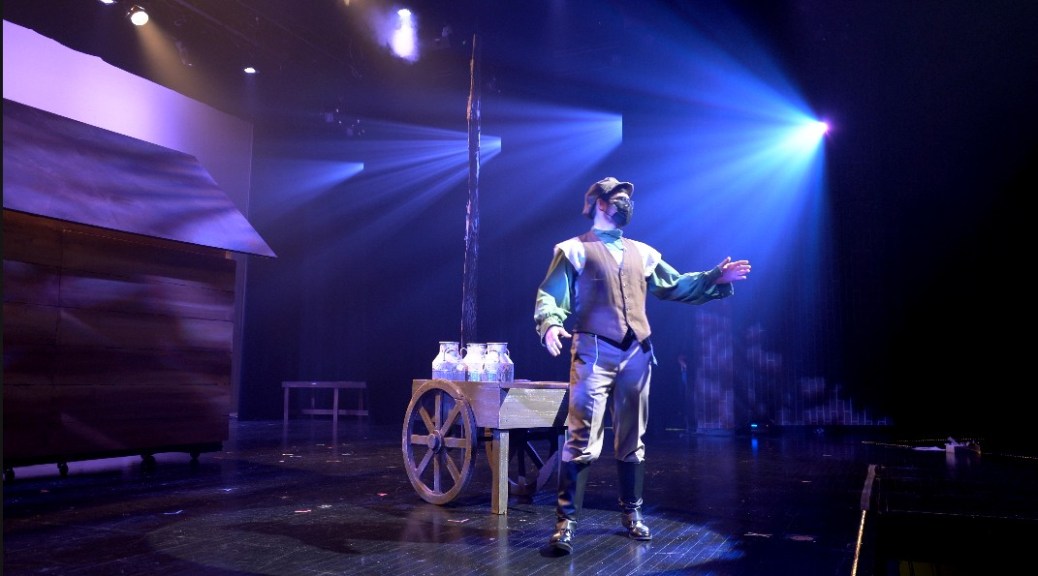


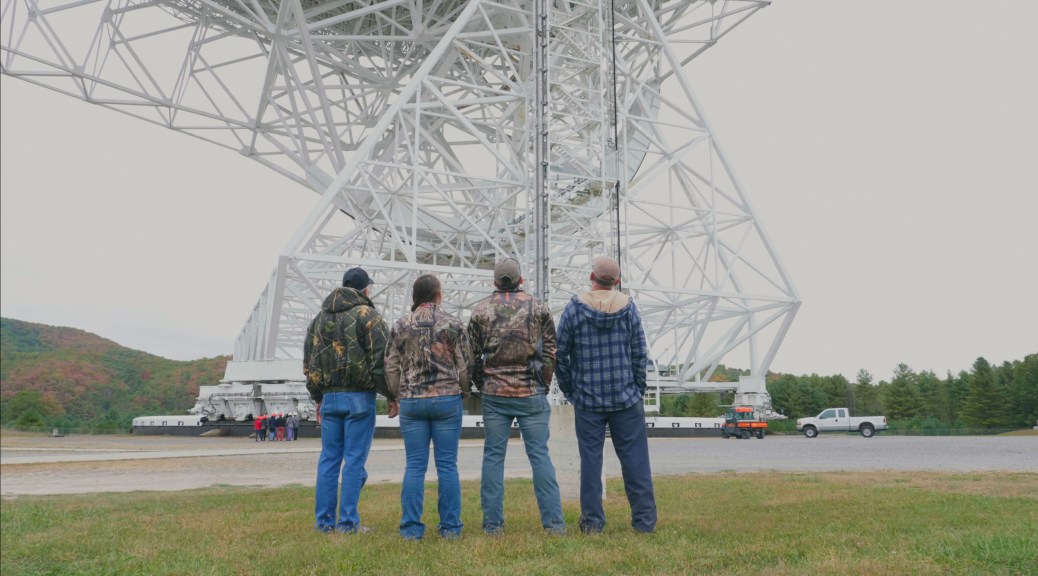
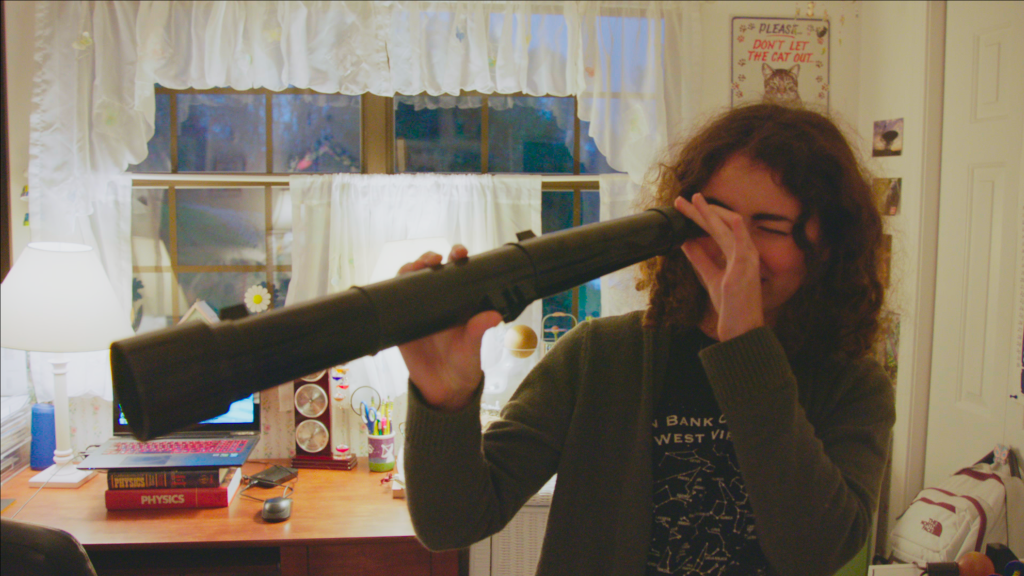
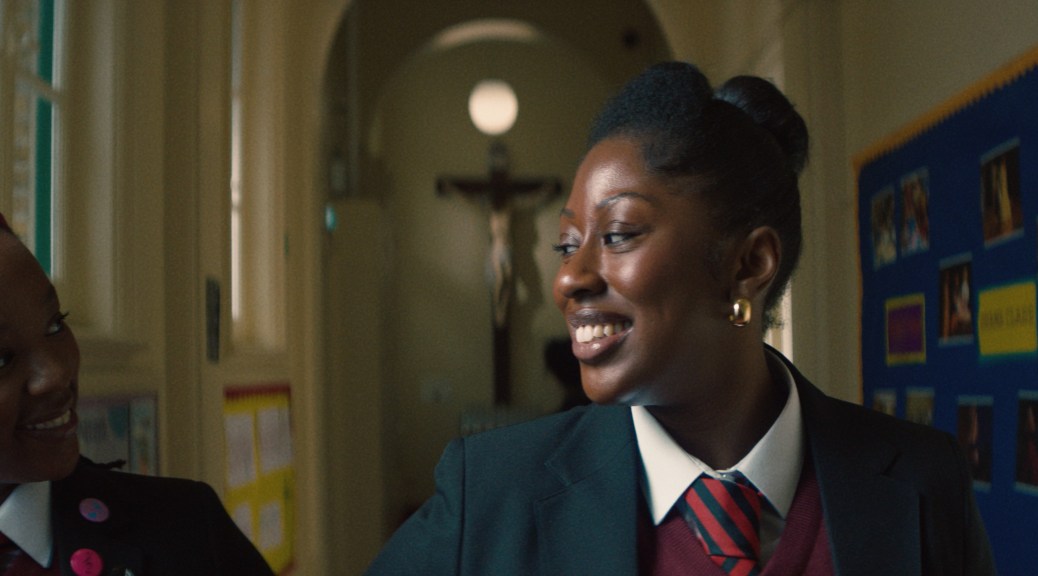


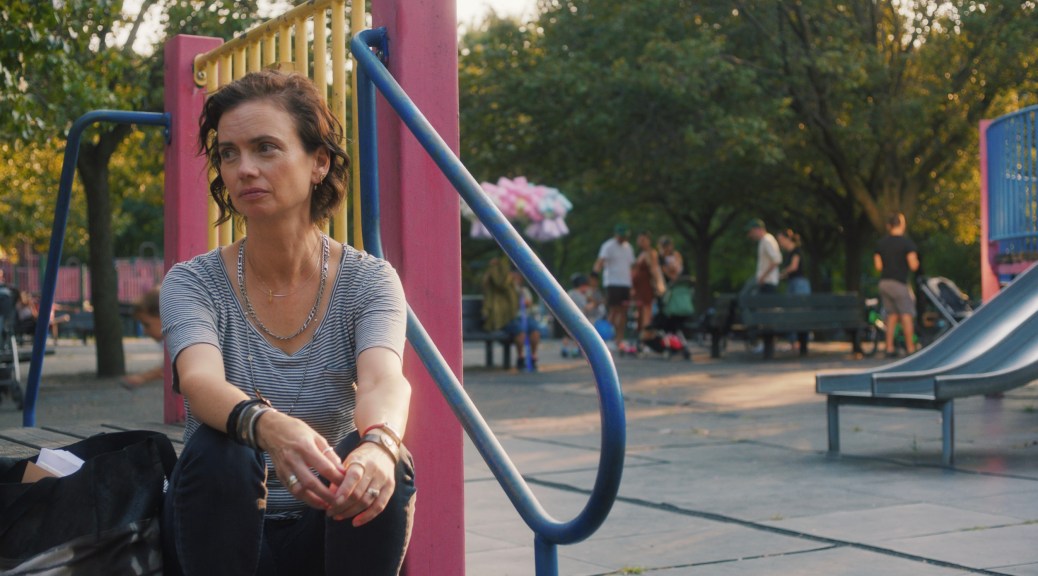


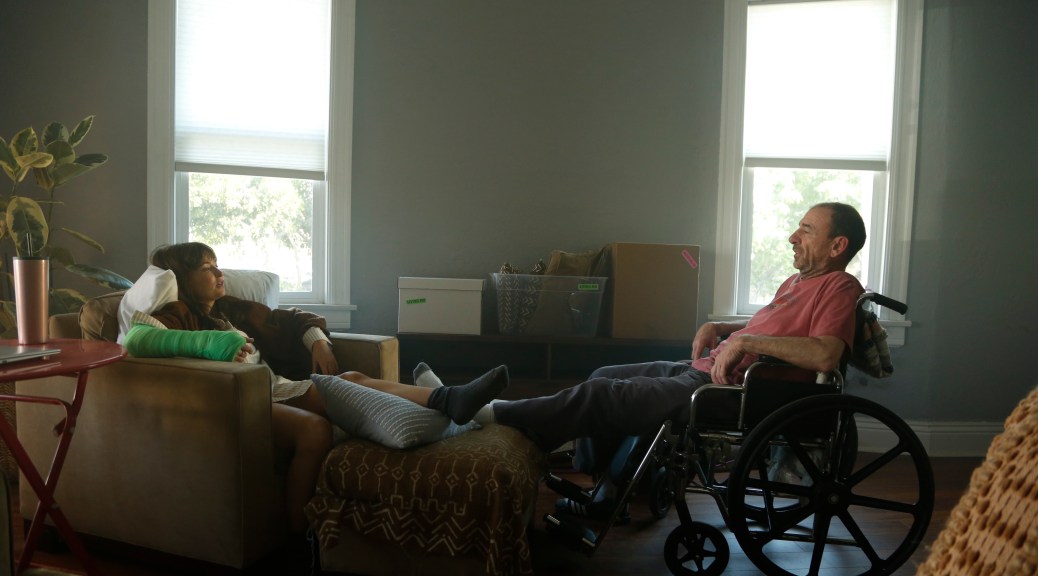
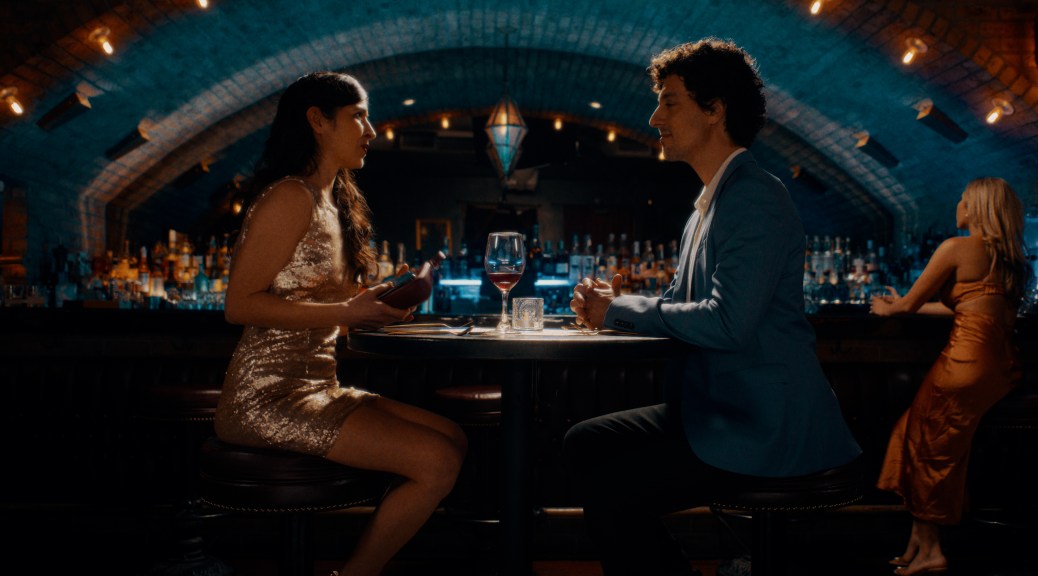
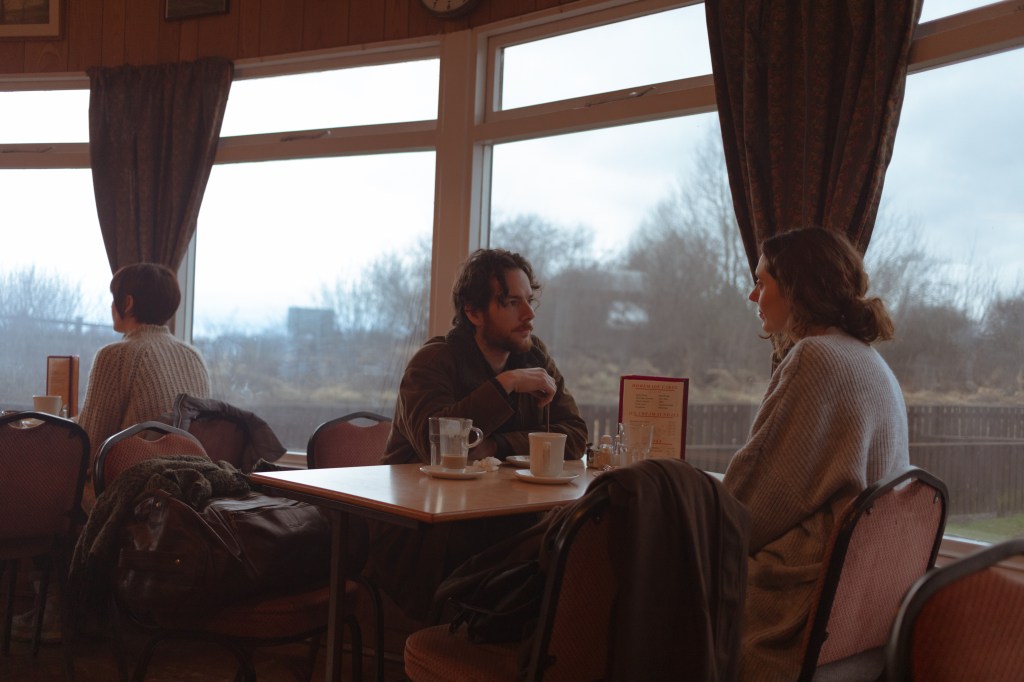
 The Movie State