

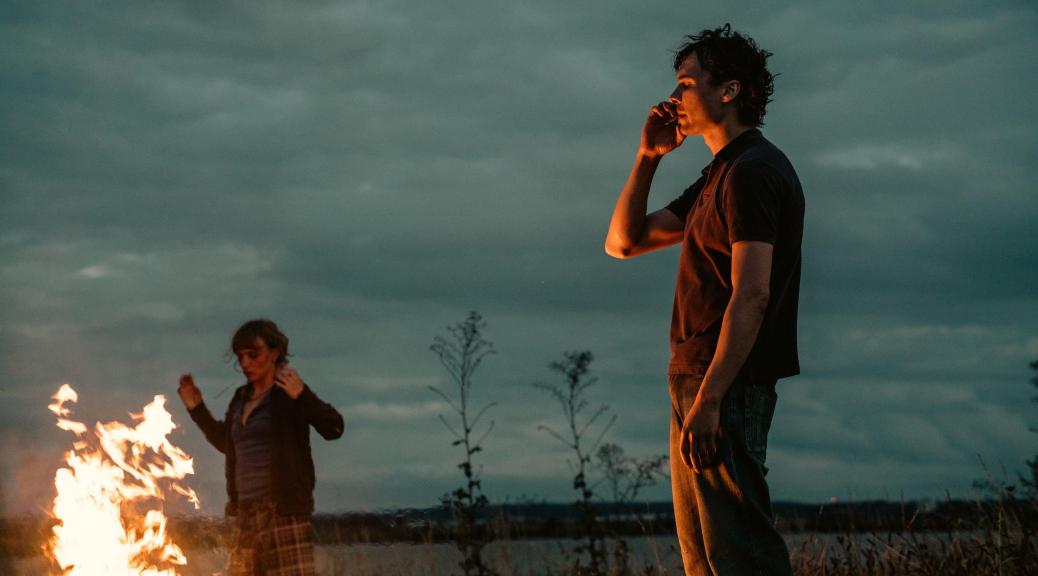
Below is my conversation with Travis Wood, Alex Mallis, and Weston Auburn. Travis and Alex serve as the directors of The Travel Companion, and the two wrote the screenplay along with Weston. The film is an indie comedy making its Midwest Premiere at the Heartland Film Festival about a pair of long-time friends and the chaos that comes when a romantic interest enters their lives. We discuss how the duo began working together, the real-life parallels that inspired the story, and the logistics of filming in airports. Our conversation has been edited and condensed for clarity.
Ben Sears: Alex and Travis, you both did a short film together, but this is both of your first times directing a feature. How did you come together on this, and what was the process like co-directing a film? Was it any different than making a short film?
Alex Mallis: We came together when we were part of a filmmaking collective called Meerkat Media, and we started making shorts together, and I think we just have a similar mentality and desire to be improvisational. Ultimately, one thing that I was attracted to about Travis is he was down to just do it. With any artistic process, there’s always hurdles, either existential or self-made creative hurdles, and Travis had this energy about him and I really appreciated that. We both came from skateboarding and this DIY practice, and we were just hanging out at a film festival and he was telling me that he was potentially going to lose his flight benefits because his buddy, who works at an airline, got a new girlfriend. So that was the launching point for this project, and more generally, we were both at a place where we thought ‘let’s do this’. It really synced up, and pretty quickly, Travis introduced me to Wes, and it all came together pretty quickly.
Travis Wood: I think it all came pretty natural. We didn’t sit down at a table and say “here’s what co-directing looks like.’ We were both very invested to make this, and we both just had that same energy to get it done. It’s like a natural dance and we’re usually pretty aligned to think of what works.
BS: Travis, it sounds like one of the characters was kind of a proxy for you; did you write that character from your perspective, or did it require some input from both of you?
TW: I think the general framework was certainly inspired by my life, but when we got to writing it, we were all three just telling each other different stories about life experiences and jobs that we’ve had. I feel like we just made an amalgamation of our experiences and put those into each character. Simon’s (Tristan Turner) day job was inspired by Alex’s job of filming taxis, and then there’s Wes’s day job and dealing with bosses and an advertising environment.
Weston Auburn: I would also say that Travis is way more chill than Simon is. He has a much smoother way of operating than what Simon does.
BS: You filmed a few scenes in airports and on planes. Was it difficult, logistically speaking, to get access to those airports, or were there a lot of regulations to go around?
AM: You’d be surprised, our airport footage was broken up into two sections. The more locked-down, dialogue heavy scenes were filmed at the West Chester airport in upstate New York, and that was a negotiation with them, getting permits, and it was all pretty straightforward. But the more montage-y footage was all filmed at JFK in New York City. That was basically just me and the actor. I had a fully refundable ticket in order to get through security, a small camera, and a gimbal, and we started shooting some sneaky shots. By the end of the four hours we spent at the airport, we were running full speed through the terminal getting shots. Turns out that, once you’re through security, it’s kind of a utopia where you can do whatever you want. Nobody blinked an eye, security didn’t look at us, nobody seemed to care what we were doing. In the age of influencers and travel bloggers, I think they assumed that’s what we were doing.
The only person who approached us was another filmmaker. He ended up PA’ing for, like, two hours. [laughs] I was sprawled out on the ground, trying to balance the gimbal, and he came up to me and said ‘hey, can I help you?’ Pretty quickly, he was carrying batteries and extra bags and running interference. He was the only person who noticed us.
BS: Tell me a little about how you landed on casting Tristan and Anthony [Overbeck].
TW: I think Anthony was an early person we had in mind. He’s very much in the independent film scene like this. We reached out, he sent an awesome tape, and I think he was the first person we had locked down. Tristan was a pretty big search; we worked with an awesome casting director, Alan Scott Neal. The film was non-union, so that limits your pool, and you have to find a new path. With Tristan, it was like, this dude totally could be an experimental documentary filmmaker, he just had that look.
BS: They believably play friends who have known each other for most of their lives. Did their chemistry together come naturally?
AM: They briefly met during the casting process, but their acting styles just came together and it was very natural. I think Tristan’s background is a bit more by-the-book, and I think it all felt really natural from the first take. It wasn’t something we even had to navigate, it was almost instantaneous.
TW: We had a really fantastic AD, and she read the script and understood it so she was able to create a schedule that allowed us to create a level of intimacy that they needed to express. They were able to build up their relationship during the shooting process, so by the time we got to more heavy, intimate scenes, they were able to do that even better.
WA: We also should mention Naomi Asa, who crushed her scenes, and we were super fortunate to have found her. She’s a bit of an undiscovered talent who acts during her free time.
AM: She was fantastic. All of our actors, we were super fortunate to find because of our tiny budget. We were squeezing every ounce of juice out of the lemon, so to have everyone ready every day so that we didn’t have to exert any energy making sure they understood what was going on. I really respect them for that.
BS: To talk about the meat of the film, what do you think that the flights that Simon gets ultimately represent to him? Is it a way for him to hold onto his friendship with Bruce? Is it simply a way for him to get out and travel the world and escape his dead-end life? Does he actually see it as a way to get his project made, or is it something else?
AM: I think we discussed that a lot throughout the writing process, and shooting and editing. I think it’s all of those things. On the one hand, it’s a very practical, very incredible resource that anybody would love. Free flights, and making a travelogue, those go together extremely naturally, and to potentially lose that benefit would be devastating. And then at the same time, it’s representative of this untapped potential, like when something is still a possibility in your head, it can feel calming. The imperfections haven’t shown up, the shortcomings haven’t shown up, so I think for him the flights give him a creative purpose.
The flights are also a connection to his best friend, and he and Bruce (Overbeck) met a long time ago, and though their lives have started to diverge, the flights are like this glue that binds them. Simon maybe doesn’t see that explicitly, but he starts to wonder, if they don’t have these flights, then what are they to each other? It’s this central piece of their friendship, and when that starts to come into question, he feels frantic, even if he doesn’t quite understand what’s happening, he does understand on an emotional level that the careful balance of his life is being threatened.
TW: I think, even in real life, I didn’t realize until I was about to lose them how much of an actual thing they were to me. When you have a successful film, for example, it’s something to talk about in a conversation. But, especially in Simon’s case, it’s a crutch to lean back onto. If you can’t talk about the film, you can at least talk about that time you went to Tokyo.
BS: Travis, since this is based, at least partially, on your experience, was it difficult to write that character and uncover some uncomfortable truths about yourself?
TW: I’ve had this friend who works at the airline for 10 years, and I know him well enough to have both sides of the conversation. In real life, it was not a thing at all, so it was actually really fun to explore those conversations and take it to this extreme. Even early on, when he started dating someone, I wondered ‘does she like to travel? Maybe I should keep it’, so it was nice to have an outlet to process and see those things through like an alternate universe. It was a good coping mechanism, if nothing else.
BS: The film skewers the independent film world, but it never feels like it’s mean-spirited. Was it difficult to strike the right balance of parody without making it seem too cartoonish?
AM: One of our guiding principals while writing this was that it has to feel real and grounded. I think with comedy, that’s a decision you can choose to accept or ignore. For us, we wanted it to feel lived-in and real, so that informed the type of comedy that we tried to incorporate.
TW: I think it was a little easier to write, too, because we are all these independent filmmakers, chatting with other filmmakers, and going to screenings. A lot of that stuff is really present for all three of us; I don’t think we had to dig too deep to find those moments that are both true and funny.
The Travel Companion will have in-person screenings at the Heartland Film Festival in Indianapolis, and will be available to stream online throughout the festival. Buy tickets here.







 The Movie State