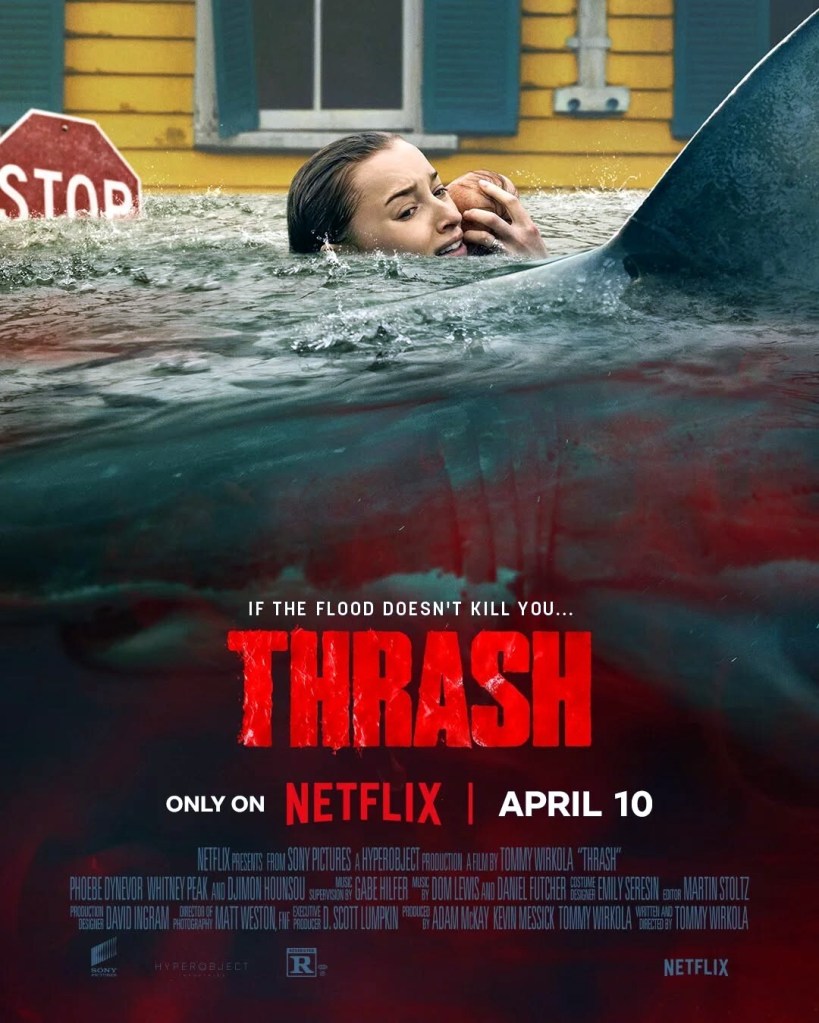
Thrash
- Director: Tommy Wirkola
- Writer: Tommy Wirkola
- Starring: Phoebe Dynevor, Whitney Peak, Djimon Hounsou, Gemma Dart, Alyla Browne, Dante Ubaldi, Stacy Clausen, Elijah Ungvary, Amy Mathews
Grade: C-
From its opening introductory text regarding the increasing frequency of intense hurricanes, Thrash – now streaming on Netflix – presents its thesis as a grand metaphor for climate change and its potentially unintended consequences. Of course, it’s nothing new for horror/thriller films to throw in a political or social message through varying degrees of subtlety, but writer-director Tommy Wirkola clues us in right off the bat regarding where his film’s priorities lie. Fortunately the film doesn’t always feel like a glorified PSA throughout its entire runtime, a la Don’t Look Up. Rather, as the film goes on, the climate change metaphor takes a back seat to shark mayhem, to varying degrees of success.
Wirkola has staked his claim in the shlocky B-grade genre film space with experiments like Dead Snow and Violent Night, but Thrash doesn’t retain the sense of fun that can elevate a tired premise. Even at only 83 minutes, including credits, the film feels lost at sea in trying to find a reason to root for anyone’s survival beyond the most basic character traits. Take Lisa (Phoebe Dynevor) for example: at 9 months pregnant and working in the front office of a meatpacking plant in Annieville, South Carolina, she’s given no discerning definition beyond “pregnant”.
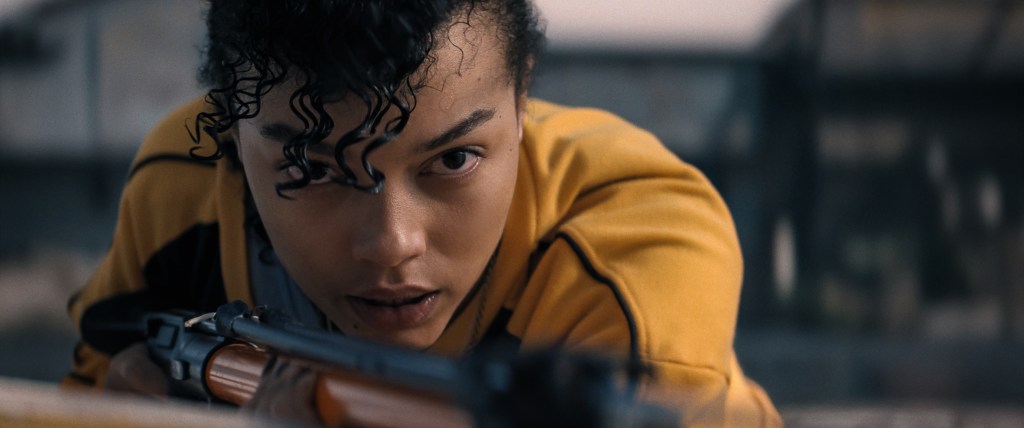
The most affecting character, by default, is Dakota (Whitney Peak), who’s still grieving the death of her mother and is under the care of her uncle Dale (Djimon Hounsou), a marine biologist. The impending Hurricane Henry affords Dakota the excuse to stay behind, in spite of the warnings and evacuation orders from officials regarding the severity of the storm. Meanwhile, a gang of plucky foster siblings (Alyla Browne, Dante Ubaldi, Stacy Clausen) contend with their abusive redneck foster parents (Elijah Ungvary and Amy Mathews), who insist that their house is strong enough to withstand the hurricane. It does not. Besides these two lowlifes, one of Thrash‘s fatal flaws is in its lack of a villain – and, no, neither the sharks nor climate change count. Any creature feature needs a good heel so that the audience can applaud when they inevitably get ripped to shreds, and Wirkola’s screenplay is lacking in character depth, no matter how cartoonish they need to be.
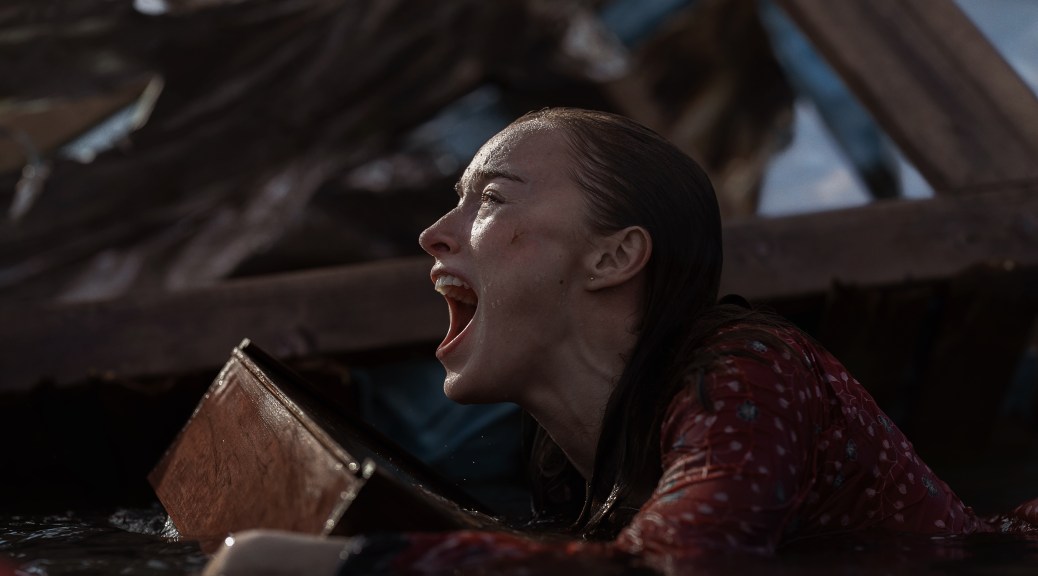
The mechanics aren’t necessarily important, and Wirkola doesn’t belabor the “how” or “why” of it all, but eventually a shiver of bull sharks swims into town and causes chaos for our disparate cast of survivors. It’s a noble concept on paper, throwing deadly sharks on top of the danger of rising waters, strong winds, and torrential downpour. But Thrash‘s set pieces never feel creatively fulfilling; the sharks mostly just appear at random, biting their victims and either tearing their limbs off or simply eating them. The visual and practical effects are solid enough for a straight-to-Netflix release, but a film like Deep Blue Sea – which had dated special effects, even in 1999 – knew how to effectively stage its brutal kills.
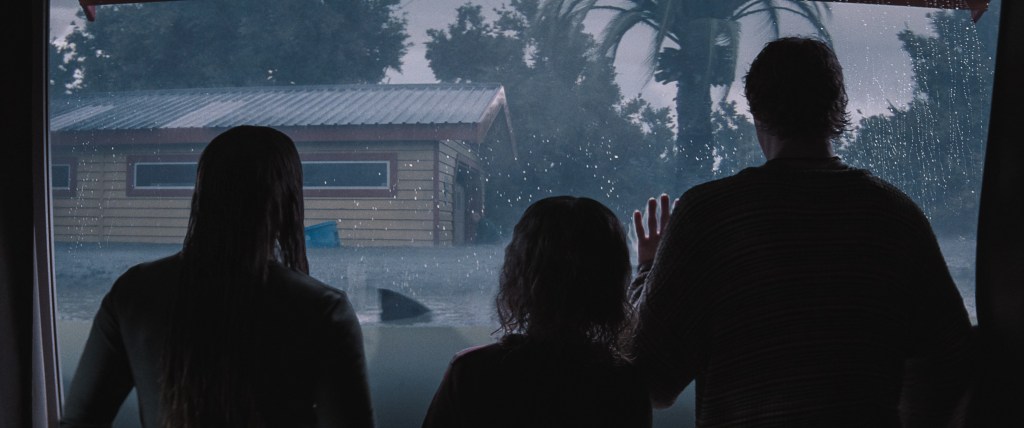
Speaking of days gone by, Thrash is the kind of film which would have surely felt at home in the straight-to-VOD catalogue during its heyday. Today, Netflix has mostly become the repository for these films, and while nobody likely had ambitions to bite off more than they could chew, Wirkola needed more time developing these ideas into a fully-fleshed film. Shlocky genre exercises can be easily digestible and fun, but Thrash is only one of those things. I wasn’t bored, and Wirkola’s feeble attempt to weave in some social commentary is admirable, but the film ultimately fails to keep its head above water.
Thrash is now streaming on Netflix.
OSCAR POTENTIAL:
- None
 The Movie State