
Jimmy
- Director: Aaron Burns
- Writer: Aaron Burns, Justin Strawhand
- Starring: KJ Apa, Max Casella, Kara Killmer, Jason Alexander, Jen Lilley
Grade: C-
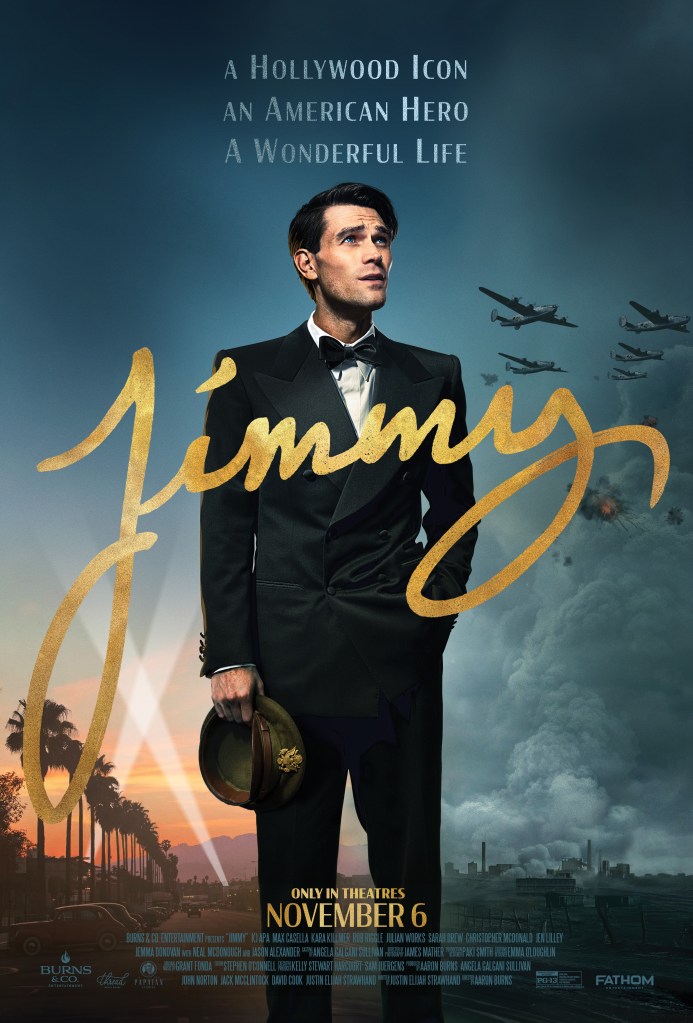
It’s not often that a high profile film sets its world premiere in Indiana, but that was the case for Jimmy, a biopic of the late actor and military officer who inspired generations of audiences with his iconic performances. I was fortunate enough to attend the premiere screening, which was held at The Scottish Rite Cathedral in Indianapolis, kicking off the 35th edition of the Heartland Film Festival. In attendance were KJ Apa (who plays the titular role), director Aaron Burns, and several other members of the cast and crew. Making the experience particularly special was the presence of Jimmy’s daughter Kelly (who has an Executive Producer credit on the film) and Karolyn Grimes, who played young Zuzu Bailey in 1946’s It’s a Wonderful Life alongside Stewart, uttering the famous line “Everytime a bell rings, an angel gets its wings.” While the spirit in the room was overwhelmingly celebratory, the film itself lacks the gravitas that would have been befitting of its larger than life subject.
Jimmy is not a standard cradle to grave biopic, instead focusing on a specific slice of Stewart’s life. It follows a classic three act structure, opening just after Stewart’s Academy Award for Best Actor for his performance of Macaulay “Mike” Connor in George Cukor’s 1959 film The Philadelphia Story. Things then move quickly into World War II, where we follow his time as a combat pilot and eventually the highest ranking actor to ever serve in the US military. This is where writers Burns and Justin Strawhand spend most of their time, and it’s probably my biggest issue with the film. While I understand the desire to highlight Stewart’s military service as an unsung part of his story, I question whether it was the most interesting time of his life to highlight here. This stretch of the film feels particularly monotonous, showing us multiple air battles Stewart was involved in that tend to feel repetitive and indistinct. It’s all pretty generic, and you could probably place most of these sequences in another war film and it wouldn’t make much of a difference. I wish the script had explored Jimmy’s psyche during this time a bit more in a way that was unique to him and his experience. On top of all that, the complexities and horrors of war are glossed over, almost propagandizing military service.
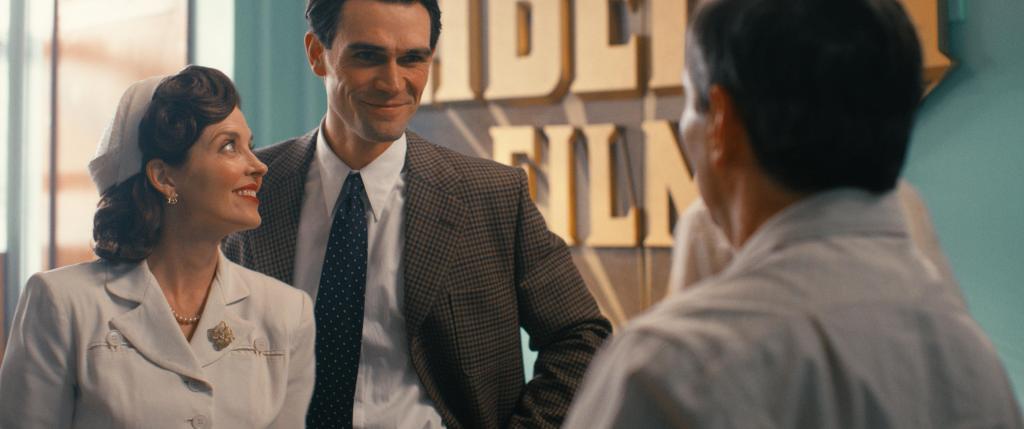
Once Stewart is home from war, Jimmy becomes mildly more interesting in the final act as he reckons with his time serving, while simultaneously trying to continue his Hollywood movie career. We finally start to understand the specificities of how Jimmy’s experiences have affected him, but it comes too late and there’s not nearly enough runtime devoted to it. These post-war scenes feel hastily tacked on to the end of the film, as if Burns and Strawhand realized they hadn’t given Stewart’s character enough juice throughout the first two thirds of the film for the audience to walk away understanding any more about him than they did when they walked in. During the post-premiere Q&A with the filmmakers and cast, Strawhand mentioned that he wrote the initial draft in a Texas hotel room over a span of 3 days, and I have to wonder whether there was much development beyond that initial pass.
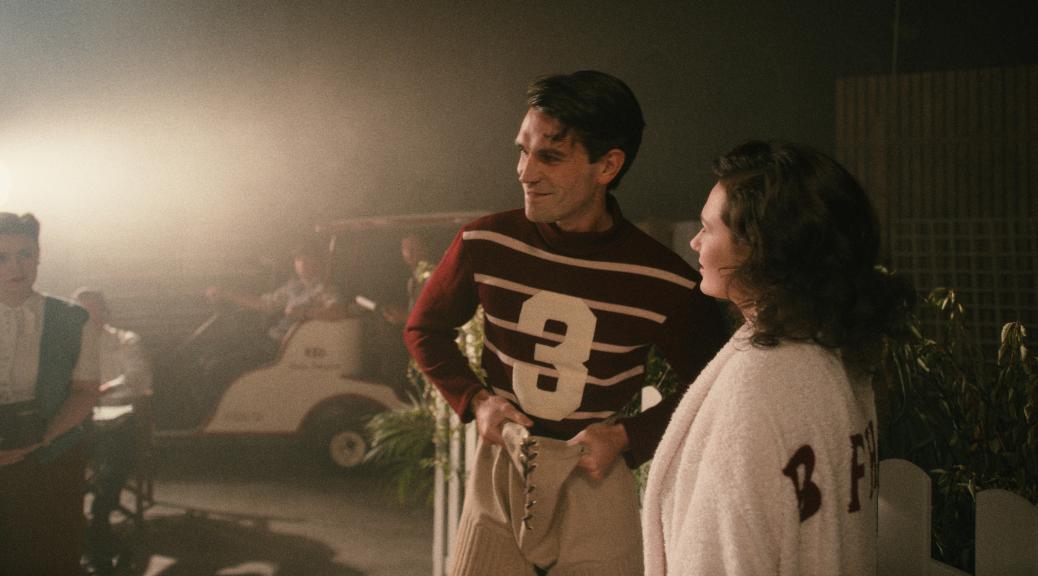
Apa is far and away the best part of the film with his portrayal of Stewart. Jimmy’s name alone conjures up a distinct image: the charm, the voice, the mannerisms–all tackled with an ease that not many other Hollywood actors could achieve. His talent is on full display as we see him struggling to recite his lines during the filming of It’s a Wonderful Life, allowing the trauma of Stewart’s military service to creep back in and rear its ugly head. Unfortunately, the film around him doesn’t give him the space to let the performance breathe as well as it could have. Other notable performances include Kara Kilmer as Lady Julia, a fictitious love interest who serves as a safe place for Stewart, and Max Casella as Frank Capra, the lauded Hollywood director who collaborated with him on three features. Both actors are steady scene partners for Apa, and give him the space to milk as much humanity out of Stewart as possible in the confines of the film. On the other hand, Jason Alexander makes a brief appearance as Louis B. Mayer that feels bizarrely out of place. His over-the-top cringe comedic performance took me out of Jimmy, and gave shades of George Costanza.
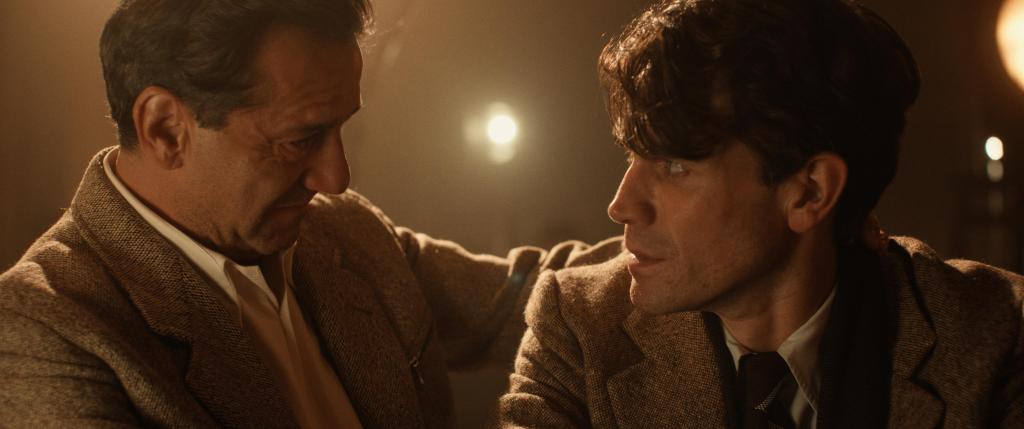
Outside of the story, the film’s technical merits also leave much to be desired. From the first scene in a studio office at Liberty Films that felt cartoonishly vibrant, I was on high alert. The production design and overall feel of the film is more caricature than truly rooted in the period it’s set in. Visually, there’s a bright gloss to the cinematography fromJames Mather that gives the film a “straight to streaming” vibe, and no particularly inventive or interesting camera shots to be found. It’s clear that Burns has not yet found his voice as a director, and doesn’t quite have the tools to turn a project of this scale into something as interesting and engaging as it should be.
Diehard Stewart fans may be happy enough to see the legendary figure resurrected on screen, but they would be better served in revisiting his timeless filmography to get their Jimmy fix.
Jimmy was screened as the Opening Night film at the Heartland International Film Festival. Fathom Entertainment will release the film in theaters on November 6.
OSCAR POTENTIAL:
- There’s a world where KJ Apa could have been in the awards conversation for acting prizes, but I don’t think the film is nearly strong enough to get him there.

