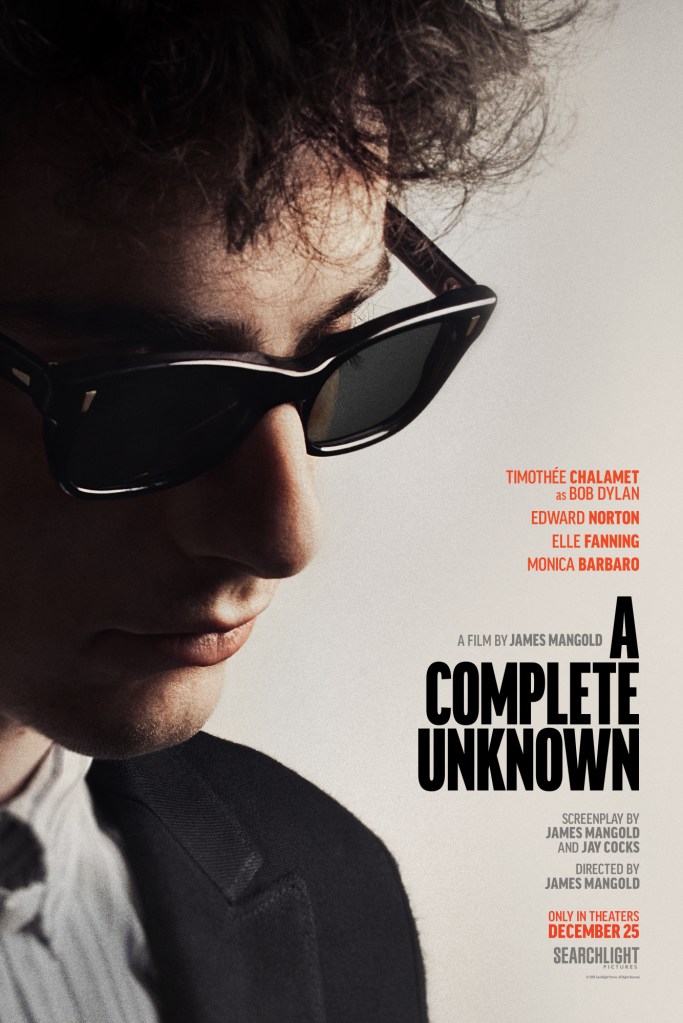
Starring: Timothée Chalamet, Elle Fanning, Edward Norton, Monica Barbaro, Boyd Holbrook, Scoot McNairy
Grade: B+
I’ve personally always been softer on musical biopics compared to most. Sure, most of these movies follow the same exact formula, telling the same rise and fall narrative, that movies like Walk Hard and Weird: The Al Yankovic Story mocked relentlessly. But some movies, like Elvis or Rocketman, add some more much-needed personality to the subgenre. But more often than not, we get movies like Bohemian Rhapsody or Bob Marley: One Love, which treat their subjects as if they are literal superheroes.
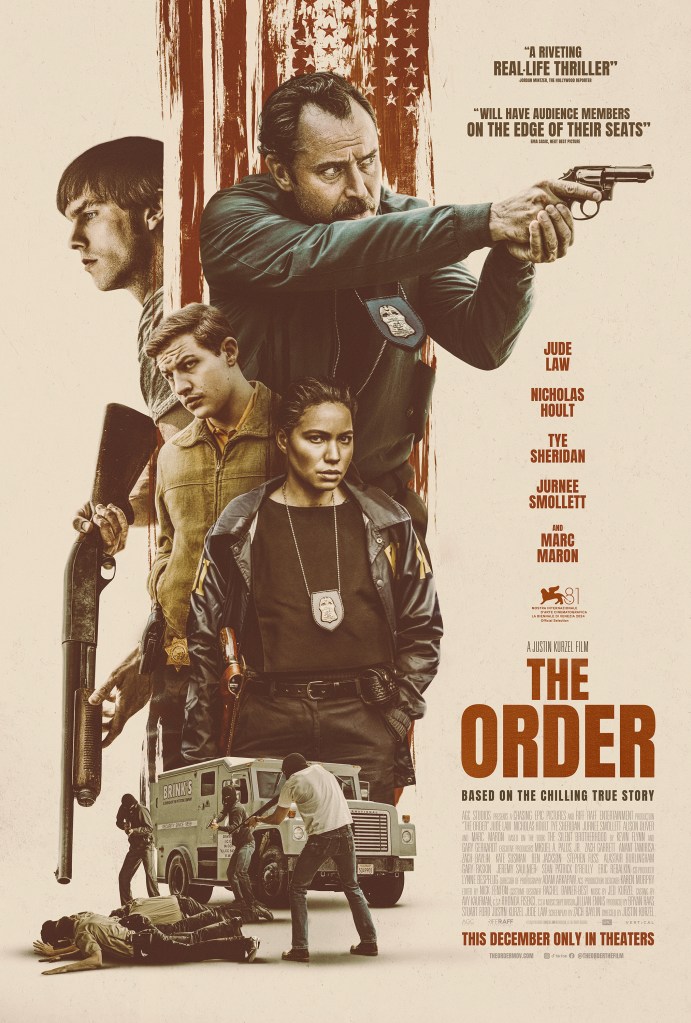
Starring: Jude Law, Nicholas Hoult, Tye Sheridan, Alison Oliver, Jurnee Smollett, Marc Maron, Odessa Young
Grade: C+
Nicholas Hoult has been busy in 2024. With films like Juror #2, Nosferatu, and a voice role in The Garfield Movie, Hoult has proven himself to be an incredibly versatile actor during this year alone, with more massive projects on the way. With director Justin Kurzel’s The Order, Hoult displays a layer of darkness that I have yet to see in his projects, carrying the film from a forgettable crime drama to an enthralling experience.
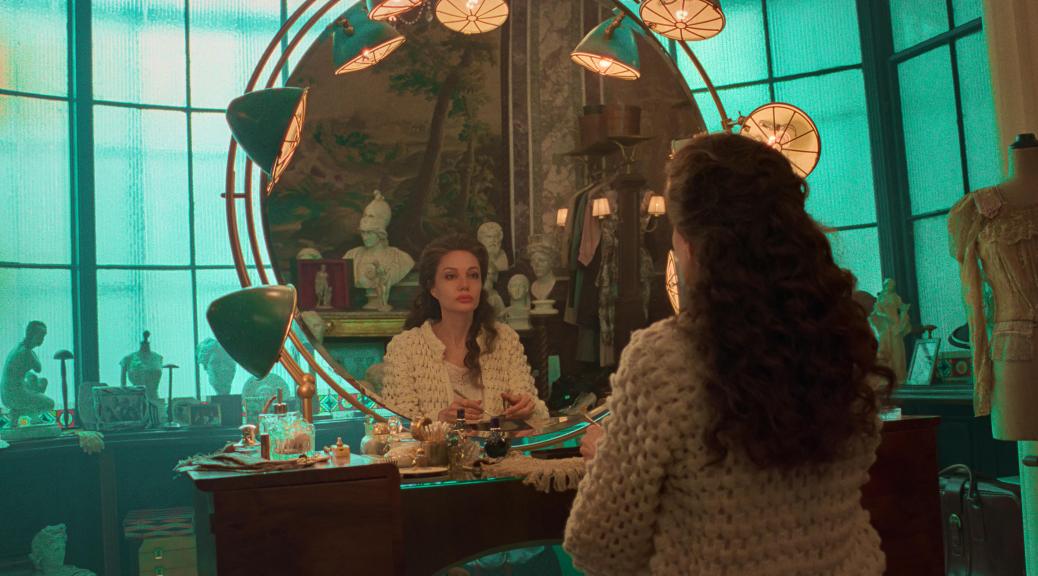
During his introduction of his latest film Maria, director Pablo Larraín espoused a childhood fondness for the opera, and a hope that the art form could return to its more welcoming, populous roots. With this in mind, it’s clear that Larraín’s film has great reverence not just for the opera itself, but for its subject, Maria Callas. It’s a thread that has connected a number of his films, especially his unofficial trilogy exploring the inner lives of the 20th century’s most misunderstood women, but there’s something missing from his latest entry, and part of it may be because of her unfamiliarity.
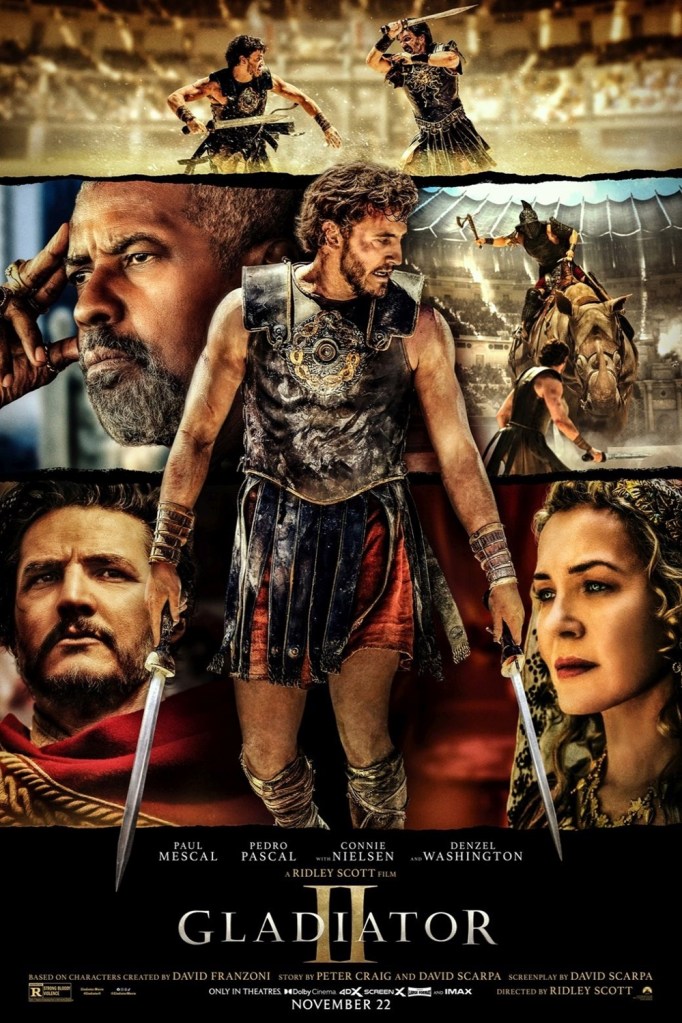
Starring: Paul Mescal, Denzel Washington, Pedro Pascal, Connie Nielson, Joseph Quinn, Fred Hechinger
Grade: B
Ridley Scott is one of our more interesting filmmakers working today. Like many of his era, he’s directed many films that have been hailed as all-time classics, like Alien, Blade Runner, and of course, the original Gladiator. However, over the past two decades, Scott’s track record has gotten much shakier with misfires such as The Counselor and Robin Hood. It really wasn’t until The Martian in 2015 that Scott felt like he was fully back in form. At least for a little bit.
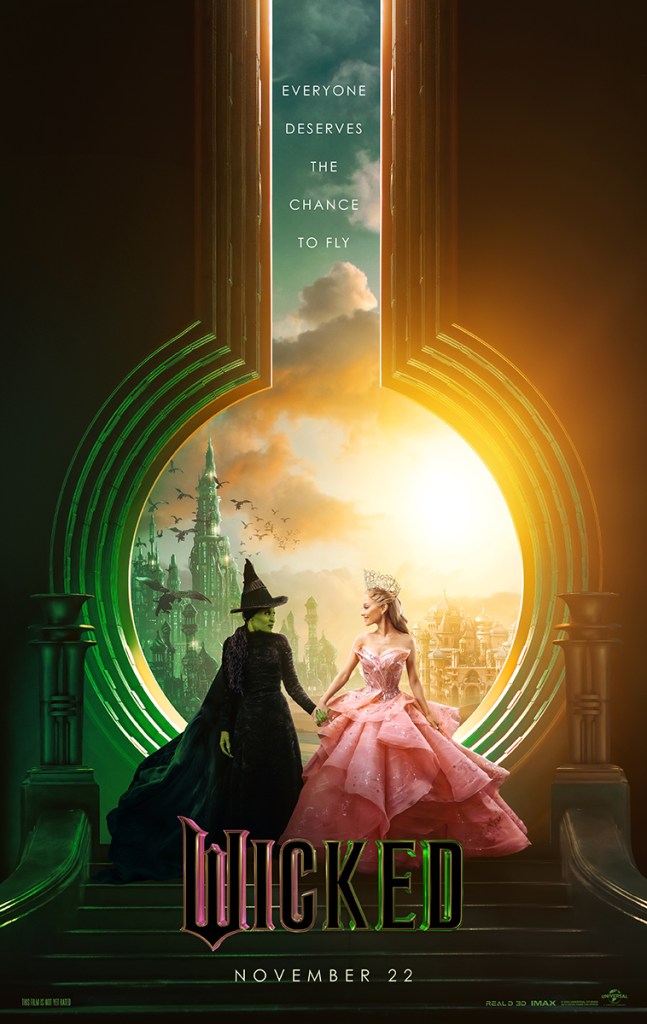
Starring: Cynthia Erivo, Ariana Grande, Michelle Yeoh, Jonathan Bailey, Marissa Bode, Bowen Yang, Jeff Goldblum
Grade: A-
The movie musical is back in a big way with the long-simmering adaptation of Wicked thanks to director Jon M. Chu and the undeniable chemistry of its leads. Since its premiere on Broadway, Hollywood has tied itself in knots trying to figure out exactly how to film its version of Gregory Maguire’s novel, and while it may not be perfect, Chu’s vision does right by the material – a more difficult feat to accomplish than expected. Yes, technically, Wicked is only half of the story (part two is currently scheduled to be released in one year), but it’s one of the breeziest, most enjoyable moviegoing experiences of the year.
Starring: Dwayne Johnson, Chris Evans, Lucy Liu, JK Simmons, Kiernan Shipka, Nick Kroll
Grade: C-
Red One has built up an interesting reputation ahead of its release. Starting production in October of 2022, the film was meant to release during Christmas of 2023, but many problems started to grow. The film delayed production for a multitude of reasons, including rumors of Dwayne Johnson’s constant tardiness and set days missed. Then, the 2023 SAG-AFTRA strike delayed the film’s release a whole year, with Amazon MGM choosing to stick with the holiday season release.
After all this time, is Red One able to overcome the controversies and obstacles that came their way? Not really.
Starring: Tom Hanks, Robin Wright, Paul Bettany, Dannie McCallum, Joel Oulette, Daniel Betts, Kelly Reilly
Grade: B-
Robert Zemeckis was once one of the top filmmakers in Hollywood. And for good reason. He had delivered hit film after hit film on a consistent basis, ranging from blockbusters like Back to the Future and Oscar-winners such as Forrest Gump.
Perhaps what’s most impressive about If That Mockingbird Don’t Sing is that its writer-director just recently turned 20 years old. Sophie Bones – who makes a small cameo appearance as well – riffs on Juno and teenage pregnancy with the right balance of laughs and heart, even when its characters are often painted with a broad brush. The story follows Sydnie (played with an impressive maturity by Aitana Doyle), who discovers she’s pregnant after breaking up with her dipshit college-bound boyfriend Lucas (Braxton Fannin).
There are abrupt character shifts, like the almost forced love triangle that develops about halfway through, or Lucas’s changing feelings on being a father or his immediate reaction to the gender of the baby. But Bones peppers in some truly thoughtful and genuine scenes that elevate If That Mockingbird Don’t Sing above your run of the mill regional film festival indie. A scene between Sydnie and Lucas’s mother Carrie (Catherine Curtin) subverts expectations by painting the two as allies, rather than showing Carrie as the agitator. Scenes like this go a long way in differentiating the film from your average romantic comedy with overly qualified stars in supporting roles. The whole endeavor isn’t perfect, but it’s got enough positives to show that Bones has the chops to be a young, original voice in indie storytelling.
All American is one of the more conventional documentaries to be found at Heartland, but it’s no less emotional. First-time director Mark Andrew Altschul chronicles the girls wrestling movement in high school sports, but his film smartly details the complicated personal lives of its subjects off the mat just as much as it does on. The film isn’t explicitly about the immigrant experience, but the trio of girls just happen to be first-generation Americans living in various areas of New York.
Altschul shows the girls’ struggles not only to excel in the sport, but to gain the acceptance of their family, friends, and the culture at large. The film’s most heartbreaking storyline comes from a girl whose family immigrated from Yemen, and who go so far as to kick her out of the home simply for wanting to play a sport traditionally dominated by men. This is in line with the other characters, whose families come from more traditional backgrounds and believe that a girl’s place is in the home. But it’s encouraging to see so many girls persevere through adversity and acceptance, and it ultimately makes All American a winner.
There’s nothing inherently disagreeable about 2:15 PM, a Korean melodrama from first-time director Seryong Jeong, with a script from Ok-nyeon Park. At times, the film reminded me of Hirokazu Kore-eda’s Monster, which also played at Heartland and was one of my favorite films of last year. But what the former lacks is the latter’s ability to dig beneath the surface to offer a message that resonates after the credits end.
Jeong’s film concerns two young girls, played by Park So-yi and Gi So-you, and their budding friendship in the face of adverse circumstances. Hyun-su (Park So-yi) finds Min-ha (Gi So-you) on her way home from school when her father breaks a window in a fit of anger. Seeing someone in need of a friend, she begins a daily ritual of coming to Min-ha’s home and spending their brief window of time together. Jeong does a nice job of inserting drama naturally, like in exploring Min-ha’s father’s abusive behavior, or in Hyun-su’s impending move to Canada. That he manages to achieve all of this within 75 minutes is all the more impressive, but I can’t help but wish there was more to latch onto at the end of the day.
Alonso Ruizpalacios channels Alfonso Cuaron and The Bear with La Cocina, an exquisitely crafted but occasionally stilted drama. The film introduces its conflict early on, setting the stage for a great deal of tension, but it abruptly changes gears in its second half to become a bizarrely ineffective story of immigration. Set over the course of a single day in a generic New York restaurant simply called “The Grill”, the film follows the grunts at the front and back of house as management investigates a large chunk of money that was allegedly stolen the previous night.
All of this serves as the backdrop for the drama between Julia (Rooney Mara), a waitress, and Pedro (Raul Briones), a line cook. She recently discovered she’s pregnant, and he wants to support her decision to get an abortion. Mara and Briones are naturally charismatic together and separately, but the film goes on extended tangents that work perfectly well on paper but grind everything to a halt. One scene shows the kitchen going on a back-and-forth of colorfully insulting each other in their native tongues and, though this is probably La Cocina’s most effective instance of the film’s vision, there are similar scenes that don’t work as well. Still, Ruizpalacios gets the details of life in a busy restaurant right more often than not, like in Luis (Eduardo Olmos), the management underling who appeals to the immigrants by appearing friendly, but secretly has the boss’s best interests at heart. And the film looks incredible, shot in black and white in the Academy aspect ratio. Ruizpalacios especially flexes his muscles behind the camera with a virtuoso minutes-long oner during the chaotic lunch rush, where the lines between reality and fantasy blur. There’s a leaner version of La Cocina that’s undoubtedly much more effective, but it’s hard not to be frustrated by the film as it stands.
No other film at Heartland this year has a logline as hilarious as Stripper Boyz. Serving as a kind of documentary-narrative hybrid, the film tackles male body positivity in an ingeniously inventive way, thanks to the chemistry and instincts of its stars. Stephen Sanow and Jozef Fahey – Stephen is the credited director, and both are credited writers – are long-time friends and struggling actors, and Jozef is engaged, so Stephen decides to throw Jozef a bachelor party. But rather than your typical night of debauchery with friends, the pair travel to Las Vegas, where they try to learn the ropes as male strippers.
The film has a lot of fun with blurring the lines of reality and fiction, as we’re often left wondering how much of what we’re seeing is a bit, versus what is genuine. Stephen’s excuse for embarking on the journey is so that he can give his friend more confidence in himself and in his impending marriage, and Jozef is fully game with what is admittedly a kind of insane idea. If the majority of the conflict within Stripper Boyz was in Jozef’s unwillingness to do what Stephen wants, the film wouldn’t resonate as long as it does. Rather, the conflict comes from outside forces and setbacks beyond their control. Thankfully, the duo have enough comedic chops to make enough worthwhile content without stretching the premise beyond its breaking point.
Gentrification is a word we all know and understand, but Emergent City takes an in-depth look at how and why it happens, in one of the biggest hotbeds for the trend. Documentarians Jay Arthur Sterrenberg and Kelly Anderson dedicate almost 10 years to filming the changes to the neighborhood of Sunset Park, a multi-cultural melting pot near the waterfront of Brooklyn. When the industrial warehouses and factories that flourished in the 1950s were left mostly empty and abandoned, the city tried to invigorate the area by turning the buildings into multi-use facilities called Industrial City, leading to upscale restaurants and businesses like what we see in most downtown areas throughout the country.
Sterrenberg and Anderson take an on-the-ground approach to the film, showing various organizations and town hall meetings, as the community pushes back against further re-zoning and redevelopment. It’s hard not to be won over to the community’s side, but Sterrenberg and Anderson are careful enough to occasionally show the potential upside to more development – like additional jobs and revitalizations to areas that were essentially blights beforehand. It can often feel like an uphill battle whenever community members – especially predominantly non-white community members – fight against a multi-billion dollar company, but Emergent City is an engrossing look at democracy in action, full of colorful personalities worth rooting for.
For four years beginning in 2003, a group of eight artists, art students, and friends ventured to create their own space in the bowels of the Providence Place Mall. Jeremy Workman’s documentary Secret Mall Apartment seeks to tell the nearly unbelievable true story of the apartment, but it quickly morphs into a portrait of how art and creativity can shape a group of people. Michael Townsend, an artist and teacher at RISD, spearheaded the project after discovering a small, undeveloped area within the mall, and he quickly makes it a kind of clubhouse for his friends to share ideas, and also play PlayStation.
It’s amusing how quickly the gang adapts to making the “apartment” their own hidden space. They subsist on food from the food court and popcorn from the movie theater. At one point, they raise the idea of getting a PO Box within the mall, so they can receive mail and make it an official address. But the heart of Secret Mall Apartment is a look at Michael’s belief that art can be anything you make, whether it’s murals of masking tape in a children’s hospital or an ad-hoc apartment with stolen electricity. Michael is an easily likable figure, even when his obsession with the apartment essentially ruins his marriage, so when the inevitable happens and the apartment is discovered, you’re still rooting for him. There isn’t much thematic weight to the film overall, but it’s a good time peppered with humor and insight about the arts, so it ultimately feels like a worthwhile endeavor.
The last gasp of summer is rendered with care and vitality in Jared Isaacs’ An Autumn Summer, a freewheeling look at a group of friends’ gradual realization that things may never be the same, for better and worse. But Isaacs, who writes and directs, rarely injects drama where it doesn’t belong, instead choosing to let his young actors see where the scene takes them. It feels as if they were given mostly free reign to improvise, and it makes this summer getaway in the northern Michigan lakeside feel like a natural extension of their lives and rituals, rather than a film with a predetermined beginning, middle, and end. Though the plot is less important here, it’s centered on Kevin (Mark McKenna) and Cody’s (Lukita Maxwell) romance, as college looms and they fear they could lose everything they have.
Isaacs’ dialogue occasionally feels a little writerly, and perhaps he could have cut the film down from its 98 minute runtime. This is a film where conversations span the gamut from college parties to the Big Bang to dreams of marriage and children, all with abundant theater kid energy. Maxwell and McKenna are the standouts and emotional anchors of the film, but Louise Barnes, Katie Baker, Tony Horton, Julian Bass, and Jun Yu make each of their characters feel distinct, and less like different mouthpieces for Isaacs to use. An Autumn Summer may be Jared Isaacs’ directorial debut, but it’s a supremely confident film that belongs at the top of your Heartland watchlist.
At only 78 minutes, Love, Danielle gets a number of sentiments right about life with cancer, but could stand to expand a bit more on its themes. In the opening minutes of the film, we learn that Danielle (Devin Sidell) has been diagnosed with a BRCA1 genetic mutation, which puts her at higher risk for ovarian and breast cancer. She then has to choose whether she wants to have preventive surgery to remove her breasts and ovaries, in spite of her desire to have children. Given that the film follows Sidell’s real-life experience with BRCA, and her co-screenwriter credit along with Steve Sears, the film feels like an accurate, genuine depiction of those who go through this very unique phenomenon. But as if BRCA wasn’t enough, Danielle’s sister Amy (Jaime King) is going through her own cancer journey, and she has to deal with lingering familial trauma from her absentee father (Barry Bostwick) and her uber-picky mother (Lesley Ann Warren).
First-time director Marianna Palka mostly avoids the quirkiness that comes with the cancer dramedy, instead exploring Danielle’s relationships with her family and loved ones. Sidell is disarmingly vulnerable in her performance, never shying away from the uglier sides of having cancer, and the specific guilt of having a treatable form when someone you love is suffering. More often than not, a film is better served when it doesn’t belabor a plot point or character beat, but here is a case where the film would have benefitted from more room to breathe. Still, Love, Danielle gets the emotions right in a genre where shortcuts are too frequently taken.