

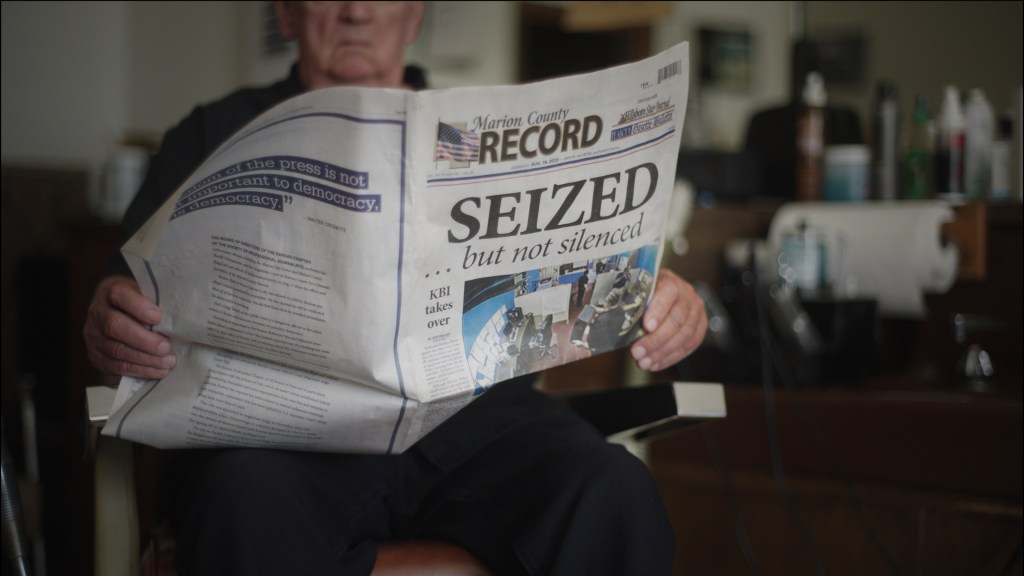
You might remember when, in 2023, a small county newspaper in Kansas was raided by the police. The story made national news, and looked on the surface to be a symbol of the crumbling strength of the First Amendment. The raid is the backbone of Seized, but director Sharon Liese uses the opportunity to explore the bickering and back-stabbing around the Marion County Record and around the small town. Kudos to Liese for discovering in real time where the story lies within this incident, and the film unfolds as a kind of true-crime account of outsized personalities, and how their perceived slights led to a breach of journalistic independence.
If anyone is the main character of Seized, it’s the newspaper’s editor Eric Meyer, who’s garnered a reputation around town for pushing buttons and soiling the people’s trust of the Record. Indeed, Meyer routinely publishes police blotter reports, which feels, to new reporter and New York transplant Finn Hartnett, like unnecessarily airing out town gossip. Hartnett’s Gen-Z measured approach works as a kind of counterbalance to Meyer’s Boomer brashness, but at the end of the day, they still have each other’s backs. By the end of the film, I wouldn’t say I felt any more or less enlightened around the state of the First Amendment. But, perhaps just as importantly, I was thoroughly entertained.

I’ve always had a strange fascination with North Korea, and School for Defectors offers a unique perspective on the isolated dictatorship. Director Jeremy Workman – who appeared at last year’s Heartland with Secret Mall Apartment – travels to the other side of the world to visit the only Korean boarding school dedicated to kids whose families have defected from the North. We mostly follow the teenagers, closer to graduating high school, but the school houses students of all ages. The school’s administration focuses on vital education tools, but puts equal emphasis on reintegration into functioning society. To the untrained eye, it may seem like sunshine and roses as soon as one crosses the 38th Parallel, but the film shows that the truth is much more difficult. Workman interviews a number of students and alumni from other, public schools, and reveals the bullying and isolation they often felt from their peers.
Those that have only skimmed the headlines surrounding North Korea, or those that missed the excellent documentary Beyond Utopia, will surely be in for a shock, as the third act takes the focus away from the students to tell the harrowing stories of how the families escaped. The drama here is certainly relevant, and School for Defectors would feel incomplete without it, but it almost feels like Workman needed more material to justify a feature-length film. Still, the film works best when it lets the kids be kids: on field trips to the coast, rehearsing TikTok dances, or discussing their hopes for life after school. It’s a gentle, smartly-made documentary that reminds us that the world isn’t as big as we believe it to be sometimes.

For those that prefer their documentaries considerably more stylized than the above, there’s I Got Bombed at Harvey’s, which feels like it would be more at home as part of a larger series on Netflix. The true-crime film examines a bizarre act of terrorism in Lake Tahoe in 1980, when a 1,600-pound bomb was wheeled into Harvey’s Casino and ransomed for 3 million dollars. Directors Amy Bandlien Storkel and Bryan Storkel utilize a blend of recreations and talking heads (along with the occasional found footage for things like court-filed evidence) to tell the story, and your appetite for the film will likely depend on your tolerance for these devices. Where Harvey’s works best is in its examination of the perpetrator, “Big” John Birges, a gambling addict who enacted the plan as a form of revenge against his debtor. Chief in telling the story is his son, Jim, who suffered under his father’s abuse and was even enlisted to help build the bomb and collect the ransom when he was a teenager.
However, the Storkel’s employ a controversial and, frankly, slapdash, technique to get the perspective of John’s other son, John Jr. via the use of AI. John published a novel on the matter, and the filmmakers use those words, along with video footage from prior interviews, to bring John’s voice to “life”. Regardless of whether you’re ambivalent about AI usage in film, or are a total luddite on the matter, the gambit adds essentially nothing to the film, especially when I Got Bombed at Harvey’s already uses actors to recreate the events he discusses. It’s an unfortunate mark on an otherwise decent documentary that knows that the real, human story lies underneath the sensationalized headlines.

